Following the uproar over the Pope's quote, I decided to do a bit of reading
First the Economist: Foreign policy | In the world of good and evil
America's foreign policy seems strongly influenced by religion. But that influence is much more complex than its critics suppose.
Good discussion of the role(s) of religion and the European view of America
"Critics of America's “faith-based” foreign policy make two errors. They lump all religious Americans together into one mass, and then confound the lumping by quoting the wackiest people they can find. (Oddly, many of the worst lumpers are the first people to insist on the importance of distinguishing between radical and moderate Islam.)
Walter Russell Mead, of the Council on Foreign Relations, points out that America is so rich in religion that you can quote a religious person in support of every political position imaginable. He also makes a vital distinction between fundamentalists and evangelicals. Fire-and-brimstone fundamentalists such as Mr Falwell and Mr Robertson get all the press; but evangelicals, while also embracing biblical literalism, are both more temperate and much more inclined to think that sensible policy can improve the world.
The second error is to overestimate the influence of religion on Americans' views of foreign policy. A succession of polls by the Pew Research Centre has shown that religion has little direct influence on the average American's views of foreign policy. In 2003 only 10% of Americans said that their religious beliefs shaped their opinions on the Iraq war. Americans consistently say that the media have more influence on their views of foreign policy than religion does."
Further : a very good read from Freeman Dyson - Wikipedia in The New York Review of Books: Religion from the Outside where he discusses his own views of the role of religion in modern life.
"Dennett puts forward other hypotheses concerning the evolution of religion. He observes that belief, which means accepting certain doctrines as true, is different from belief in belief, which means believing belief in the same doctrines to be desirable. He finds evidence that large numbers of people who identify themselves as religious believers do not in fact believe the doctrines of their religions but only believe in belief as a desirable goal. The phenomenon of "belief in belief" makes religion attractive to many people who would otherwise be hard to convert. To belong to a religion, you do not have to believe. You only have to want to believe, or perhaps you only have to pretend to believe. Belief is difficult, but belief in belief is easy."
"... the famous remark of the physicist Stephen Weinberg: "Good people will do good things, and bad people will do bad things. But for good people to do bad things—that takes religion." Weinberg's statement is true as far as it goes, but it is not the whole truth. To make it the whole truth, we must add an additional clause: "And for bad people to do good things—that takes religion."
and on the study of religion
"The sacred writings, the Bhagavad Gita and the Koran and the Bible, tell us more about the essence of religion than any scientific study of religious organizations. The research that Dennett advocates, using only the scientific tool kit that was designed for a different purpose, will always miss the goal. We can all agree that religion is a natural phenomenon, but nature may include many more things than we can grasp with the methods of science."
He closes with comments on ""amikaze Diaries: Reflections of Japanese Student Soldiers" and tries to understand the terrorists of 9/11 in this context.
Which led to some looking for a particular quote ...
---
"I came to the conclusion long ago … that all religions were true and also that all had some error in them, and whilst I hold by my own, I should hold others as dear as Hinduism. So we can only pray, if we are Hindus, not that a Christian should become a Hindu … But our innermost prayer should be a Hindu should be a better Hindu, a Muslim a better Muslim, a Christian a better Christian."
"Even as a tree has a single trunk but many branches and leaves, there is one religion — human religion — but any number of faiths."
"Rama, Allah and God are to me convertible terms."
"If we are to respect others' religions as we would have them respect our own, a friendly study of the world's religions is a sacred duty."
all from Mohandas Gandhi
---
All fit the spirit of openess and willingness to learn.
Compare this to the idea that to question "The Prophet" is blasphmey.
Later found what could be interesting reading and links here: %u0927%u0930%u094D%u092E - Wikipedia
Never mind the odd characters, the link works
From which an excerpt:
"Inclusivism
People with inclusivist beliefs recognize some truth in all faith systems, highlighting agreements and minimizing differences, but see their own faith as in some way ultimate. Examples include:
From Islam:
The Qur'an states: "Only argue with the People of the Book in the kindest way - except in the case of those of them who do wrong - saying, 'We have faith in what has been sent down to us and what was sent down to you. Our God and your God are one and we submit to Him.'" (Holy Qur'an, Surat al-'Ankabut; 29:46)
"Among the people of the Book there are some who have faith in God and in what has been sent down to you and what was sent down to them, and who are humble before God. They do not sell God's Signs for a paltry price. Such people will have their reward with their Lord. And God is swift at reckoning." (Holy Qur'an, Surat Al 'Imran; 3:199)
"...You will find the people most affectionate to those who have faith are those who say, 'We are Christians.' That is because some of them are priests and monks and because they are not arrogant." (Holy Qur'an, Surat al-Ma'idah; 5:82)"
and
Religion - Wikipedia
Thursday, September 21, 2006


Wednesday, September 20, 2006
Loss
Thought of calling this one "a hole in my heart" but maybe more of a loss like a "hole in my (future) brainpan" I say future for all the conversations and stimulation that won't happen, I won't loose the memories of those that did.
I'm still amazed at how many times I recall talks, conversations, ideas from years past, and all of the ideas I'd be able to bring back to people and organizations I know and work with.
First spotted this:
From The Doc Searls Weblog : Tuesday, September 19, 2006
PC Forum, which for almost thirty years was the premier computer industry conference — and one where I got to know Dan — and so many other industry folks. If you wanted to meet the real A-list, this was the place where you not only met them, but discovered that what they were doing, and what we all needed to talk about, was far more important than who anybody was.
I attended nearly every PC Forum from the late 80s through 2005. Many times I paid the full four-figure fee, out of my own small company's pocket, rather than, say, buying a car. Because it was totally worth it. No yearly event had more leverage for me, personally, ever, in more ways, than PC Forum.
Turns out this year's was the last. The theme was "User In Charge". The topic was right up my alley; but alas, I couldn't make it.
But the subject, as usual, was the right one. Because, it turns out, PC Forum didn't reach the end of the road. It finished paving the road we're all traveling now.
Going to PC Forum every year was a treat and a privilege for me. So, big hugs and thanks to Esther, Daphne and the crew for a job extremely well done.
We'll miss it.
and link to source : Release 1.0 / PC Forum
Damn but I'll miss it.
Not just as what Shirley and I used as excuse for a "Spring Break", by setting it as a jumping off point for some other travel during a dull month in NMich, but for the outstanding intellectual stimulation.
I recall so many people and ideas from PCForum.
It was truly outstanding.
I recall my first time, late 90's, will have to look up exactly when, and the best way that I could describe to others was after the first 24hrs, my brains were oozing out my ears.
Guess I'll have to sit down and catalog some of the amazing folks I've met and gotten to know. That was always the best part, the sessions sometimes fell flat, or at least failed to hold my rapt attention, but I attended every one, and made my, often difficult, choices of the breakout sessions in the afternoons. Many times I wished to be twins or triplets, so I could attend every one I wanted to.
Esther always seemed to be at least a couple of years "ahead of the curve" topics and ideas that we'd be exposed to at PCForum wouldn't hit mainstream for years later.
Esther and her titanium rolledex, the uber-networker, and such an inspiration.
One topic that I've "wrestled" with was important this year, that of "Virtual Worlds"
Looney Dunes: Worlds of Wierdness ?
As we finished breakfast this year, and were headed out, I spotted Daphne and crew. Stopped to ask when PCForum was going "Virtual"... I had no idea how prophetic that offhand comment might have been.
Although it was just Two and a Half days out of 365, this is like the loss of an old dear friend.
Esther, Daphne, Christina, Brodie, we'll miss you.
Religion and Reason
WSJournal piece on the Pope's words.
Copyrighted, but well worth saving, so I'm posting it in full, rather than just the tagline which says it all:
"By their reaction to the pope's speech, some Muslim leaders showed again that Islam has a problem with modernity that is going to have to be solved by a debate within Islam. The day Muslims condemn Islamic terror with the same vehemence they condemn those who criticize Islam, an attempt at dialogue -- and at improving relations between the Western and Islamic worlds -- can begin."
 POPE'S WORDS
Copyrighted, but well worth saving, so I'm posting it in full, rather than just the tagline which says it all:
"By their reaction to the pope's speech, some Muslim leaders showed again that Islam has a problem with modernity that is going to have to be solved by a debate within Islam. The day Muslims condemn Islamic terror with the same vehemence they condemn those who criticize Islam, an attempt at dialogue -- and at improving relations between the Western and Islamic worlds -- can begin."
Benedict the Brave
September 19, 2006; Page A20
It's a familiar spectacle: furious demands for an apology, threats, riots, violence. Anything can trigger so-called Muslim fury: a novel by a British-Indian writer, newspaper cartoons in a small Nordic country or, this past week, a talk on theology by the head of the Roman Catholic Church.
In a lecture on "Faith and Reason" at the University of Regensburg in Germany, Benedict XVI cited one of the last emperors of Byzantium, Manuel II Paleologus. Stressing the 14th-century emperor's "startling brusqueness," the pope quoted him as saying: "Show me just what Mohammed brought that was new, and there you will find things only evil and inhuman, such as his command to spread by the sword the faith he preached."
Taken alone, these are strong words. However, the pope didn't endorse the comment that he twice emphasized was not his own. No matter. As with Salman Rushdie's "Satanic Verses," which millions of outraged Muslims didn't bother to read (including Ayatollah Khomeini, who put the bounty on the novelist's life), what Benedict XVI meant or even said isn't the issue. Once again, many Muslim leaders are inciting their faithful against perceived slights and trying to proscribe how free societies discuss one of the world's major religions.
Several Iraqi terrorist groups called for attacks on the Vatican. A cleric linked to Somalia's ruling Islamist movement urged Muslims to "hunt down" and kill the pope. In an apparently linked attack Sunday in Mogadishu, a nun was gunned down in a children's hospital. Pakistan's parliament unanimously adopted a resolution condemning the pontiff and demanding an apology.
POPE'S WORDSRead excerpts from the pope's speech that set off the firestorm, the full speech and the pontiff's apology.
Under pressure and no doubt to stop any further violence, the pope on Sunday did so. "I am deeply sorry for the reactions in some countries to a few passages of my address . . . which were considered offensive to the sensibility of Muslims," he told pilgrims at his Castelgandolfo summer residence. The quote doesn't "in any way express my personal thought. I hope this serves to appease hearts."
It was a gracious gesture on the pope's part, especially because his original argument deserves to be heard, not least by Muslims. The offending quotation was a small part in a chain of argument that led to his main thesis about the close relationship between reason and belief. Without the right balance between the two, the pontiff said, mankind is condemned to the "pathologies and life-threatening diseases associated with religion and reason" -- in short, political and religious fanaticism.
In Christianity, God is inseparable from reason. "In the beginning was the Word," the pope quotes from the Gospel according to John. "God acts with logos. Logos means both reason and word," he explained. "The inner rapprochement between Biblical faith and Greek philosophical inquiry was an event of decisive importance not only from the standpoint of history of religions, but also from that of world history. . . . This convergence, with the subsequent addition of the Roman heritage, created Europe."
The question raised by the pope is whether this convergence has taken place in Islam as well. He quotes the Lebanese Catholic theologist Theodore Khoury, who said that "for Muslim teaching, God is absolutely transcendent, his will is not bound up with any of our categories." If this is true, can there be dialogue at all between Islam and the West? For the pope, the precondition for any meaningful interfaith discussions is a religion tempered by reason: "It is to this great logos, to this breadth of reason, that we invite our partners in the dialogue of cultures," he concluded.
This is not an invitation to the usual feel-good interfaith round-tables. It is a request for dialogue with one condition -- that everyone at the table reject the irrationality of religiously motivated violence. The pope isn't condemning Islam; he is inviting it to join rather than reject the modern world.
By their reaction to the pope's speech, some Muslim leaders showed again that Islam has a problem with modernity that is going to have to be solved by a debate within Islam. The day Muslims condemn Islamic terror with the same vehemence they condemn those who criticize Islam, an attempt at dialogue -- and at improving relations between the Western and Islamic worlds -- can begin.
Tuesday, September 19, 2006
Oil's Tale of woe
Predicted it: Looney Dunes: Alaskan Oil
"News over the weekend that BP will have to shut down Prudhoe Bay for repairs.
AP: "BP said oil production would be reduced by 400,000 barrels a day, close to 8 percent of U.S. oil production."
If oil doesn't gain at least $5 on this news, my guesss is that it will drop $5-10.
Why?
News of major cut in production should be positive for prices.
If not, this will be evidence that there is plenty of oil either in the market or ready for the market.
This would drive down prices.
Unwinding of speculative positions will further pressure prices."
Now it's news
Oil’s Rout Outpaces Its Advance - New York Times
And speculation (note that this "Hedge" fund appears not to have been hedged):
A Hedge Fund’s Loss Rattles Nerves - New York Times
Monday, September 18, 2006
The Economics of Bad News
Jim Dunnigan lays it out pretty well:
If it bleeds it leads:
"When mass media was first invented (with the development of the steam press, which made cheap-enough-to-reach-a-mass-audience newspapers possible) in the mid 19th century, editors quickly learned that terrorism sells. Put another way, excitement sells, and the best way to excite readers is to scare them. Modern terrorism, based on using murderous mass attacks on the public to trigger a flurry of media coverage, came out of this. The 19th century anarchists, followed by the Bolsheviks (communists), several fascist movements (like the Nazis) and many others, all used this media proclivity to jump on terrorist acts in order to scare readers into buying more newspapers. The terrorists got the publicity and attention they wanted, which sometimes led to acquiring political power as well. It wasn't until television news became big that most newspapers stopped printing multiple editions each day. You could sell individuals several editions a day if you had a really hot story. Scary stories were, and remain, the best kind of stories."
Rest of the piece here:
Winning The Real Winner in the War on Terror
Saturday, September 16, 2006
Oh Woe - Oil Disaster
Tell this to the voting public and see what happens ...
The Good News About Oil Prices Is the Bad News - New York Times
"The bad news about energy just keeps coming. Oil prices have fallen sharply since July. Nuclear tensions with Iran and Alaskan pipeline troubles haven’t caused an upward spike. A weakening real estate market and other possible harbingers of recession suggest that oil demand — and therefore prices — could erode even further.
Finally, in something like the coup de grâce, Chevron and its partners announced a new oil discovery in the Gulf of Mexico, one that could increase America’s oil reserves by as much as 50 percent.
What’s that you say? You think this sounds like good news rather than bad? You figure cheaper oil would boost economic growth while slashing the income of such lovable oil exporters as Iran?
Don’t kid yourself. Anything that reinforces the role of fossil fuels — particularly oil — as the industrial world’s primary energy source is bad, not good. Anything that prolongs the life of the internal combustion engine is a negative, not a positive. Anything that makes it cheaper to pump greenhouse gases into the atmosphere is cause for mourning rather than celebration.
What we need is not lower oil prices but higher ones — significantly higher, enough to deter consumption and make us look seriously at alternatives. "
Friday, September 15, 2006
Camera saga
Sooo
Managed to lose my nice camera (Canon PowerShot SD550)
Was cuttin standing dead pines, had camera in my shirt pocket, thought it was all buttoned in , but nope, it wasn't ... fell out.
I think it was when a Maple sapling sprang back after a release.
We went back, scoured the area, I even went back after dark thinking I knew the last piece I cut .. no damn luck.
Went back again today, no luck.
Set a search grid kept looking, but gave up, cut some more standing dead.
Used up my gas, and was headed back to the Jeep ... and Bingo:

Sittin shiney in the sun
Here's pretty good idea of what I saw :
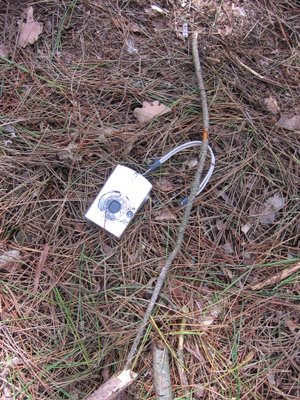
Well
Now I know our bit of woods is haunted
Gnome must of hidden it, then brought it out when I was tired ...
Looked all over, but when I stopped looking, there it was.
Thankfull
Managed to lose my nice camera (Canon PowerShot SD550)
Was cuttin standing dead pines, had camera in my shirt pocket, thought it was all buttoned in , but nope, it wasn't ... fell out.
I think it was when a Maple sapling sprang back after a release.
We went back, scoured the area, I even went back after dark thinking I knew the last piece I cut .. no damn luck.
Went back again today, no luck.
Set a search grid kept looking, but gave up, cut some more standing dead.
Used up my gas, and was headed back to the Jeep ... and Bingo:
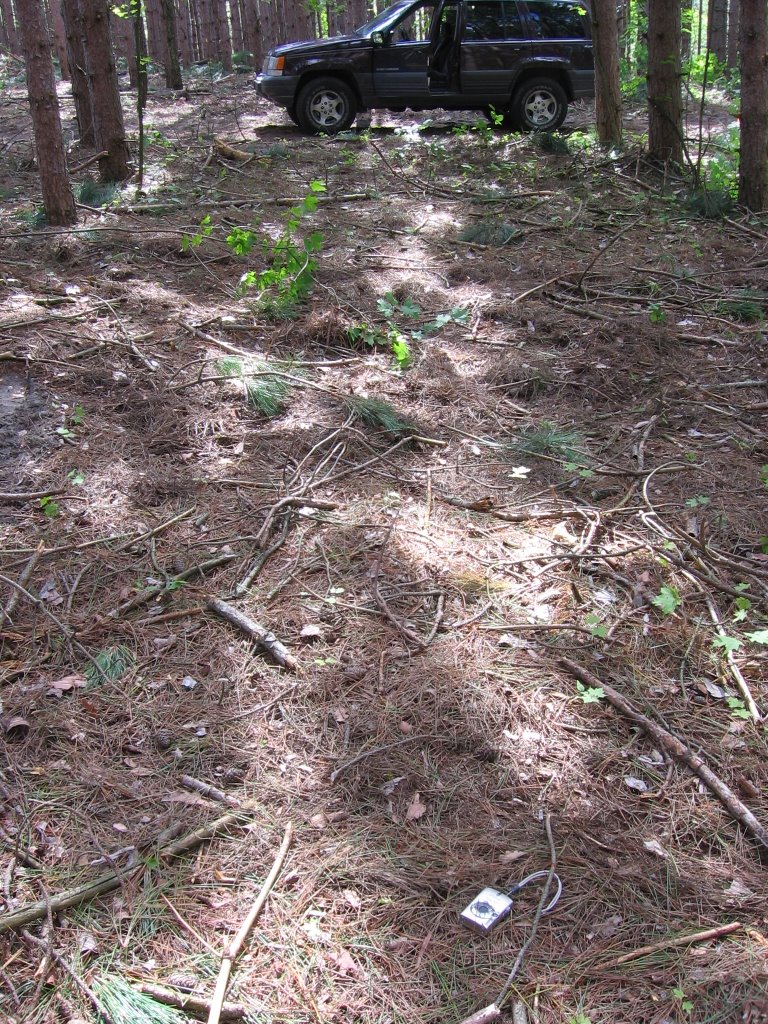
Sittin shiney in the sun
Here's pretty good idea of what I saw :
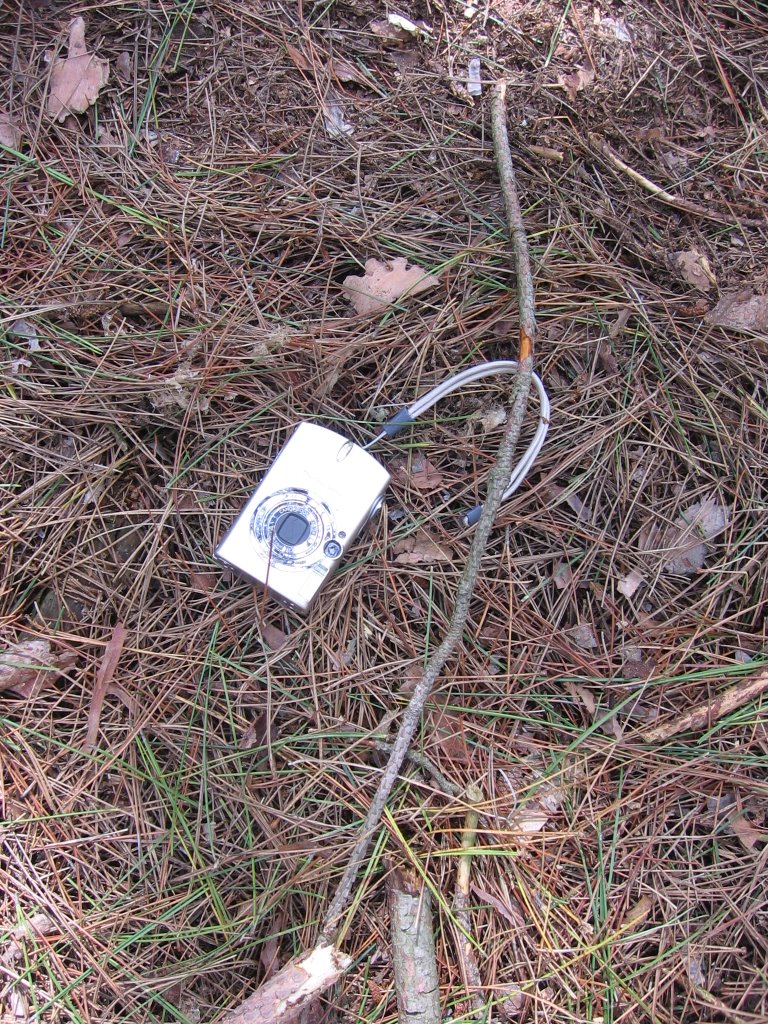
Well
Now I know our bit of woods is haunted
Gnome must of hidden it, then brought it out when I was tired ...
Looked all over, but when I stopped looking, there it was.
Thankfull
Sure sign of end of oil bubble ...
Gas Card Spam:
Your Card is waiting to be picked-up,
You have been referred by a friend to receive a Gas Gift-Card! By simply
entering your zipcode to confirm you status, your personal card can be ready
for you right now. You also may be able to recieve other great opportunities.
Available in 3 different types to choose from, Mobil, Shell, and
Exxon.
---------------------------------------------------
Personal GasCard
Confirmation #937UB40
To: Member #723918
-----------Verify Here-----------
http://studyo3i9.net/soi?e=6grL0f5FfzvNw0Jf5GlPzGr&m=418191&l=0
-----------------------------------
Pickup your Gas Card Now, confirm above
Thank you.
----
Sincerly,
A.J.
Thinner
Spent a good bit of time this week "overseeing " the thinning of our "Pine Plantation"
Went from this:

To something "thinner"
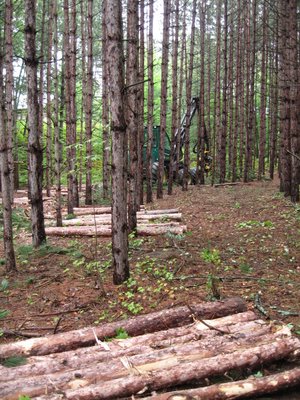
Crew used something like this: John Deere Forestry: 1070D Wheeled Harvester : John Deere
Pretty damn slick.
I timed it as one min from cut at the base (nice, only a couple of inches off the ground) to tipping, cutting into 10 and 8 foot logs, stripped of branches and chopping the "bush" at the top.
Most were about 40-50ft tall.
All was computer controled, with the system gauging the average diameter, taper and deciding where to make the best cuts for 10's&8's.
We likely won't make much $$$ on all of this, the goal was to thin the stand. It was obvious from the rings that growth the last decade or so has been constrained by crowding.

Now we'll (make that I'll) go back through the stand, taking down dead standing stuff (aka Beetle Food) to protect the rest of the stand. Another few years, a selective cut of the remaining runts, and we should have an awesome stand.
My guess is that this is 20-25% of the cut
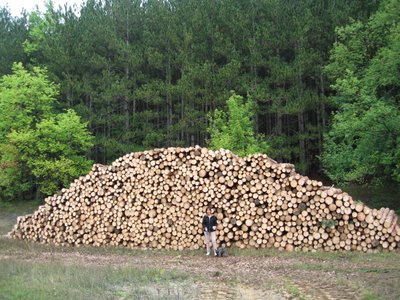
All of this on just a portion of our "property" and just within the portion planted with redpine. The rest will end up in Conservation Easement, wetlands & hillsides, pine & hardwoods.
Went from this:

To something "thinner"
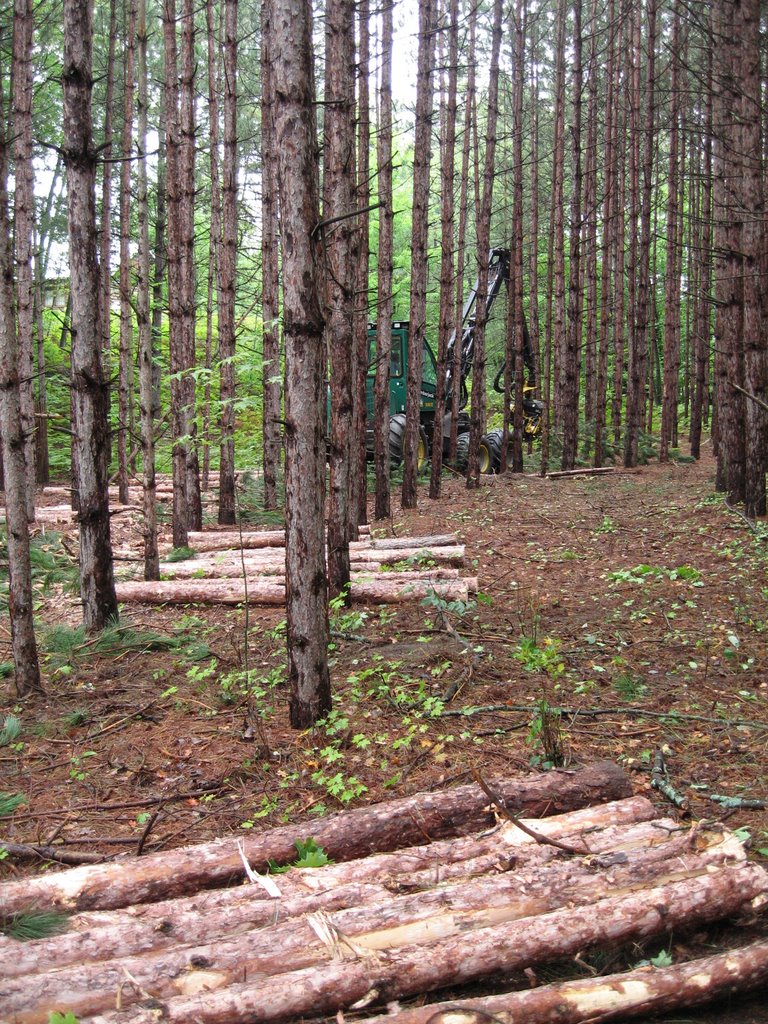
Crew used something like this: John Deere Forestry: 1070D Wheeled Harvester : John Deere
Pretty damn slick.
I timed it as one min from cut at the base (nice, only a couple of inches off the ground) to tipping, cutting into 10 and 8 foot logs, stripped of branches and chopping the "bush" at the top.
Most were about 40-50ft tall.
All was computer controled, with the system gauging the average diameter, taper and deciding where to make the best cuts for 10's&8's.
We likely won't make much $$$ on all of this, the goal was to thin the stand. It was obvious from the rings that growth the last decade or so has been constrained by crowding.

Now we'll (make that I'll) go back through the stand, taking down dead standing stuff (aka Beetle Food) to protect the rest of the stand. Another few years, a selective cut of the remaining runts, and we should have an awesome stand.
My guess is that this is 20-25% of the cut

All of this on just a portion of our "property" and just within the portion planted with redpine. The rest will end up in Conservation Easement, wetlands & hillsides, pine & hardwoods.
You'd think it was an Election Year...
Congress hissy fit over oil leases.
Flawed leases under Clinton, failure to correct under Bush.
click here
Fingerpointing time.
"... even as Republican and Democratic lawmakers expressed outrage that the government could lose more than $10 billion over the next decade, the Bush administration said it flatly opposed House bills that would pressure oil companies into renegotiating flawed leases that the government signed in the late 1990’s.
Failure to act on almost everything.
Flawed leases under Clinton, failure to correct under Bush.
click here
Fingerpointing time.
"... even as Republican and Democratic lawmakers expressed outrage that the government could lose more than $10 billion over the next decade, the Bush administration said it flatly opposed House bills that would pressure oil companies into renegotiating flawed leases that the government signed in the late 1990’s.
The 56 companies hold leases that allow them to extract billions of dollars in oil and gas from the Gulf of Mexico without paying any royalties, regardless of how high energy prices or the industry’s profits might climb."
Dumb contract, questionable remedies.
"In what has now become a major scandal, the Interior Department inadvertently signed 1,100 drilling leases in the late 1990’s that offered lucrative incentives to deepwater drillers, regardless of how high energy prices might climb.
Officials then covered up the mistake for nearly six years. In that time, the prices for oil and gas soared and the magnitude of the potential loss to taxpayers escalated to more than $10 billion."
Plenty of blame to share...
Failure to act on almost everything.
Thursday, September 14, 2006
Uh Oh - time to move north?
James Lovecock, who's "underpins much of modern environmentalism. The electron capture detector he invented in the 1950’s produced initial measurements of dispersed traces of pesticides and ozone-destroying chlorofluorocarbons, providing a foundation for the work of Rachel Carson and for studies revealing risks to the atmosphere’s protective ozone layer."
Updating Prescriptions for Avoiding Worldwide Catastrophe
" The human species has been on the planet for a million years now. We’ve gone through seven major climatic changes that are equivalent to this. The ice ages were shifts in climate comparable with this one that’s coming. And we’ve survived.
That series of glaciations and interglacials put the pressures on us to select the kind of human that could adapt. And we’re the progeny of them. And we’re just up against a new and different stress. Maybe we’ll come out better. "
Saturday, September 09, 2006
Reinforcement
So here's da prediction
Looney Dunes: Hydrocarbons
And now I found this : An Early Retirement For The Hydrogen Fuel Cell | EnergyBulletin.net | Peak Oil News Clearinghouse
Excerpt:
At last weekends Lucerne Fuel Cell Conference, which is a highly respected technical conference, Ulf Bossel, the organizer, made a pretty signinficant announcement: the European PEMFC Forum series will not be continued because hydrogen fuel will never contribute to a sustainable world. Instead they will focus on phosphoric acid fuel cells, molten carbonate fuel cells and solid oxide fuel cells which "can meet the challenges of a sustainable future".
And more:
Fuel cells are energy converters, not energy sources. They will be part of a sustainable energy solution only if they can compete with other conversion technologies. This includes system parameters, fuels and applications. Time has come for a critical assessment.
We need fuel cells for available fuels, not synthetic fuels for new fuel cells. Natural gas and oil-derived liquid hydrocarbons will be around for many years. However, their use will be restricted by costs, environmental concerns or even political reasons. Sustainable hydrocarbons like bio-methane, bio-ethanol and bio-methanol from organic waste, wood or farming are already replacing fuels of fossil origin. Hydrocarbon fuels will be important forever and so will fuel cells capable of directly converting these fuels into electricity.
Thursday, September 07, 2006
Pontification
Well, to blow my own horn, been right so far
Looney Dunes: Oil - right
Oil headed down.
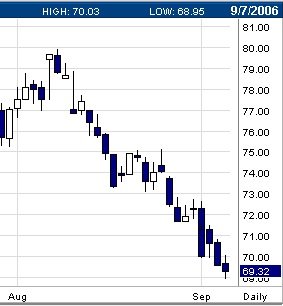
First pontification was Aug 7th with interday high of $79.67, closed today $69.32.
So if I'm so damn smart, what next?
I'll go out on a limb and say ... lower, likely lower by Nov 6th.
Gasoline will, of course, be lower too.
I wouldn't be suprised to see something under $65
Looney Dunes: Oil - right
Oil headed down.
First pontification was Aug 7th with interday high of $79.67, closed today $69.32.
So if I'm so damn smart, what next?
I'll go out on a limb and say ... lower, likely lower by Nov 6th.
Gasoline will, of course, be lower too.
I wouldn't be suprised to see something under $65

Zippie
Paul give's thumb's up to a net-savvy, for profit, "share a ride":
Zipcar makes car sharing sexy, not sorry. By Paul Boutin - Slate Magazine
I'd consider very strongly if I lived in a big city, but as we live on a dirt road, out side a small town, about 20min form a modest sized city, we'll stick to our "Envoy".
Zipcar makes car sharing sexy, not sorry. By Paul Boutin - Slate Magazine
I'd consider very strongly if I lived in a big city, but as we live on a dirt road, out side a small town, about 20min form a modest sized city, we'll stick to our "Envoy".
Wednesday, September 06, 2006
Whew


From the east, news that Prince Akishino and Princess Kiko have a baby son.
Very important to have an heir to the throne ...
"Following the Feb. 7 announcement that Princess Kiko was pregnant, Prince Akishino and his family had experienced both joyous and anxious days, sources said.
Many magazines published speculative and unsupported articles--on an almost daily basis--regarding the baby's gender, and some reported rumors about arguments within the Imperial household over the issue of Imperial succession."
Almost Gilbert and Sulllivan ...
But now all is peaceful for another generation.
Like I was holding my breath.
Tuesday, September 05, 2006
Peak Oil or Peek Oil?
This will take time to play out
NYTimes:
What could be a major discovery of domestic oil in the Gulf of Mexico was announced today by a trio of companies led by Chevron.
Estimates of recoverable reserves run from 5Billion Barrels to 15Billion. The higher numbers would add 50 PERCENT to current total US Reserve Estimates.
Likely
1) won't come onstream for almost a decade
2) will encourage a push for further offshore exploration and opening of other areas currently off limits
3) will tend to depress oil prices even if production is years off.
NYTimes:
New Oil Field in Gulf May Yield Billions of Barrels
Estimates of recoverable reserves run from 5Billion Barrels to 15Billion. The higher numbers would add 50 PERCENT to current total US Reserve Estimates.
Likely
1) won't come onstream for almost a decade
2) will encourage a push for further offshore exploration and opening of other areas currently off limits
3) will tend to depress oil prices even if production is years off.
Hybrids not Mil-Spec
Technology limitations stall military hybrids
"Oshkosh Truck Corp. and General Dynamics Land Systems have pressed on with hybrids despite the technological problems and the military’s waning support.

The U.S. military has long sought diesel-electric hybrids that would improve fuel economy, offer a reduced logistical burden and provide the ability to export power, among other advantages.
But after more than a decade of research and development, and despite much recent hype, military hybrids are still years away from mass production.
None of the current military hybrid engine efforts has any specific goals or timelines to deliver an operational vehicle. “Right now, we do not have a current hybrid program that targets fielding,” says Gus Khalil, team leader of hybrid-electric research at the Army’s Tank Automotive Research, Development and Engineering Center, or TARDEC.
But there is potential for civilian uses... note that garbage trucks have frequent stops, and could use regenerative braking."Oshkosh Truck Corp. and General Dynamics Land Systems have pressed on with hybrids despite the technological problems and the military’s waning support.
Oshkosh has pinned its hopes on the development of a hybrid drive for the heavy expanded mobility tactical truck, or HEMTT. The technology is jointly funded by Oshkosh, the Army and the Energy Department, which is interested in commercial and civilian applications of large hybrids, such as municipal garbage collection.
The Army uses the HEMTT for heavy cargo hauling. The hybrid HEMTT, which Oshkosh calls the A3, uses ultra-capacitors, rather than batteries, to store diesel-generated AC power, an adaptation that effectively skirts the problem that doomed the hybrid Humvee. Ultra-capacitors are safer and more efficient than batteries, company officials said, but store less energy per unit of weight than batteries and are more complex.
“When we’re coasting to a slower speed, when we have ‘regenerative braking,’ the rolling of the truck turns traction motors into generators, says Gary Schmiedel, Oshkosh vice president for advanced products. The ultra-capacitors can store 1.5 mega-joules of energy that way, he notes. “With that energy, I can add 190 horsepower to the truck for 10 seconds or 19 horsepower for 100 seconds. That saves fuel."Monday, September 04, 2006
Friends perceptions of Crystal River vs Lake
Bookmarking this so that I don't loose it
"Friends of the Crystal River" view of history.
Glen Lake/Crystal River History
"Friends of the Crystal River" view of history.
Glen Lake/Crystal River History
Whoops
Australia’s ‘Crocodile Hunter’ Killed by Stingray - New York Times:
"CAIRNS, Australia (AP) -- Steve Irwin, the hugely popular Australian television personality and conservationist known as the ''Crocodile Hunter,'' was killed Monday by a stingray while filming off the Great Barrier Reef. He was 44."
"CAIRNS, Australia (AP) -- Steve Irwin, the hugely popular Australian television personality and conservationist known as the ''Crocodile Hunter,'' was killed Monday by a stingray while filming off the Great Barrier Reef. He was 44."
Sunday, September 03, 2006
THE Car Company
Since I've long admired Honda, having owned about 1/2 dozen, both Civic's and Accord's, and Forbes just decided to "Archive" pieces like this, even though I'm a long time print subscriber, I'm going to post the text here.
Engineers Rule: Finance Guys And Marketers Rise to the Top. Not at Honda
Forbes
By Jonathan Fahey and Tim Kelly
Sept. 4, 2006
At American auto companies, finance guys and marketers rise to the top. Not at Honda.
Of all the bizarre subsidiaries that big companies can find themselves with, Harmony Agricultural Products, founded and owned by Honda Motor, is one of the strangest. This small company near Marysville , Ohio produces soybeans for tofu. Soybeans? Honda couldn't brook the sight of the shipping containers that brought parts from Japan to its nearby auto factories returning empty. So Harmony now ships 33,000 pounds of soybeans to Japan .
An inveterate tinkerer, Honda also set up a center nearby to develop better soybean varieties and improve agricultural processes.
This is from a company that sold 21 million internal combustion engines for cars, motorcycles, lawnmowers and boats last year. But there's nothing Honda hates more than waste, and there is nothing Honda likes more than an engineering problem. Indeed, how else to explain why Honda has studied the maddeningly evasive cockroach (for anticollision technology), decoded the rice genome (to increase crop yields and create more-productive crops for biofuels) and developed a robot that can get instructions by reading human brain waves (to learn how machines and humans can better coexist).
Honda's engineering obsessions have the Japanese company better prepared than perhaps any other automaker for high oil prices and roiled energy markets. Most auto companies have placed big bets on one or two alternative propulsion technologies while they dabble or play catch-up in others. General Motors, for example, has focused on fuel cells, Toyota on hybrids, DaimlerChrysler on diesels. Honda, the world's eighth-biggest automaker, has developed a panoply of technologies: hybrids, fuel cells, clean
diesels, natural gas vehicles and the world's most sophisticated mass-market gasoline engines. It even announced in July it will sell a small, fuel-efficient jet (see box, p. 116).
Honda's ability to juggle these technologies successfully is perhaps a matter of survival. It competes in the mass market against companies, such as Toyota , General Motors, Ford and Nissan, that are either bigger or in alliances with other automakers. Other small carmakers like Porsche and BMW flourish by selling high-margin luxury cars. So that leaves Honda, with just 9 percent of the U.S. market, on its own and adamant that it remain unattached.
The trick: "You need to give people the freedom to spend and the freedom to make mistakes," says Takeo Fukui, Honda's 61-year-old president. "If management oversight is too strong, then it's difficult to innovate."
Longtime auto analyst John Casesa, who now runs a consulting company, says, "There's not a company on earth that better understands the culture of engineering."
The strategy has worked thus far. Honda has never had an unprofitable year. It has never had to lay off employees. In the fiscal year that ended in March, profit grew 12 percent, to $5.1 billion, on $84 billion in sales. In the U.S. , which accounts for 43 percent of Honda's sales, vehicle sales are up 7 percent through July, even as the industry slipped 5 percent. The company sold more vehicles in July than one member of the old Big Three, the Chrysler Group.
The lean and compact Fukui , like all of his predecessors, is an engineer who started in R&D and later ran the subsidiary. While other auto chief-executives-to-be were punching keyboards in an accounting office, Fukui ran the company's motorcycle racing operations. He's still racing. He hikes the stairs to his tenth-floor desk–tenth floor so he's in the middle of things at Honda's 16-story Tokyo headquarters and a desk because executives at Honda don't have offices. Honda doesn't disclose executive pay in detail, but the sum of salaries and bonuses that Fukui shares with 36 board members, $13 million, is just about enough for the boss at a big
American company.
Honda traces its resourcefulness to the 1960s, when the Japanese government tried to keep Honda, then just a motorcycle maker, from building cars because it feared there were too many carmakers. Honda quickly produced a tiny car driven by a chain, like a motorcycle, called the S-500. This led Honda to adopt perhaps the sappiest slogan in corporate history: "To be a company that society wants to exist."
"It's not just words," Fukui swears. "It's something that has always been at the core of our company." Whatever the case, Honda believes that society does not cotton to companies that melt ice caps and kill coral reefs. Cars that create less pollution also cost less to fill up. Honda's recent growth has been fueled by a pair of small cars, the newly redesigned Civic that sells for $15,000 to $22,000 (and gets 34 miles per gallon) and an even smaller car, the Fit, that sells for about $15,000.
Gunnar Lindstrom, who is charged with marketing Honda's alternative fuel vehicles in the U.S. , believes that by 2020 six fuels will split the market: gasoline, diesel, biofuels, hydrogen, natural gas and electricity, perhaps working side by side in a single vehicle. "It's risky to have just one fuel strategy," he says. "In the event of a crisis of any sort, we would like to be flexible. These are insurance policies that have some realistic assumptions behind them."
Honda spent $4.4 billion on R&D last year, 5.2 percent of sales, but, like most carmakers, it won't disclose how much is for basic research. One big investor says: "The good news is that they are run by engineers. The bad news is that they are run by engineers."
Honda announced in June that, by 2009, it will market an all-new hybrid vehicle, the company's fourth, and offer a clean diesel passenger car that will likely get 45 miles to the gallon. Honda has sold 141,000 hybrids since 1999 in the U.S. , second to Toyota 's 273,000.
The hype about hydrogen fuel cell cars has died down in the last year or so, but Honda hasn't noticed. Fuel cells are twice as efficient as combustion engines, and that is enough for Honda. Honda was the first to certify fuel cell vehicles for private use in the U.S. and is already leasing a few to individuals in California . Yozo Kami, Honda's fuel cell chief, promises to solve all of fuel cell vehicles' technical problems by 2012 and to have the cost of fuel cells to "Accord-level" by 2020. GM's goal is to to build a prototype by 2010 that could be reasonably priced if mass-manufactured. Toyota doesn't make any public predictions about its hydrogen fuel cell efforts.
And if Honda needs to be the one to solve the issue of creating
infrastructure to enable hydrogen-powered vehicles, so be it. In back of Honda's Torrance , Calif. research campus are a pair of prototype appliances designed to produce hydrogen at home. Engineers have built a contraption of water heater size that strips hydrogen out of natural gas while burning the carbon to provide heat for the home.
Then there's a wall of solar panels attached to an electrolysis unit that turns water into hydrogen. This thing is just a wee bit cumbersome: 700 square feet to create enough hydrogen to run a fuel cell car 10,000 miles a year and supply electricity for the house. Engineers like to point out that it takes just one-and-a-half gallons of water–one toilet flush–to create enough hydrogen for an average day's driving, 30 miles. The thin-film solar panels, developed by Honda, are more efficient than current solar panels,
so Honda will market them on their own to homes and small businesses.
Also this year, Honda became the first to offer a natural gas-powered vehicle to the public. The Civic GX is $7,000 more expensive than a gasoline Civic (before the effect of a $4,000 federal tax credit), the range of the vehicle is just 250 miles, and there are only 800 public natural gas refueling stations in the country.
Ah, but Honda thought of that too. As a test case for hydrogen refueling, Honda will also offer to Civic GX buyers in California and New York a home refueling unit cheekily called Phill. The backpack-size Phill, costing $3,500, fills up the car overnight in your garage from your utility's gas pipe, at a gasoline-equivalent cost of $1.20 per gallon. (Buyers get a $1,000 federal tax credit to boot plus, sometimes, state subsidies.)
Honda's sales target for the car is a modest 1,000 per year. It's easy on the conscience: Most natural gas is domestically produced. And, over its lifetime, the Civic will emit less pollution than is produced by spilling a teaspoon of gasoline on the ground. Maybe this is what Fukui means when he talks about society wanting Honda to stick around.
Saturday, September 02, 2006
Whoooooo
Headed out to a party, Shirley had spotted this earlier, I just happened to have a camera ... so we "gave it a shot"
Barred Owl ("Bard" ?)

Not that I didn't stoop to Hooter jokes ...
Here's a closer look... eyes caught the flash and reflected

Barred Owl ("Bard" ?)

Not that I didn't stoop to Hooter jokes ...
Here's a closer look... eyes caught the flash and reflected

Friday, September 01, 2006
We'll Sail Away

Evening cruise on Inland Seas Education Association & the Great Lakes Schoolship with Shirley, my folks and friends.
Wonderfull evening, modest breezes (about 7knots), clear skys, moon came up...
Thursday, August 31, 2006
Wisdom of Crowds
Or "Crowdsourcing" and my evolving thinking.
The following is interesting, but mostly, to me as to the application of AI.
"This turns out to be the perfect division of labor between man and machine: Evaluating content is easy for people, and analyzing large data sets is easy for computers."
Google Revealed: The IT Strategy That Makes It Work - Management News by InformationWeek:
Collective Insight
"VP of engineering Adam Bosworth last year wrote that Google's success in making a more relevant search was based on "leveraging the wisdom of crowds," referring to the company's PageRank algorithm. (James Surowiecki's book, The Wisdom Of The Crowds, was published in 2004 by Random House.) Company founders Larry Page and Sergey Brin built the business on PageRank, which analyzes the human-generated link structure of the Web to determine the relative importance of a Web page. As PageRank sees it, the more people link to a given page, the more important that page is likely to be.
This turns out to be the perfect division of labor between man and machine: Evaluating content is easy for people, and analyzing large data sets is easy for computers. By marrying collective intelligence with automation, Page and Brin built a company fueled by artificial intelligence. "AI is a great tool for helping people make better decisions," Merrill says. "It's not so good at making complex decisions."
The wisdom of the crowd, farmed and refined by machine, remains critical to Google. As Merrill puts it, "All of us together are smarter than any of us individually." That insight may not be as surprising now that it has been reinforced by the likes of Wikipedia and Digg.com, but it's still mostly lip service at many other companies."
I'm pondering the difference(s) between "Crowdsourcing" as applied to Intangibles, such as software, vs. Tangibles, such as ... Cars. Hardware has a much longer amortization period, much harder to change once the design is set. Software, esp. in the case of Google, is very much an evolving product, and there is virtually no "installed base" (on the customer's machine/device/interface)
Wednesday, August 30, 2006
Likely one Bad-Ass team
If the image is right, looks like it's centered near the Ionia Maximum Security Prison


Friday, August 25, 2006
The REAL Real Estate story
From the WSJournal we have a story about home sales:
"Sales of newly built homes tumbled last month, but a firm reading on orders for big-ticket factory goods suggests the economy will continue to grow moderately despite head winds from a slumping housing market and high energy prices.
Home for Sale, by Anxious Owner - New York Times
"In California, the Northeast, South Florida and parts of the Southwest, deal sweeteners like these are playing an increasingly important role in supporting home prices. From large national home builders to individual homeowners, many sellers are offering thousands of dollars in perks, including straight cash, so they do not have to slice deeply into asking prices.
"Mr. Zandi, the economist, said he believed that the use of perks was now approaching its peak and that sellers would soon be forced to cut list prices more heavily. He predicted that the home-price data released by the Realtors association would show a year-over-year decline, relative to the same month a year earlier, before the end of this year. If so, that would be the first such drop since 1993. The Realtors have never reported a drop in the annual average of national home prices, a fact frequently cited by real estate analysts.
“The reason the Realtors’ data has never showed an outright decline” before, he said, “might be that they’re not measuring the effective price.”
"Sales of newly built homes tumbled last month, but a firm reading on orders for big-ticket factory goods suggests the economy will continue to grow moderately despite head winds from a slumping housing market and high energy prices.
The Commerce Department said sales of new homes in July fell 4.3% from June to a rate of 1.07 million units, a pace that is 21.6% slower than a year ago. The inventory of unsold homes on the market rose to a supply of 6.5 months, up from 4.2 months a year earlier, while the median price fell to $230,000 in July and is essentially flat compared with a year ago."
But the actual situation may be worse than it looks from the numbers.Home for Sale, by Anxious Owner - New York Times
"In California, the Northeast, South Florida and parts of the Southwest, deal sweeteners like these are playing an increasingly important role in supporting home prices. From large national home builders to individual homeowners, many sellers are offering thousands of dollars in perks, including straight cash, so they do not have to slice deeply into asking prices.
But these discounts are almost entirely missing from the statistics on new-home prices reported by the government and on existing-home prices reported by the National Association of Realtors. As a result, home prices may now be falling, despite what the official numbers show, many economists say.
The use of rebates helps home builders and individual sellers by making the real estate market look healthier than it may truly be and by preventing a snowballing decline in home prices. It also keeps commissions for real estate agents higher than they would otherwise be."
and:"Mr. Zandi, the economist, said he believed that the use of perks was now approaching its peak and that sellers would soon be forced to cut list prices more heavily. He predicted that the home-price data released by the Realtors association would show a year-over-year decline, relative to the same month a year earlier, before the end of this year. If so, that would be the first such drop since 1993. The Realtors have never reported a drop in the annual average of national home prices, a fact frequently cited by real estate analysts.
“The reason the Realtors’ data has never showed an outright decline” before, he said, “might be that they’re not measuring the effective price.”
Tuesday, August 22, 2006
Another Karl Rove Plot
Must be nefarious plot to discredit Al Gore and his new movie.
Weather Street: 2006 Atlantic Tropical Storm Season Below Normal (August 21):
"Global Warming?
The slow hurricane season and the cooling sea surface temperatures might be somewhat surprising to the public. Media reports over the last year have suggested that, since global warming will only get worse, and last year's hurricane activity was supposedly due to global warming, this season might well be as bad as last season. But it appears that Mother Nature might have other plans."
"Part of the reason for the slow season is that tropical western Atlantic sea surface temperatures (SSTs) are running about normal, if not slightly below normal (see graphic below, which shows SST departures from normal).

In contrast, at the same time last year SSTs in the same region were running well above normal.
The cooler SSTs in the Atlantic are not an isolated anomaly. In a research paper being published next month in Geophysical Research Letters, scientists will show that between 2003 and 2005, globally averaged temperatures in the upper ocean cooled rather dramatically, effectively erasing 20% of the warming that occurred over the previous 48 years."
Weather Street: 2006 Atlantic Tropical Storm Season Below Normal (August 21):
"Global Warming?
The slow hurricane season and the cooling sea surface temperatures might be somewhat surprising to the public. Media reports over the last year have suggested that, since global warming will only get worse, and last year's hurricane activity was supposedly due to global warming, this season might well be as bad as last season. But it appears that Mother Nature might have other plans."
"Part of the reason for the slow season is that tropical western Atlantic sea surface temperatures (SSTs) are running about normal, if not slightly below normal (see graphic below, which shows SST departures from normal).
In contrast, at the same time last year SSTs in the same region were running well above normal.
The cooler SSTs in the Atlantic are not an isolated anomaly. In a research paper being published next month in Geophysical Research Letters, scientists will show that between 2003 and 2005, globally averaged temperatures in the upper ocean cooled rather dramatically, effectively erasing 20% of the warming that occurred over the previous 48 years."
Edler Bloggers?
Found via Doc (The Doc Searls Weblog):
An effective alternative to retirement
Earlier post :
Talk about getting hard on a guy
An effective alternative to retirement
| AARP covers blogs. Ronni Bennett is featured. Here she catches us up on other elderbloggers. |
Earlier post :
| Wednesday, August 16, 2006 |  |
Talk about getting hard on a guy
| Ariel: Old Men Can't Get It Up, Erect Blogs Instead. |
| On the other head, maybe we've kept it up longer than the rest of ya'll. |
Just because I trimmed my service?
Front page WSJournal:
Sprint said Chief Operating Officer Len Lauer will leave the cellphone carrier, which is grappling with lower subscriber growth than rivals and a slumping stock.
Maybe it's more than just my trimming of service...
Sprint said Chief Operating Officer Len Lauer will leave the cellphone carrier, which is grappling with lower subscriber growth than rivals and a slumping stock.
Maybe it's more than just my trimming of service...
Buffett on Media
Excerpt from Warren Buffett on newspapers:
"Charlie and I think newspapers are indispensable. I read four a day. He reads five. We couldn’t live without them. But a lot of people can now. This used to be the ultimate bulletproof franchise. It’s not anymore."
"Charlie and I think newspapers are indispensable. I read four a day. He reads five. We couldn’t live without them. But a lot of people can now. This used to be the ultimate bulletproof franchise. It’s not anymore."
Saturday, August 19, 2006
Can you believe your eyes?
Came across this while keying in http://fakesteve.blogspot.com/ for my morning giggle
Fake or Photo?
Autodesk "quiz" to see if you can differentiate CG from Photo's.
Pretty interesting
I missed one, which I wasn't sure about, so would give myself "partial points"
All in all, a lot better than the Reuter's crap: (Bloggers Bash Bogus Photos )
Fake or Photo?
Autodesk "quiz" to see if you can differentiate CG from Photo's.
Pretty interesting
I missed one, which I wasn't sure about, so would give myself "partial points"
All in all, a lot better than the Reuter's crap: (Bloggers Bash Bogus Photos )
Further on Blogging
Different spin on blogging, from (The Doc Searls Weblog : Friday, August 18, 2006)
I had a prior post was about economists...
Looney Dunes: Why Blog?
Back to Doc's piece.
Is blogging just about getting rank, promotion, and therefore just about advertising?
Not necessarly.
Doc rebuts the following "...in the end, that¹s what the A-list is all about: directing traffic. They are the traffic cops of the blogosphere and they are not as easily replaced as some would like to make us believe. They are brand names and we tend to trust them, even if they let us down sometimes."
and (excerpt)
"
---
Back to my "voice"...
Can blogging be commercial? Damn right it can, and it can be a powerfull tool for those that know how to use it. But that discussion is for another time/place/
But it can also be simply a means of communicating with friends (know and unknown) and a broader community.
I personally "work" from a home on a lake in NW Mich, surrounded by a National Park.
We have our circle of friends here, but I also have friends, business associates and other contacts from coast to coast. I can work the hours I want, post ideas (good, bad or indifferent) at any/all hours of day or night.
This blog is public, others are private - family/friends only.
Now back to anger management practice ... (VBG)
I had a prior post was about economists...
Looney Dunes: Why Blog?
Back to Doc's piece.
Is blogging just about getting rank, promotion, and therefore just about advertising?
Not necessarly.
Doc rebuts the following "...in the end, that¹s what the A-list is all about: directing traffic. They are the traffic cops of the blogosphere and they are not as easily replaced as some would like to make us believe. They are brand names and we tend to trust them, even if they let us down sometimes."
and (excerpt)
"
| As the blogophere has become more rigidly hierarchical, not by design but as a natural consequence of hyperlinking patterns, filtering algorithms, aggregation engines, and subscription and syndication technologies, not to mention human nature, it has turned into a grand system of patronage operated - with the best of intentions, mind you - by a tiny, self-perpetuating elite. A blog-peasant, one of the Great Unread, comes to the wall of the castle to offer a tribute to a royal, and the royal drops a couple of coins of attention into the peasant's little purse. The peasant is happy, and the royal's hold over his position in the castle is a little bit stronger. |
| Bullshit. |
| Want to succeed in the blogosphere, or the Web in general? Easy. Do search engine optimization. Here's how: |
|
| That's it. |
| I can't promise royalty, because there isn't any. But I can promise a rewarding relationship with the readers you'll get, regardless of how many there are. |
---
Back to my "voice"...
Can blogging be commercial? Damn right it can, and it can be a powerfull tool for those that know how to use it. But that discussion is for another time/place/
But it can also be simply a means of communicating with friends (know and unknown) and a broader community.
I personally "work" from a home on a lake in NW Mich, surrounded by a National Park.
We have our circle of friends here, but I also have friends, business associates and other contacts from coast to coast. I can work the hours I want, post ideas (good, bad or indifferent) at any/all hours of day or night.
This blog is public, others are private - family/friends only.
Now back to anger management practice ... (VBG)
Thursday, August 17, 2006
Utilities ?
1) Sprint Long Distance
You dial up the 800 number, confirm the balance due and key in the credit card number and expiration.
OK, all of this is straightfoward.
Bot voice, which sounds like a stern grade school teacher, reads back the information with query if this is correct press 2.
You key 2
Then the bot reads your confirmation number and asks if you want it either repeated or "if this is correct press 2"
Huh?
Does not compute ... Sprint gives me confirm number with no further information and expects me to confirm their confirmation.
2) Charter Communicatons, my internet provider, via cablemodem
So ... service is out.
Dial the 800 number, before you get series of decision trees to get to service information, there is an offer to let Charter be your phone service.
Decision tree almost invariabley all Bot's
Message that they are either out of service or down for maintiance...
Sooo ... I want to call Charter to check service and they offer to have a service that may not work?
Huh.
Almost as good as the our Electric Utility website that offers estimated time to be back in service during an outage .... which most likely knocks out my internet service.
Who dreams this stuff up?
Oil - right
Well, for the moment, I'll claim to be right
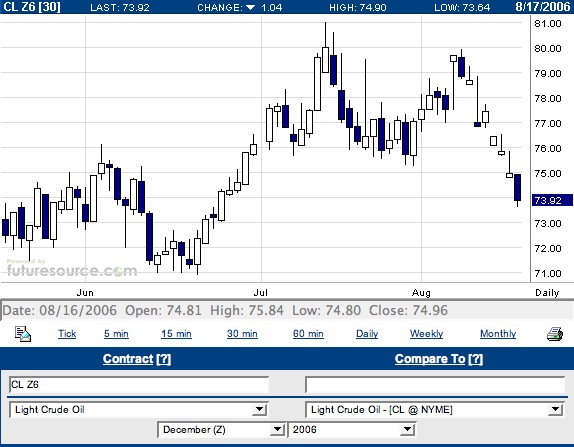
Looney Dunes: Alaskan Oil Aug 7th 9:30 AM, and Dec Crude was trading around $79.50 up from 77-78 the previous Friday.
As of about 8:45 this AM it was trading under $74.
So why didn't I take this trade?
Chicken I guess ...
Tuesday, August 15, 2006
Oil Future(s)
Good leader from The Economist on NOC's (National Oil Companies) and why they should be privatised to improve efficency.
"WHEN activists, journalists and others speak of “Big Oil”, you know exactly what they mean: companies such as Exxon Mobil, Chevron, BP and Royal Dutch Shell. These titans have been making lots of money for their shareholders; their bosses enjoy vast pay packets; and their actions affect us all. BP's decision to shut down Prudhoe Bay, America's biggest oilfield, to repair leaking pipes is a case in point, outraging many and pushing petrol prices even higher (see article).
Yet Big Oil is pretty small next to the industry's true giants: the national oil companies (NOCs) owned or controlled by the governments of oil-rich countries, which manage over 90% of the world's oil, depending on how you count. Of the 20 biggest oil firms, in terms of reserves of oil and gas, 16 are NOCs. Saudi Aramco, the biggest, has more than ten times the reserves that Exxon does. Those with misgivings about oil—that its price is too high, that reserves are running out, that it damages the environment, that it is more a curse than an asset for countries that produce it—must look to NOCs for reassurance.
These companies are certainly sitting on a reassuring amount of oil. Saudi Aramco's proved reserves alone could keep the world supplied for several decades. But it is only exploiting ten of its 80 or so fields, so will be able to pump at the present rate for about 70 years even if it never discovers another drop of oil. In fact, Aramco and other NOCs are likely to find plenty more if they look, since their territory has not been very thoroughly explored. Only 2,000 wildcat wells have ever been dug in the countries around the Gulf, according to Leonardo Maugeri, an Italian oilman, compared with more than 1m wells in the United States."
Hybrid future?
So not directly about Hybrid's, but the talk of Li-ion battery packs might give one pause...
"Dell plans to recall more than four million laptop batteries with components from Sony that can pose a fire hazard. It is the largest PC-related recall in Consumer Product Safety Commission history...
Dell's move follows a series of smaller recalls of lithium-ion batteries, and comes at a time of intense scrutiny of the battery technology -- particularly on airplane flights. Now that lithium-ion-powered laptops and MP3 players have become favorite carry-ons for many air travelers, transportation officials are evaluating the safety risks posed on airliners and whether tighter restrictions are required. The dangers of battery-related fires in laptops aboard airlines were the subject of a page-one article in The Wall Street Journal yesterday."
I do trust that the problems will be worked out, but no easy answer.
More Here: Need for Battery Power Runs Into Basic Hurdles of Science - New York Times
"But scientists are running into some basic hurdles of chemistry and physics. The more energy they store in a small package, the more volatile and dangerous that package becomes.
The volatility of batteries in laptops, and those powering millions of portable consumer devices from cellphones to power drills, was made apparent Monday with Dell’s recall of 4.1 million laptop batteries. Dell said the batteries, made by Sony, could catch fire because of a problem in the manufacturing process.
Though the chance of a flaming notebook is small, the number of incidents involving burning batteries is rising each year because there are so many more devices using small and powerful power sources.
There is another pressing reason for the quest for improvements: battery-powered cars. An electric car needs a power source that is 2,000 times as powerful as a laptop battery. “That size would be extremely dangerous,” said Sanjeev Mukerjee, a chemistry and chemical biology professor at Northeastern University. “This technology has a downside, and that is that it is very sensitive to how it is manufactured.”
The potential for fire in a lithium-ion battery is a result of its chemical composition. Contained in that small package are all the elements needed for a fierce blaze: carbon, oxygen and a flammable fluid. The battery is made of a thin layer of lithium cobalt oxide, which serves as the cathode, and a strip of graphite, the anode. These are separated by a porous insulator and surrounded by fluid, a lithium salt electrolyte that happens to be highly flammable."
Monday, August 14, 2006
Various Paths to Success
Accidental Tech Entrepreneurs Turn Their Hobbies Into Livelihoods - News by InformationWeek
Maybe not paths to prosperity, but some success
Dooce, Moveable Type, Del.icio.us, Digg & Zoot.
Maybe not paths to prosperity, but some success
Dooce, Moveable Type, Del.icio.us, Digg & Zoot.
Bloggers Bash Bogus Photos
Various coverage of how bloggers exposed fake "news" photos on Reuters:
Washington Post:Blogger Takes Aim At News Media and Makes a Direct Hit
By Paul Farhi
Washington Post Staff Writer
Wednesday, August 9, 2006; Page C01
Like what blind editor would ever fall for this:
 Like ... how about the regular pattern on the right - looks like a curling iron was used on the "smoke"...
And :Strategy Page : Information Warfare:
"Pictures That Don't Tell the Story
August 12, 2006: As the scandal around Photoshopped and staged war-in- Lebanon photos used by various mainstream media outlets continues, it is becoming more obvious that what happens in newsrooms is having an effect on the war. Hizbollah, unable to defeat Israel via conventional means, resorted to the use of the Western media – which usually has very few restraints – to increase diplomatic and political pressure on Israel."
Washington Post:Blogger Takes Aim At News Media and Makes a Direct Hit
By Paul Farhi
Washington Post Staff Writer
Wednesday, August 9, 2006; Page C01
"Charles Johnson could tell there was something wrong with the news photo the minute he saw it. Something about the three plumes of black smoke rising over the buildings -- smoke just doesn't curl that way, pirouetting in unison. It was, he wrote Saturday, "blatant evidence of manipulation."
He was right on target.
The Reuters photo showing the aftermath of an Israeli airstrike on Beirut was doctored. The British-based news service acknowledged as much Sunday, withdrawing that picture and another doctored image, of an Israeli jet, that were taken by freelance photographer Adnan Hajj. The agency subsequently severed its ties with the Lebanese photographer and purged its files of his work.
The exposure of the doctored airstrike photo was a coup for Johnson and his four-year-old political blog, Little Green Footballs. Make that a second coup, of sorts.
In September 2004, not long after "60 Minutes II" seemed to offer damning revelations about President Bush's service in the Texas Air National Guard, Johnson was at the forefront of bloggers who raised questions about the CBS report. (Johnson used the Microsoft Word program to retype the memos used in the report and found that his computer could reproduce the same typefaces and line breaks that Dan Rather had said were produced by a manual typewriter in the mid-1970s.) The incident became a historic debacle for the network and contributed to Rather's retirement from the "CBS Evening News" anchor chair."
Bloggers Drive Inquiry on How Altered Images Saw Print - New York TimesLike what blind editor would ever fall for this:
Adnan Hajj/Reuters
A photographer has been accused of doctoring a photo of an Israeli air raid on Beirut. The manipulated image, left, and the original picture, right.
And :Strategy Page : Information Warfare:
"Pictures That Don't Tell the Story
August 12, 2006: As the scandal around Photoshopped and staged war-in- Lebanon photos used by various mainstream media outlets continues, it is becoming more obvious that what happens in newsrooms is having an effect on the war. Hizbollah, unable to defeat Israel via conventional means, resorted to the use of the Western media – which usually has very few restraints – to increase diplomatic and political pressure on Israel."
Sunday, August 13, 2006
Hydrocarbons
Well, I finally decided to stick my neck out.
Long Bets [ 257: Hydrocarbon fuels will be the "fuel of choice" for personal transportation for the next 50 years ]
"Picking up on Danny's argument (#168) about non biogenic sources of hydrocarbons and a belief (faith?) in the market system where higher prices will bring increased exploration for hydrocarbons, I would argue that hydrocarbon fuels will remain "desirable".
The energy density of hydrocabon fuels trumps alternatives for mobile systems.
Note that I'm not arguing about fixed plants, where such systems as fuel cells may well work, only mobile."
I'll add to the argument (later).
Mostly that with the pace of development (slow) in personal transportation, due to the installed base (plant and equipment), as well as the adoptation of technologies such as hybrids, we'll be using hydrocarbon fuels for a long time. Maybe not gasoline, althought this may well be the choice, but bio-diesel, or diesel from Natural Gas are likely.
Friday, August 11, 2006
Hybrid ... cont
I've posted a few times about Hybrid Hype, such as Toyota Prius.
Now here's one that makes more sense... real world vs. image and video game.
Autoweek on Saturn Vue Greenline:
"It’s good to see that people building these vehicles are working toward simple everyday use, with hybrid in mind. This is no super-high-tech setup—just a belt assist via a starter/generator, regenerative braking, a battery pack, fuel cutoff, and some electronic gear to keep it all working together. But overall, it just does its thing—auto stop/start, belt-assisted acceleration, a gauge to report whether you’re using electric power or generating it, and a little green “ECO” light to tell you whether the vehicle is exceeding the EPA mileage estimate. Otherwise it works like a normal gasoline-engine SUV. It doesn’t call attention to fuel economy with some readout on the dash—that’s just the kind of thing that has greenies driving their hybrids as 49.3 mph in the California HOV lanes as they try to squeeze another mile per gallon out of their average miles per gallon readout. That may be green in the extreme, but it’s equal part stupid, and unsafe as well.
Overall, the Vue Green Line is a smart package at a great price for a hybrid with this much utility. This one was decked out with quite a few options—heated power leather seats, DVD entertainment system—and still cost $4,000 less than the last Ford Escape Hybrid we drove. And you’d be well on your way to buying a second Vue Green Line for the money you’d save over a Toyota Highlander Hybrid, which starts at $33,635.
This hybrid trucklet may not thrill the techno-geeks, nor will it calm the hardcore enviro-whackos, but it should please anyone looking for space for five and cargo room, a nice sticker price, and a lot less stress at the gas pump with the big $3.09 per gallon staring you in the face."
Good Visit
Well, we finally got together.
Old friend from High School, Brooks Stover, dropped by.
We haven't seen each other for something like 40 yrs.
Yup... dates me/us.
Turns out that he has owned property up here almost as long as I have.
Small world - common good taste (VBG)
Brooks showed up with his H3

His was tan/grey rather than red.
Turns out that he was project manager on this before retirement.
some PR here
Earlier project had been this:

We'd drawn cars all the time in HS.
Good that he made a career out of this passtime!
Old friend from High School, Brooks Stover, dropped by.
We haven't seen each other for something like 40 yrs.
Yup... dates me/us.
Turns out that he has owned property up here almost as long as I have.
Small world - common good taste (VBG)
Brooks showed up with his H3
His was tan/grey rather than red.
Turns out that he was project manager on this before retirement.
some PR here
Earlier project had been this:
We'd drawn cars all the time in HS.
Good that he made a career out of this passtime!
Thursday, August 10, 2006
Ongoing on Oil prices
I tried to post a chart of Oil Futures, but it got to large.
Yesterday, despite, seemingly all day coverage on CNBC of Prudhoe Bay and oil prices, the Dec futures closed on the low for the day. I'm following Dec just as it has some time left and starting to get some volume.
Well, overnight we have the airline bombing plot foiled
NYTimes : "LONDON, Aug. 10 — British authorities said today that they had thwarted a terrorist plot to blow up multiple airliners traveling between Britain and the United States and cause “mass murder on an unimaginable scale.”
No link ... yet.
Today oil heads lower.
Chart here : iFS | Interactive Charts
Wednesday, August 09, 2006
Joel comes to NYC
We throughly enjoyed L'Atelier de Joel Robuchon last Summer in Paris.
Now he comes to NYC:
"Mr. Robuchon, a Michelin three-star chef whose creativity and perfectionism have kept him at the pinnacle of the culinary world, has become conspicuously active since he “retired” 10 years ago, expanding the number of restaurants that bear his name and changing his approach so that it’s more casual. He made his first foray into the particularities of the American palate last year in Las Vegas. He describes that venture these days as a warm-up for the scary, tough crowd in New York. 
Now he comes to NYC:
"Mr. Robuchon, a Michelin three-star chef whose creativity and perfectionism have kept him at the pinnacle of the culinary world, has become conspicuously active since he “retired” 10 years ago, expanding the number of restaurants that bear his name and changing his approach so that it’s more casual. He made his first foray into the particularities of the American palate last year in Las Vegas. He describes that venture these days as a warm-up for the scary, tough crowd in New York.
Last week, he was finally seeing his latest restaurant in its completed state — clearly he knew the clock was ticking. His first reaction was general approval.
Then he took a closer look."
Mr. Robuchon slices hanger steak in the kitchen.
"When Mr. Robuchon turned 50 and announced that he would retire at the top of his game, saying he was tired of haute cuisine and all the formal folderol that it involved, it rocked the world of food. Then his announcement in 2002 that he would open L’Atelier, a 36-seat, counter-only restaurant in Paris on the Left Bank, was just as stunning. By 2003 he was back in the restaurant business in France. (He had first tested the waters by opening a version of it a few months earlier in Tokyo.)
Within a year after the opening in Paris, Ty Warner, the owner of the Four Seasons hotel in New York, began to court him for his hotel, as a replacement for the Fifty Seven Fifty Seven restaurant. “Everybody was saying he was the greatest chef in the world, so I ate in all his restaurants and I was convinced,” Mr. Warner said.
L’Atelier de Joël Robuchon in New York is a little different from the others. For one thing, it has been incorporated into an existing space with a blond wood, somewhat Art Deco style by I. M. Pei, who designed the hotel. The Atelier’s look, created by the French designer Pierre-Yves Rochon, is sleek black with touches of burgundy. Mr. Pei was consulted on the design and Mr. Robuchon approved every piece of kitchen equipment.
Unlike the other Robuchon restaurants, this one has a counter that seats only 20 and is of blond wood; the others are black. Beyond it, the black open kitchen is typical of the other Ateliers.
The restaurant has another 30 seats, at tables with banquettes. But the menus for both parts of the restaurant are the same, with a list of about 20 dishes served either as small tasting plates ($12 to $78) or larger, conventional portions ($17 to $88), at both lunch and dinner. The restaurant will also offer tasting menus. Desserts are $15."
Tuesday, August 08, 2006
Why Blog?
Interesting piece here: Economists' blogs | The invisible hand on the keyboard from The Economist.
Bottom line: distance matters less today.
Access to ideas means more.
"The faster flow of information and the waning importance of location—which blogs exemplify—have made it easier for economists from any university to have access to the best brains in their field. That anyone with an internet connection can sit in on a virtual lecture from Mr DeLong means that his ideas move freely beyond the boundaries of Berkeley, creating a welfare gain for professors and the public."
Bottom line: distance matters less today.
Access to ideas means more.
Aug 3rd 2006
From The Economist print edition
Why do economists spend valuable time blogging?
“CLEARLY there is here a problem of the division of knowledge, which is quite analogous to, and at least as important as, the problem of the division of labour,” Friedrich Hayek told the London Economic Club in 1936. What Mr Hayek could not have known about knowledge was that 70 years later weblogs, or blogs, would be pooling it into a vast, virtual conversation. That economists are typing as prolifically as anyone speaks both to the value of the medium and to the worth they put on their time.
..."The faster flow of information and the waning importance of location—which blogs exemplify—have made it easier for economists from any university to have access to the best brains in their field. That anyone with an internet connection can sit in on a virtual lecture from Mr DeLong means that his ideas move freely beyond the boundaries of Berkeley, creating a welfare gain for professors and the public."
Oil Prices
Still pretty early to tell, but following Looney Dunes: Alaskan Oil we have CNN Report:
" Global oil prices are slightly lower Tuesday, a day after the market jumped 3 percent on news BP was shutting down Alaska's giant Prudhoe Bay oilfield, possibly for months.
The 400,000 barrel-per-day Alaskan field accounts for eight percent of U.S. domestic production.
U.S. light, sweet crude oil was down 28 cents at $76.70 a barrel by 0641 GMT Tuesday, Reuters reported. It jumped 3 percent to $76.98 a barrel on Monday, within sight of its record of $78.40 reached in July.
London Brent crude is down 41 cents to $77.89 a barrel. It hit a record high Monday of $78.64.
Share markets in Asia, which fell sharply on Monday as part of a global slump, recovered Tuesday, with Japan's Nikkei up more than 2 percent at the close. South Korea, Taiwan and Australia were all up more than 1 percent.
BP said on Monday it would shut down its Prudhoe Bay operation for an indefinite period after finding "unexpectedly severe corrosion" on one line and a small oil spill.
In a subsequent statement, BP said it would replace all of the field's transit lines, potentially putting it out of service for months.
BP America President Bob Malone said in a news release dated Tuesday, August 8: "We have now taken the decision to replace the main oil transit lines at Prudhoe Bay. This will be accomplished as part of our overall plan for ensuring the integrity of the field."
Malone said BP deeply regretted that it was necessary to take the "drastic action" of a shutdown.
Crude oil prices began climbing as soon as the first BP announcement was made and analysts said consumers could expect an increase in gas prices at the pump.
"We apologize to the nation and to the state of Alaska for any adverse impact, however this decision was made due to discovery of unexpectedly severe corrosion and a small spill from a crude oil transit pipeline," BP spokesman Daren Beaudo told CNN. (Watch BP man apologize -- 4.26)
Oil reserve
The U.S. Department of Energy said it was willing to release supplies from the nation's emergency oil reserve to prevent a crisis.
BP, which is already facing a criminal investigation over a large corrosion-related spill in March at Prudhoe Bay, saw its stock drop several percentage points on the London Stock Exchange after the shutdown announcement, The Associated Press said.
Beaudo said it would take a "few days" to shut down production on the affected pipeline.
He said approximately four to five barrels of oil had leaked, but the spill had been contained. He said pumping would resume until it was environmentally safe to continue.
BP said tests had revealed 16 anomalies in 12 locations in an oil transit line on the eastern side of the oil field.
According to AP, the oil firm confirmed in June that it had received a subpoena from a U.S. grand jury investigating the March spill at Prudhoe Bay.
Also last week, BP said it would shut down 12 oil wells on Alaska's North Slope as a precaution after whistle blowers alleged more than 50 were leaking, AP said. Most of the closed wells were in Prudhoe Bay.
Monday's announcement follows more than a year of escalating oil prices with violence in the Middle East and Africa, wranglings over Russian energy firms and adverse weather in key North American oil fields all piling pressure on a jittery market.
But there are some hopes for a breakthrough in the Middle East conflict."
And from July 12 International Energy Agency:
Supply ahead of demand
International Energy Agency - Oil Market Report:
"Benchmark NYMEX WTI crude futures rallied above $75/bbl in early July driven by strong gasoline prices, refinery problems and geopolitical uncertainty. Supply constraints remain in Nigeria, although Iraq’s northern pipeline is providing additional supplies. Headline-driven reactions to developments involving Iran’s nuclear programme continue to have a major impact on market sentiment.
World oil product demand growth is largely unchanged for 2006, at 1.21 mb/d, as weak 2Q06 OECD consumption is counterbalanced by Chinese demand strength. Demand projections for 2007 show growth of 1.57 mb/d based on recoveries in North America and Southeast Asia.
Non-OPEC oil supply growth accelerates to 1.7 mb/d in 2007 from 1.1 mb/d in 2006. Supply (including biofuels) averages 53.0 mb/d next year. The FSU and Africa account for 60% of growth, and the Americas for 30%. New oilfields and an assumed rebound after severe 2005/2006 outages underpin the increase in 2007. The North Sea and OECD Pacific also see a temporary respite in 2007 from recent declines."
Now back to our regularly scheduled nonsense ...
Not Quite "I've Been Everywhere" (Jonny Cash)
Seem to be missing Delaware (unsure of that) and
know that I'm missing Alaska and Maine

Check this link to create your own visited states map
Then there is World Travels
Guess I'm pretty much a "Northern Hemisphere" guy.

And you can: create your own visited countries map
know that I'm missing Alaska and Maine
Check this link to create your own visited states map
Then there is World Travels
Guess I'm pretty much a "Northern Hemisphere" guy.
And you can: create your own visited countries map
Monday, August 07, 2006
Hey Dan ...
 Spotted this on the Web.
Just too funny noot to post it.
Fact is, I don't watch Today nor CBS Evening News.
Alaskan Oil
News over the weekend that BP will have to shut down Prudhoe Bay for repairs.
AP:
"BP said oil production would be reduced by 400,000 barrels a day, close to 8 percent of U.S. oil production."
If oil doesn't gain at least $5 on this news, my guesss is that it will drop $5-10.
Why?
News of major cut in production should be positive for prices.
If not, this will be evidence that there is plenty of oil either in the market or ready for the market.
This would drive down prices.
Unwinding of speculative positions will further pressure prices.
Sunday, August 06, 2006
Mario in Michigan
Star Chef Splits his time, some "up here".
Just spotted a piece that ran in Detroit Free Press back on July 26th
 Get 11 friends and your checkbook
And here's coverage from the TC Record-Eagle
A buddy in the kitchen: Batali repeats offer to cook as fundraiser prize
Just spotted a piece that ran in Detroit Free Press back on July 26th
Get 11 friends and your checkbook High bid: Lunch Up North with star chef
July 26, 2006
It isn't for the faint of heart, stomach or pocketbook, but superstar chef Mario Batali is offering to cook with you and 11 of your friends Up North next month, if you're the high bidder in a charity auction.
Uber restaurateur, Food Network icon, author of best-selling cookbooks and last year's James Beard Foundation chef of the year, the pony-tailed Batali and his family -- wife, Susi, and sons Benno, 9, and Leo, 8 -- have a home near Northport on the Leelanau Peninsula. The Aug. 27 afternoon cooking lesson, wine tasting and multi-course lunch is a fund-raiser for the Leelanau Conservancy, a group dedicated to land preservation in the area.
This is the second event he's done for the group; the first one went for $25,000.
"It was fabulous -- one of those events of a lifetime," said Mary Loveless of Omena, a guest of the winning bidders, who did not want to be named. "Mario was just so much fun -- fun and funny and gracious."
This year, according to the Conservancy Web site at www.theconservancy.com , the meal featuring "the bounty of the Leelanau Peninsula" will start at 1 p.m. "and continue until the Roman mindset is achieved."
With the bidding finale set for next week, we caught up with Batali at his Up North home and peppered him with questions about the event and his life in Michigan.
Here's what he had to say:
Question: I understand you recently did a charity dinner for your child's school that went for $52,000. How many of these events do you usually do a year, and why are you doing this one for the Leelanau Conservancy?
Answer: This one is a lunch, but I do dinners of this variety between six and 10 times a year, and they all go for around that range. But I did one with Emeril that went for $150,000. It's a case of having the right people involved -- and they'll drop that money anyway. As for why I'm doing this one, we spend a substantial amount of our time here and all our holidays. I think it's a remarkably beautiful place that needs to be protected.
Q: If my friends and I scrape up several thousand dollars to win this event, what can we expect?
A: It's Roman cooking at its best. And it's hands-on participation to the extent that someone wants it to be. They could just sit there if they want to and let me cook, but last year's group got down and got into it. We'll have a lot of wine, little artichokes, fava beans, saltimbocca ... There'll be 10 courses, each in small portions, prepared on the spot -- and everything will be fresh.
Q: Can you describe "the Roman mindset"?
A: That of running the world, likely intoxicated, and (being) deliriously happy.
Q: And they say money can't buy happiness ...
A: But you can certainly trade some cash for a few moments of it.
Q: What's the difference between living in Manhattan and living in Northport?
A: (Laughs.) Well, let's put it this way: You can drive slow in Northport. You don't have any stop lights ... well, no, there's one blinking light in Northport. There are no taxis. Everything's over at midnight, and nobody minds.
Those are some of the crucial differences.
Q: How'd you end up there?
A: My wife went to college at the U of M. We started coming out to visit some of her friends about eight years ago. We stayed one week, and the next year we stayed two weeks. And then three weeks, and then five. And then the guy whose house we had been renting decided to move up here. So we started looking around at places, and at that point, we decided to buy.
Q: So you go in winter, too?
A: We come at Christmas and Thanksgiving, and last year at Thanksgiving we had a beautiful snow. It was just like being in a beautiful snow globe. I hadn't realized it, but the lake effect makes the snow just float around. We were here for five days, and it was just magnificent.
Q: What's your favorite thing to do up there? Do you have a garden? Make wine? Fish for walleye? Read paperbacks? Write more cookbooks?
A: All of the above, but I do have a wood-burning pizza oven in my backyard overlooking Lake Michigan. So making pizza out there may be my favorite thing to do here. It makes my children very happy, and it makes me happy.
Q: What's a typical night on the Leelanau Peninsula for you and your family?
A: The other night we went on a big boat ride -- drove across to the other side of Grand Traverse Bay, looked at Eastport and rode around, dragged the kids on an inner tube, and then we went to my friends Barbara and Lee's house, and they made barbecue chicken and peach and raspberry cobbler.
Q: Does anyone up there invite you over for dinner?
A: Well, sure -- Barbara and Lee do! (Barbara Nelson-Jameson is a close friend of Susi's from college and a member of the Conservancy board.)
Q: By now, do you consider yourself a Michigander?
A: I am definitely, ... particularly in the summer. But I still honk my horn every now and then, so I must be a New Yorker.
And here's coverage from the TC Record-Eagle
A buddy in the kitchen: Batali repeats offer to cook as fundraiser prize
Thursday, August 03, 2006
Creative Writing
Funny stuff
Got email from Graeme first thing this AM with the link The Secret Diary of Steve Jobs, Aged 51 1/2
Some pretty funny stuff, esp. for Mac-aholic (evidence below).
The following shot from this summer's "family gathering"
Several Powerbooks "elsewhere" and the rest of the kludge a collection of devices kept out of way of the 13month old. Add in a few digital cameras, diapers, kiddie snacks

And this was just 4 adults, one left her's at home.
Wednesday, August 02, 2006
Art of War (that wasn't)
Or maybe "Theater of Operations"
Pretty interesting shots of swiss bunkers
(check out the site - 19 shots)
Some are obvious

some very much non-obvious at first glance

From the site:
Swiss Bunkers
For over four years, I have developed a photographic documentary work on Swiss fortified constructions – bunkers. Each element of these photographs has a relation with Switzerland and particularly the mountain landscape that is an inherent part of our identity. The bunkers are a integral part of a finely developed popular defense military system in Switzerland, a military with historically strong links to the landscape.
After the cold war ended many of the bunkers became obsolete. The tendency is to forget them or even to renounce them, my approach on the contrary, aims to expose them from a new angle. This approach has led me to discover a great number of bunkers, some in remote areas, sometimes difficultly accessible, covering the whole of the Swiss territory. The relations between these basic shaped bunkers and the often-sumptuous landscape surrounds them became an essential part of the study. I looked for the most spectacular bunkers, notable for their camouflage devices, true theatre scenery made with the utmost care. A quality indeed fully Swiss.
leo fabrizio
www.leofabrizio.com
Pretty interesting shots of swiss bunkers
(check out the site - 19 shots)
Some are obvious
some very much non-obvious at first glance
From the site:
Swiss Bunkers
For over four years, I have developed a photographic documentary work on Swiss fortified constructions – bunkers. Each element of these photographs has a relation with Switzerland and particularly the mountain landscape that is an inherent part of our identity. The bunkers are a integral part of a finely developed popular defense military system in Switzerland, a military with historically strong links to the landscape.
After the cold war ended many of the bunkers became obsolete. The tendency is to forget them or even to renounce them, my approach on the contrary, aims to expose them from a new angle. This approach has led me to discover a great number of bunkers, some in remote areas, sometimes difficultly accessible, covering the whole of the Swiss territory. The relations between these basic shaped bunkers and the often-sumptuous landscape surrounds them became an essential part of the study. I looked for the most spectacular bunkers, notable for their camouflage devices, true theatre scenery made with the utmost care. A quality indeed fully Swiss.
leo fabrizio
www.leofabrizio.com
Weather
Been hot, we've needed some rain
Here is shot of "Water Vapor" from Intellicast

For fresh input of water to the Great Lakes Basin, we need sources from the outside, either Pacific or Gulf of Mexico.
This looks like Pacific off the coast of Mexico
Winter, we sometimes get it from off coast of Canada.
We got the first bands last night, a bit before 9PM.
Minor bands overnight (about 2AM)
Then early this AM we picked up some more.

Of note is that as the water warms up (Lake Mich) the storms can hold together as they pass over the lake.
Earlier in the season, when the waters are colder, they seem to suck the energy out of the storms.
From now through the rest of the year, storms will carry across the Lake.
For the rest of the summer, we'll get occasional light shows.
As we are situated on the north shore, we get to see storms move across our view.
Subscribe to:
Posts (Atom)