Susan Werner
Great evening
No worthwhile photos
Great performance - wide range, from "Great American Songbook" style through bluegrass and cabaret.
Ironic sense of humor
Sunday, July 31, 2005


Profile of Whole Foods
Face value | A Wal-Mart for the granola crowd | Economist.com
Good star for Purity Foods to be hitched to.
---
John Mackey sees no limit to the appetite for natural foods
NO ONE admits to being more surprised by the runaway success of Whole Foods Market than its boss. “In all my profound wisdom I decreed a maximum of 100 stores, and thought that would saturate the United States,” recalls John Mackey of the time when his company went public in 1992. That in itself was quite a milestone for a grocery retailer that he began in 1978 in a garage in Austin, Texas, when he was living in a vegetarian co-op. At first, hippies and college students were his main customers. But now, with over 170 stores feeding America's organic-food-addicted middle class, Whole Foods Market has become firmly established as the world's largest natural-foods chain.
Nor is there any sign of the firm's rapid growth coming to an end. Its sales rose by 23% to $3.9 billion in the latest financial year. Mr Mackey is now expanding the firm abroad, initially with a move to London. As for the success of this, a chastened Mr Mackey says, “we actually don't have the least bit of doubt”.
Good star for Purity Foods to be hitched to.
---
John Mackey sees no limit to the appetite for natural foods
NO ONE admits to being more surprised by the runaway success of Whole Foods Market than its boss. “In all my profound wisdom I decreed a maximum of 100 stores, and thought that would saturate the United States,” recalls John Mackey of the time when his company went public in 1992. That in itself was quite a milestone for a grocery retailer that he began in 1978 in a garage in Austin, Texas, when he was living in a vegetarian co-op. At first, hippies and college students were his main customers. But now, with over 170 stores feeding America's organic-food-addicted middle class, Whole Foods Market has become firmly established as the world's largest natural-foods chain.
Nor is there any sign of the firm's rapid growth coming to an end. Its sales rose by 23% to $3.9 billion in the latest financial year. Mr Mackey is now expanding the firm abroad, initially with a move to London. As for the success of this, a chastened Mr Mackey says, “we actually don't have the least bit of doubt”.
Saturday, July 30, 2005
more on the Kelo decision - property rights
Looney Dunes: Uh-Oh not good news
Some states moving to protect property rights, some cities move to seize property...
Ruling Sets Off Tug of War Over Private Property - New York Times
Then we have Michigan's Great Lakes Beaches ...
"State's top court rules beach-walking is OK
Tradition a right, Michigan justices say
July 30, 2005
BY HUGH McDIARMID JR.
FREE PRESS STAFF WRITER
Strolling along a Great Lakes beach is no crime, Michigan's Supreme Court ruled Friday in upholding the time-honored tradition of beach-walking.
The court, with five of seven justices fully agreeing, found that "walking the beach ....is inherent in the exercise of traditionally protected public rights."
The decision reverses a state Court of Appeals judgment that walking along the shoreline was trespassing. That ruling had stunned many Michiganders, for whom beach-walking is a long-standing tradition.
Now, its legality is certain.
"This means so much to our state, and so much for the Great Lakes," Pamela Burt, the attorney who argued in favor of beach--walking, said Friday.
But it is a blow to property--rights' advocates who had agreed with the appeals court.
"My initial reaction is that I'm disappointed," said Bob LaBrant, senior vice president with the Michigan Chamber of Commerce. The chamber had filed a court brief in support of property-owners' rights to prohibit beach walkers.
All seven justices agreed the public had the right to walk the beach. Five ruled the boundary was the ordinary high-water mark, loosely defined as "the point on the bank or the shore up to which the presence and action of the water is so continuous as to leave a distinct mark." Two -- Justices Stephen Markman and Robert Young Jr. -- said the beach-walker's domain should be confined to the area of shoreline commonly referred to as wet sand, which could be feet from the water's edge, depending on wind and wave conditions.
The decision was a comfort to generations of Michiganders who have enjoyed a tacit understanding that it is acceptable to walk Great Lakes shoreline as long as walkers stayed near the water's edge out of respect for waterfront landowners.
But that became the fulcrum in a dispute that mushroomed from a garden-variety easement squabble between neighbors in Alcona County.
Joan Glass sued neighbors Richard and Kathleen Goeckel after they tried to block her access to Lake Huron via an easement that runs through their land. They eventually settled all their differences except one: Glass claimed she had the right to venture off the 15-foot wide easement to stroll the shore in front of the Goeckels' property. The Goeckels said it was trespassing and that Glass regularly congregated with friends on the beach in front of their home.
The high court decision did not appear to address what activities other than strolling might be permitted along the shoreline strip, although it did state that beach-walking "remains subject to regulation as is any use of the public trust."
Pro beach-walking groups, including environmental organizations, joined Glass in the case, contending the shoreline is Great Lakes bottomland and belongs to Michigan's citizens.
Property-rights groups, some landowners and the state Chamber of Commerce backed the Goeckels, arguing waterfront property-owners' rights extend all the way to the water's edge, including the high-water mark and the wet sand.
The Goeckels were not available for comment late Friday.
Glass said, "I'm very, very happy, but it's been very, very upsetting for me."
And did she think her neighborhood squabble would turn into a Supreme Court case?
"No, never, never, never, never. I hope it's over now."
Some states moving to protect property rights, some cities move to seize property...
Ruling Sets Off Tug of War Over Private Property - New York Times
Then we have Michigan's Great Lakes Beaches ...
"State's top court rules beach-walking is OK
Tradition a right, Michigan justices say
July 30, 2005
BY HUGH McDIARMID JR.
FREE PRESS STAFF WRITER
Strolling along a Great Lakes beach is no crime, Michigan's Supreme Court ruled Friday in upholding the time-honored tradition of beach-walking.
The court, with five of seven justices fully agreeing, found that "walking the beach ....is inherent in the exercise of traditionally protected public rights."
The decision reverses a state Court of Appeals judgment that walking along the shoreline was trespassing. That ruling had stunned many Michiganders, for whom beach-walking is a long-standing tradition.
Now, its legality is certain.
"This means so much to our state, and so much for the Great Lakes," Pamela Burt, the attorney who argued in favor of beach--walking, said Friday.
But it is a blow to property--rights' advocates who had agreed with the appeals court.
"My initial reaction is that I'm disappointed," said Bob LaBrant, senior vice president with the Michigan Chamber of Commerce. The chamber had filed a court brief in support of property-owners' rights to prohibit beach walkers.
All seven justices agreed the public had the right to walk the beach. Five ruled the boundary was the ordinary high-water mark, loosely defined as "the point on the bank or the shore up to which the presence and action of the water is so continuous as to leave a distinct mark." Two -- Justices Stephen Markman and Robert Young Jr. -- said the beach-walker's domain should be confined to the area of shoreline commonly referred to as wet sand, which could be feet from the water's edge, depending on wind and wave conditions.
The decision was a comfort to generations of Michiganders who have enjoyed a tacit understanding that it is acceptable to walk Great Lakes shoreline as long as walkers stayed near the water's edge out of respect for waterfront landowners.
But that became the fulcrum in a dispute that mushroomed from a garden-variety easement squabble between neighbors in Alcona County.
Joan Glass sued neighbors Richard and Kathleen Goeckel after they tried to block her access to Lake Huron via an easement that runs through their land. They eventually settled all their differences except one: Glass claimed she had the right to venture off the 15-foot wide easement to stroll the shore in front of the Goeckels' property. The Goeckels said it was trespassing and that Glass regularly congregated with friends on the beach in front of their home.
The high court decision did not appear to address what activities other than strolling might be permitted along the shoreline strip, although it did state that beach-walking "remains subject to regulation as is any use of the public trust."
Pro beach-walking groups, including environmental organizations, joined Glass in the case, contending the shoreline is Great Lakes bottomland and belongs to Michigan's citizens.
Property-rights groups, some landowners and the state Chamber of Commerce backed the Goeckels, arguing waterfront property-owners' rights extend all the way to the water's edge, including the high-water mark and the wet sand.
The Goeckels were not available for comment late Friday.
Glass said, "I'm very, very happy, but it's been very, very upsetting for me."
And did she think her neighborhood squabble would turn into a Supreme Court case?
"No, never, never, never, never. I hope it's over now."
10 years after the Netscape IPO
Wired 13.08: We Are the Web
Damn - 10 years already ???
Time flys.
Good read.
Is the Web going to develop to be Kurzweil's "Intelligent Machine ?
Read on ...
"But looking back now, after 10 years of living online, what surprises me about the genesis of the Web is how much was missing from Vannevar Bush's vision, Nelson's docuverse, and my own expectations. We all missed the big story. The revolution launched by Netscape's IPO was only marginally about hypertext and human knowledge. At its heart was a new kind of participation that has since developed into an emerging culture based on sharing. And the ways of participating unleashed by hyperlinks are creating a new type of thinking - part human and part machine - found nowhere else on the planet or in history."
Much more, with the conclusion :
"There is only one time in the history of each planet when its inhabitants first wire up its innumerable parts to make one large Machine. Later that Machine may run faster, but there is only one time when it is born.
You and I are alive at this moment.
We should marvel, but people alive at such times usually don't. Every few centuries, the steady march of change meets a discontinuity, and history hinges on that moment. We look back on those pivotal eras and wonder what it would have been like to be alive then. Confucius, Zoroaster, Buddha, and the latter Jewish patriarchs lived in the same historical era, an inflection point known as the axial age of religion. Few world religions were born after this time. Similarly, the great personalities converging upon the American Revolution and the geniuses who commingled during the invention of modern science in the 17th century mark additional axial phases in the short history of our civilization.
Three thousand years from now, when keen minds review the past, I believe that our ancient time, here at the cusp of the third millennium, will be seen as another such era. In the years roughly coincidental with the Netscape IPO, humans began animating inert objects with tiny slivers of intelligence, connecting them into a global field, and linking their own minds into a single thing. This will be recognized as the largest, most complex, and most surprising event on the planet. Weaving nerves out of glass and radio waves, our species began wiring up all regions, all processes, all facts and notions into a grand network. From this embryonic neural net was born a collaborative interface for our civilization, a sensing, cognitive device with power that exceeded any previous invention. The Machine provided a new way of thinking (perfect search, total recall) and a new mind for an old species. It was the Beginning."
Damn - 10 years already ???
Time flys.
Good read.
Is the Web going to develop to be Kurzweil's "Intelligent Machine ?
Read on ...
"But looking back now, after 10 years of living online, what surprises me about the genesis of the Web is how much was missing from Vannevar Bush's vision, Nelson's docuverse, and my own expectations. We all missed the big story. The revolution launched by Netscape's IPO was only marginally about hypertext and human knowledge. At its heart was a new kind of participation that has since developed into an emerging culture based on sharing. And the ways of participating unleashed by hyperlinks are creating a new type of thinking - part human and part machine - found nowhere else on the planet or in history."
Much more, with the conclusion :
"There is only one time in the history of each planet when its inhabitants first wire up its innumerable parts to make one large Machine. Later that Machine may run faster, but there is only one time when it is born.
You and I are alive at this moment.
We should marvel, but people alive at such times usually don't. Every few centuries, the steady march of change meets a discontinuity, and history hinges on that moment. We look back on those pivotal eras and wonder what it would have been like to be alive then. Confucius, Zoroaster, Buddha, and the latter Jewish patriarchs lived in the same historical era, an inflection point known as the axial age of religion. Few world religions were born after this time. Similarly, the great personalities converging upon the American Revolution and the geniuses who commingled during the invention of modern science in the 17th century mark additional axial phases in the short history of our civilization.
Three thousand years from now, when keen minds review the past, I believe that our ancient time, here at the cusp of the third millennium, will be seen as another such era. In the years roughly coincidental with the Netscape IPO, humans began animating inert objects with tiny slivers of intelligence, connecting them into a global field, and linking their own minds into a single thing. This will be recognized as the largest, most complex, and most surprising event on the planet. Weaving nerves out of glass and radio waves, our species began wiring up all regions, all processes, all facts and notions into a grand network. From this embryonic neural net was born a collaborative interface for our civilization, a sensing, cognitive device with power that exceeded any previous invention. The Machine provided a new way of thinking (perfect search, total recall) and a new mind for an old species. It was the Beginning."
V65 Sabre

Just a shot of my old Honda
V65 (1100cc) V4
Nice ride, unobtrusive, quick (likely 11sec Quarter Mile), fast enough for me
Stock except for wider rims (about an inch added to each wheel) and (what use to be) sticky tires.
Rake a bit long for "sporty" riding, but that's OK
Rock steady.
Thursday, July 28, 2005
Nice Chamber Music Concert tonight
Manitou Music Festival - Stellar Piano Trio - July 28 & 29, 2005, 7:30PM
Tried to get some photos - but nothing much turned out.
Stellar Piano Trio
Adrienne Jacobs, violin
Debra Fayroian, cello
Maria Meirelles, piano
Ludwig van Beethoven: Violin Sonata No. 5 in F Major Spring Op. 24,
Ludwig van Beethoven: Piano Sonata No. 23 in F minor �Apassionata� Op.57
Antonin Dvorak: Piano Trio No. 4 in D minor
Adrienna is Debra's daughter
Debra is Music Director of the Festival
Tried to get some photos - but nothing much turned out.
Stellar Piano Trio
Adrienne Jacobs, violin
Debra Fayroian, cello
Maria Meirelles, piano
Ludwig van Beethoven: Violin Sonata No. 5 in F Major Spring Op. 24,
Ludwig van Beethoven: Piano Sonata No. 23 in F minor �Apassionata� Op.57
Antonin Dvorak: Piano Trio No. 4 in D minor
Adrienna is Debra's daughter
Debra is Music Director of the Festival
Wednesday, July 27, 2005
Well's War of the Worlds as a communications experiment
Christian Science Monitor Blog | The Index Archive July, 2005
"... while the film version of the century-old tale of alien invaders will no doubt dazzle, the real surprise for some might be the effects that the 1938 Halloween radio adaptation of the H.G. Wells book had on listeners—and some who were connected to the broadcast.
Four years after Adolf Hitler came to power in Germany—violating provisions of the Versailles Treaty—a collaboration between the Columbia Broadcasting System (CBS) and a small cadre of social scientists and communications researchers created one of the most memorable phenomena in the history of mass media.
On October 30, 1938, two days after Hitler forced thousands of Polish Jews from their German homes and into Poland, Orson Welles, John Houseman, Howard Koch and their Mercury Theater on the Air alarmed listeners with the fictional broadcast about Martian marauders who were wreaking havoc on the northeastern US seaboard. The book was originally set in the England countryside, but Koch and Welles adapted it for a US audience, landing the extra terrestrials in a New Jersey hamlet called Grovers Mill.
According to estimates attributed at the time to the Gallup organization, around six million people tuned in to the program that evening, or about 13 million in today’s US population. It is believed that about one million (a little over two million today) were said to have been fooled by the performance.
What the listeners of the program didn't know was that, with the prospect of entering the war looming, they were more or less part of a large-scale lab experiment - an examination of how communications affects the public's reaction to certain events."
"... while the film version of the century-old tale of alien invaders will no doubt dazzle, the real surprise for some might be the effects that the 1938 Halloween radio adaptation of the H.G. Wells book had on listeners—and some who were connected to the broadcast.
Four years after Adolf Hitler came to power in Germany—violating provisions of the Versailles Treaty—a collaboration between the Columbia Broadcasting System (CBS) and a small cadre of social scientists and communications researchers created one of the most memorable phenomena in the history of mass media.
On October 30, 1938, two days after Hitler forced thousands of Polish Jews from their German homes and into Poland, Orson Welles, John Houseman, Howard Koch and their Mercury Theater on the Air alarmed listeners with the fictional broadcast about Martian marauders who were wreaking havoc on the northeastern US seaboard. The book was originally set in the England countryside, but Koch and Welles adapted it for a US audience, landing the extra terrestrials in a New Jersey hamlet called Grovers Mill.
According to estimates attributed at the time to the Gallup organization, around six million people tuned in to the program that evening, or about 13 million in today’s US population. It is believed that about one million (a little over two million today) were said to have been fooled by the performance.
What the listeners of the program didn't know was that, with the prospect of entering the war looming, they were more or less part of a large-scale lab experiment - an examination of how communications affects the public's reaction to certain events."
Monday, July 25, 2005
Off the wall piece about "Going Green"
The Green Machine That Could Be Detroit - New York Times:
Note that I've had prior rants on hybrids.
Great marketing
Not a revolution
"O.K., but aren't there technological barriers to building a clean car company? Could a major automaker retool itself this way culturally as well as physically? Sure it can. It would be costly, but there is precedent. The entire American auto industry retooled itself to emphasize quality, and it now makes some of the most dependable cars in the world. Maybe the best way for an automaker to manage this latest transition would be to build a new brand, the way G.M. once did with Saturn. In this new case, however, the brand would consume the parent company."
I don't buy it
Cost money - yeah, a lot
Where does the capital come from ?
Pensions? Health Care? Banks? Investors?
Doubt if it comes from cashflow - that's going to the UAW.
And don't think you aren't going to be laying off workers (at 95% pay) to do the transition.
I think the model is already being executed ... by Toyota
Build and subsidise the Prius ... get that "green halo" while moving into heavy duty pick-em-up trucks.
I'm not against the green marketing approach, Maximum Bob (Lutz) has recoginzed it as brilliant. But I don't see the argument to turn the company upside down overnight.
Note that I've had prior rants on hybrids.
Great marketing
Not a revolution
"O.K., but aren't there technological barriers to building a clean car company? Could a major automaker retool itself this way culturally as well as physically? Sure it can. It would be costly, but there is precedent. The entire American auto industry retooled itself to emphasize quality, and it now makes some of the most dependable cars in the world. Maybe the best way for an automaker to manage this latest transition would be to build a new brand, the way G.M. once did with Saturn. In this new case, however, the brand would consume the parent company."
I don't buy it
Cost money - yeah, a lot
Where does the capital come from ?
Pensions? Health Care? Banks? Investors?
Doubt if it comes from cashflow - that's going to the UAW.
And don't think you aren't going to be laying off workers (at 95% pay) to do the transition.
I think the model is already being executed ... by Toyota
Build and subsidise the Prius ... get that "green halo" while moving into heavy duty pick-em-up trucks.
I'm not against the green marketing approach, Maximum Bob (Lutz) has recoginzed it as brilliant. But I don't see the argument to turn the company upside down overnight.
Sunday, July 24, 2005
Neptune Quartet
Wonderful music from our friends The Neptune Quartet plus guest mandolinist Alan Epstien
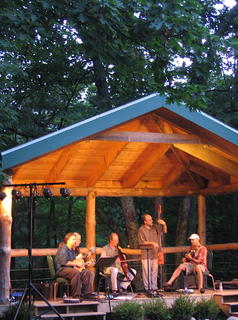
Manitou Music Festival
Concert was at the Leelanau School
OK, so it was a bit humid.
Otherwise a perfect evening.
Check out their site for more info and samples
As they closed with "The Great Thaw", an homage to Lake Michigan, a pair of Great Blue Herons flew across the high clouds, lit by the setting sun.
Not the best photo - blame the photographer.
A bit better shot from earlier in the evening:
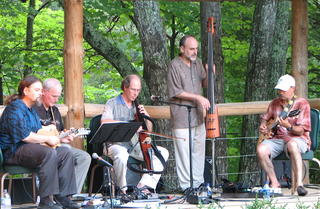
Used Shirley's new PowerShot S2IS (image stablized)
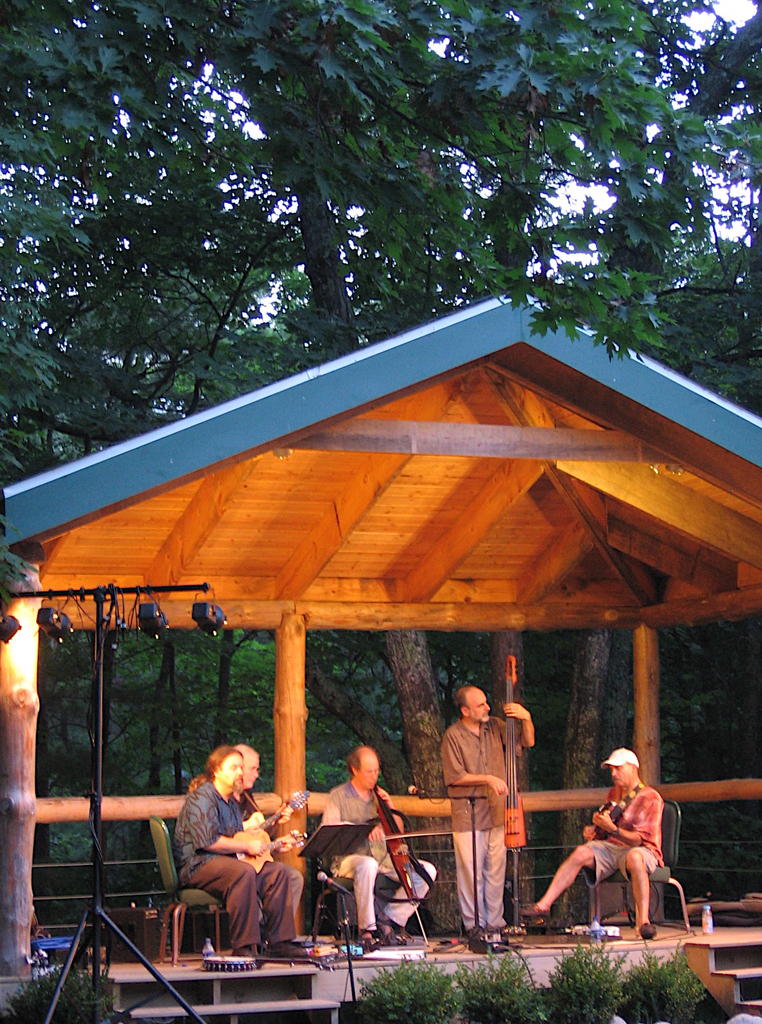
Manitou Music Festival
Concert was at the Leelanau School
OK, so it was a bit humid.
Otherwise a perfect evening.
Check out their site for more info and samples
As they closed with "The Great Thaw", an homage to Lake Michigan, a pair of Great Blue Herons flew across the high clouds, lit by the setting sun.
Not the best photo - blame the photographer.
A bit better shot from earlier in the evening:
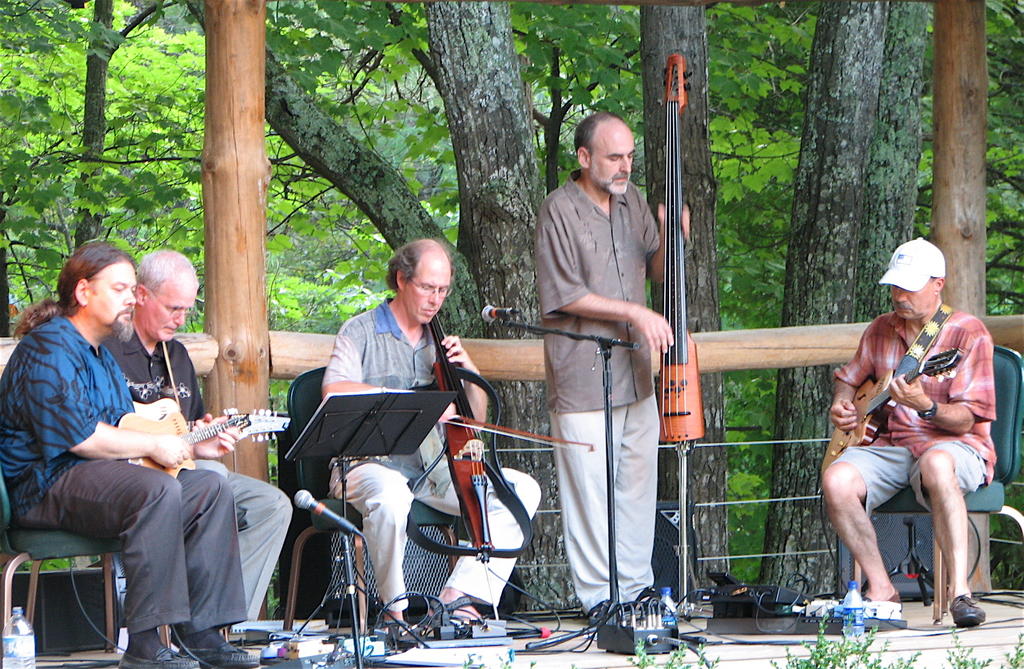
Used Shirley's new PowerShot S2IS (image stablized)
Friday, July 22, 2005
Tom Friedman on Hate Speach
Giving the Hatemongers No Place to Hide - New York Times:
"Every quarter, the State Department should identify the Top 10 hatemongers, excuse makers and truth tellers in the world. It wouldn't be a cure-all. But it would be a message to the extremists: you are free to say what you want, but we are free to listen, to let the whole world know what you are saying and to protect every free society from hate spreaders like you. Words matter."
"Every quarter, the State Department should identify the Top 10 hatemongers, excuse makers and truth tellers in the world. It wouldn't be a cure-all. But it would be a message to the extremists: you are free to say what you want, but we are free to listen, to let the whole world know what you are saying and to protect every free society from hate spreaders like you. Words matter."
Podcast Stuff
The Podcast as a New Podium - New York Times
Rather lightweight review from NYTimes
"So what's on these podcasts? The best ones fall into three categories. The first includes the programs of weird monologists and couples capering, complaining and exposing their personal lives in ostentatiously appalling ways. They can be funny. The second category is for talk shows about technology, from which you learn genuinely useful things, including that MapQuest.com is over, and that serious direction-seekers now turn to Google Maps. And then there are podcasts from abroad, including a good esoteric music podcast from Scotland, and an eccentric Roman Catholic one, which is produced by a priest in the Netherlands."
Other stuff
Doc's Podblog
Apple on Podcasting
All of this reminds me of College Philosophy class.
It was pretty esoteric and, for the "term paper" I talked instead of wrote.
Took a portable tape recorder, drove around Mid Michigan and talked.
All I can recall at this time is that one of the topics I used was analysis of various Marvel Comics, such as SpiderMan, X-Men, etc. and how the issues the characters delt with fit topics of the course.
Now, if I'd just held on to my collection ...
Podcasting
What about recording from a POD?
PODS
Wonder what the acoustics would be like...
Rather lightweight review from NYTimes
"So what's on these podcasts? The best ones fall into three categories. The first includes the programs of weird monologists and couples capering, complaining and exposing their personal lives in ostentatiously appalling ways. They can be funny. The second category is for talk shows about technology, from which you learn genuinely useful things, including that MapQuest.com is over, and that serious direction-seekers now turn to Google Maps. And then there are podcasts from abroad, including a good esoteric music podcast from Scotland, and an eccentric Roman Catholic one, which is produced by a priest in the Netherlands."
Other stuff
Doc's Podblog
Apple on Podcasting
All of this reminds me of College Philosophy class.
It was pretty esoteric and, for the "term paper" I talked instead of wrote.
Took a portable tape recorder, drove around Mid Michigan and talked.
All I can recall at this time is that one of the topics I used was analysis of various Marvel Comics, such as SpiderMan, X-Men, etc. and how the issues the characters delt with fit topics of the course.
Now, if I'd just held on to my collection ...
Podcasting
What about recording from a POD?
PODS
Wonder what the acoustics would be like...
Nice product - many tools in one
Hybrid Morphs and Fills Several Household Voids - New York Times
If one consideration has kept the tablet PC from becoming a popular household item, it's that few hardware manufacturers have designed one that's actually handy around the house. A cross between a souped-up P.D.A., tablet PC and hand-held gaming device, the Pepper Pad from Pepper Computer tries to fill that void. It begs to be held in your hands while you loaf on the couch.
Also : Walt Mossberg's review (WSJ pay site)
Info Appliance Offers Nice Touches, but It's Costly, Has Limitations
Ah, but there are some interesting applications ...
More later
More here
Pepper Computer - Home
If one consideration has kept the tablet PC from becoming a popular household item, it's that few hardware manufacturers have designed one that's actually handy around the house. A cross between a souped-up P.D.A., tablet PC and hand-held gaming device, the Pepper Pad from Pepper Computer tries to fill that void. It begs to be held in your hands while you loaf on the couch.
Also : Walt Mossberg's review (WSJ pay site)
Info Appliance Offers Nice Touches, but It's Costly, Has Limitations
Ah, but there are some interesting applications ...
More later
More here
Pepper Computer - Home
Thursday, July 21, 2005
Aerial of the Glen Lakes

Shot from the south
View of Big and Little Glen with the Manitou Islands in Lake Michigan
Is Money Obscene? Try Europe
Is Money Obscene? Try Europe | MartinVarsavsky.net:
Interesting piece I came across (but it was several days ago and I forgot how I got to it... someone's blog)
Anyway - contrast in American and European view's.
---
"Obscenity
'designed to incite to lust or depravity'
So whatever incites lust or depravity is obscene, sex for example is obscene, or is it?
After living in America for 18 years and in Europe, for 10 I can argue differently. Sex is obscene in America, but in Europe money is more obscene."
Interesting piece I came across (but it was several days ago and I forgot how I got to it... someone's blog)
Anyway - contrast in American and European view's.
---
"Obscenity
'designed to incite to lust or depravity'
So whatever incites lust or depravity is obscene, sex for example is obscene, or is it?
After living in America for 18 years and in Europe, for 10 I can argue differently. Sex is obscene in America, but in Europe money is more obscene."
Monday, July 18, 2005
"The End of the M.E.?," Feature Article, May 2005
"The End of the M.E.?," Feature Article, May 2005:
Peter Huber and Mark Mills on Mechanical Engineering
"They call this 'convergence.' Old lines are changing, or disappearing altogether. What it's doing under the hood is downright electrifying. "
Shift from mechanical controls to electronic.
Peter Huber and Mark Mills on Mechanical Engineering
"They call this 'convergence.' Old lines are changing, or disappearing altogether. What it's doing under the hood is downright electrifying. "
Shift from mechanical controls to electronic.
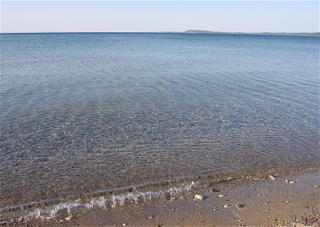
Good Harbor Bay
Lake Michigan
Evening shot
7:40
Looking up the coast
"Whaleback" ridge and dune on horizon
Evening shot
7:40
Looking up the coast
"Whaleback" ridge and dune on horizon

Videos to Your iiPod ?
Wired News: Coming: Videos to Your iPod
08:04 AM Jul. 18, 2005 PT
An iPod with video? Apple Computer has been talking to several major recording companies, looking to license the sale of music videos through the popular iTunes music service, The Wall Street Journal reported.
Negotiations are an indication that Apple is moving to release a device that plays video files, possibly by September, the Journal said. Analysts see the development as likely because of Apple's strength in video software, including the Quicktime movie format and video-editing software, such as Final Cut Pro and iMovie.
An Apple spokeswoman declined to comment.
The Journal notes that so far, commercial movie download services have not met with much success, nor have devices already on the market allowing users to transfer video files from their PCs.
Meanwhile, Apple (AAPL) said Monday that iTunes has surpassed 500 million downloads since its inception two years ago.
08:04 AM Jul. 18, 2005 PT
An iPod with video? Apple Computer has been talking to several major recording companies, looking to license the sale of music videos through the popular iTunes music service, The Wall Street Journal reported.
Negotiations are an indication that Apple is moving to release a device that plays video files, possibly by September, the Journal said. Analysts see the development as likely because of Apple's strength in video software, including the Quicktime movie format and video-editing software, such as Final Cut Pro and iMovie.
An Apple spokeswoman declined to comment.
The Journal notes that so far, commercial movie download services have not met with much success, nor have devices already on the market allowing users to transfer video files from their PCs.
Meanwhile, Apple (AAPL) said Monday that iTunes has surpassed 500 million downloads since its inception two years ago.
Sunday, July 17, 2005
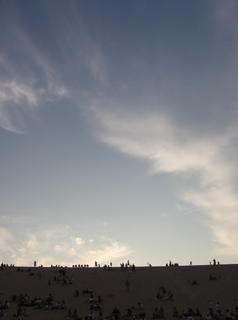
Dune Climb Concert
Dune Climb Concert
More than a couple thousand showed up for the opening concert
Manitou Music Festival
Song of the Lakes
and
Welcome to the California Guitar Trio

and a look up the dune...
Wonderful Concert
Song of the Lakes great as usual
California Guitar Treo stunning with everything from Bach (Toccata and Fugue) to Beethoven (Ode to Joy) to the Doors (riders of the storm) to Ellington (Caravan, complete with drum solo)...
More than a couple thousand showed up for the opening concert
Manitou Music Festival
Song of the Lakes
and
Welcome to the California Guitar Trio

and a look up the dune...

Wonderful Concert
Song of the Lakes great as usual
California Guitar Treo stunning with everything from Bach (Toccata and Fugue) to Beethoven (Ode to Joy) to the Doors (riders of the storm) to Ellington (Caravan, complete with drum solo)...
Saturday, July 16, 2005
Friday, July 15, 2005
Moons
Good time of year for casual moon viewing
Moon(s) low over southern horizon, but rising quickly from month to month.
Days long, this moon rising early.
Shot is just after 9PM
Same stats as before, only some additional sharpening.
The rest of the exposure is unchanged.

Native American Moon name (Eastern North America)
From the Farmer's Almanac
Full Sturgeon Moon - July The fishing tribes are given credit for the naming of this Moon, since sturgeon, a large fish of the Great Lakes and other major bodies of water, were most readily caught during this month. A few tribes knew it as the Full Red Moon because, as the Moon rises, it appears reddish through any sultry haze. It was also called the Green Corn Moon or Grain Moon.
Moon(s) low over southern horizon, but rising quickly from month to month.
Days long, this moon rising early.
Shot is just after 9PM
Same stats as before, only some additional sharpening.
The rest of the exposure is unchanged.

Native American Moon name (Eastern North America)
From the Farmer's Almanac
Full Sturgeon Moon - July The fishing tribes are given credit for the naming of this Moon, since sturgeon, a large fish of the Great Lakes and other major bodies of water, were most readily caught during this month. A few tribes knew it as the Full Red Moon because, as the Moon rises, it appears reddish through any sultry haze. It was also called the Green Corn Moon or Grain Moon.
Yet more on Apple/Intel/Movies etc
PBS | I, Cringely . July 14, 2005 - More Shoes
"Shoes are dropping all over, in this case concerning a story I thought we had finished with: Apple and Intel. You see, IBM announced its new dual-core PowerPC processors a few days ago, and they pretty much contradict much of what Steve Jobs was saying about how he'd compared IBM's processor timeline with Intel's, and frankly, they simply didn't compare. IBM's G5 dual cores look easily comparable to Intel's Pentium Ds, both in terms of computing power and electrical power consumption. So what's really up?"
"Shoes are dropping all over, in this case concerning a story I thought we had finished with: Apple and Intel. You see, IBM announced its new dual-core PowerPC processors a few days ago, and they pretty much contradict much of what Steve Jobs was saying about how he'd compared IBM's processor timeline with Intel's, and frankly, they simply didn't compare. IBM's G5 dual cores look easily comparable to Intel's Pentium Ds, both in terms of computing power and electrical power consumption. So what's really up?"
Thursday, July 14, 2005
David as Fellow at Harvard
Very cool.
Good move on Berkman Center's part!
isen.blog
"It's on the Berkman website, so it must be official; I'm a fellow of Harvard's Berkman Center for Internet and Society for Academic Year 2005-2006. My project will be "Freedom to Connect." I'm tempted to link it to the F2C: Freedom to Connect conference I produced in March, but I don't want to lock the project in too tightly just yet."
Congrats David!
Good move on Berkman Center's part!
isen.blog
"It's on the Berkman website, so it must be official; I'm a fellow of Harvard's Berkman Center for Internet and Society for Academic Year 2005-2006. My project will be "Freedom to Connect." I'm tempted to link it to the F2C: Freedom to Connect conference I produced in March, but I don't want to lock the project in too tightly just yet."
Congrats David!
Mark Cuban on Podcasting
Mark with his usual sharp insight into the economics of the net.
Niche is nice, but not necessarly profitable enough to exploit
Podcasting - Blog Maverick - www.blogmaverick.com _
Followed by :
Podcasting - Blog Maverick - www.blogmaverick.com _
But what happens if we can move it to video?
"4th. We won’t get into video since it’s not a fair comparison. The number of portable devices capable of receiving a video podcast right now is miniscule. (Yes, I know about the devices with potential to get them, but they can’t yet and probably all have to be replaced to do so.) So what."
What about devices like : Pepper Pad ?
Niche is nice, but not necessarly profitable enough to exploit
Podcasting - Blog Maverick - www.blogmaverick.com _
Followed by :
Podcasting - Blog Maverick - www.blogmaverick.com _
But what happens if we can move it to video?
"4th. We won’t get into video since it’s not a fair comparison. The number of portable devices capable of receiving a video podcast right now is miniscule. (Yes, I know about the devices with potential to get them, but they can’t yet and probably all have to be replaced to do so.) So what."
What about devices like : Pepper Pad ?
Wednesday, July 13, 2005
SkyShots
Evening of July 12, between 9:25 and 9:30PM
Sunset about 9:28
Clouds remains of Hurricane Dennis

Meanwhile, back to the NEast
Note the mutiple sub-rings immediatly below the main band, and, I did not notice this until "processing", there's a hint of a outer ring on the far left of the frame.

And to the SEast
Note the similar value between the rainbow and the clouds

All shots have minor digital "enhancement" with sharpness increased 20+ % due to the lower light and exposure settings cut 25-30%.
Shutter speeds of 3/10 at f8
Sunset about 9:28
Clouds remains of Hurricane Dennis

Meanwhile, back to the NEast
Note the mutiple sub-rings immediatly below the main band, and, I did not notice this until "processing", there's a hint of a outer ring on the far left of the frame.

And to the SEast
Note the similar value between the rainbow and the clouds

All shots have minor digital "enhancement" with sharpness increased 20+ % due to the lower light and exposure settings cut 25-30%.
Shutter speeds of 3/10 at f8
MORE more more
The Doc Searls Weblog : Tuesday, July 12, 2005
"I've always wanted MORE back.."
I concur
MORE 3.1
Was a great tool
Have to look into OPML
Also had flashback to ...the Not Missed 70's hit...
"I've always wanted MORE back.."
I concur
MORE 3.1
Was a great tool
Have to look into OPML
Also had flashback to ...the Not Missed 70's hit...
Monday, July 11, 2005
More serious note - reflections on the London Bombing
If It's a Muslim Problem, It Needs a Muslim Solution - New York Times
Excerpt :
"But maybe the most important aspect of the London bombings is this: When jihadist-style bombings happen in Riyadh, that is a Muslim-Muslim problem. That is a police problem for Saudi Arabia. But when Al-Qaeda-like bombings come to the London Underground, that becomes a civilizational problem. Every Muslim living in a Western society suddenly becomes a suspect, becomes a potential walking bomb. And when that happens, it means Western countries are going to be tempted to crack down even harder on their own Muslim populations."
I also had reactions to posting by my friend David
Quote of Note: Martin Varsavsky
Then there was a reply by David
Civilian death
And my comment :
"I happened to have been stunned by the tone of the "posting" we both linked to by those "celebrating" the incident.
I sometimes wish that radicals of all sides (as there are many sides, not just two) could be confined to an island and find their own bit of "heaven" by dealing with one another."
Let's take it a bit further
Does Anyone give a damn about Africa?
The Congo Case - New York Times
But that starts a whole 'nuther discussion
Not to mention any distraction from G8 Summit attempts to help Africa or Live8...
Excerpt :
"But maybe the most important aspect of the London bombings is this: When jihadist-style bombings happen in Riyadh, that is a Muslim-Muslim problem. That is a police problem for Saudi Arabia. But when Al-Qaeda-like bombings come to the London Underground, that becomes a civilizational problem. Every Muslim living in a Western society suddenly becomes a suspect, becomes a potential walking bomb. And when that happens, it means Western countries are going to be tempted to crack down even harder on their own Muslim populations."
I also had reactions to posting by my friend David
Quote of Note: Martin Varsavsky
Then there was a reply by David
Civilian death
And my comment :
"I happened to have been stunned by the tone of the "posting" we both linked to by those "celebrating" the incident.
I sometimes wish that radicals of all sides (as there are many sides, not just two) could be confined to an island and find their own bit of "heaven" by dealing with one another."
Let's take it a bit further
Does Anyone give a damn about Africa?
The Congo Case - New York Times
But that starts a whole 'nuther discussion
Not to mention any distraction from G8 Summit attempts to help Africa or Live8...
Very Cool - Nikki Hayden wins
Soup :: Laguna Seca MotoGP Race Photos
Nikki was fastest in qualifying, then led every lap
His first MotoGP win
Home, in front of friends and family.
Nikki was fastest in qualifying, then led every lap
His first MotoGP win
Home, in front of friends and family.
Sunday, July 10, 2005
A step beyond Intel/Apple?
PBS | I, Cringely . July 7, 2005 - Pod Person
NerdTV is coming
VBlogging
Sorta iTunes meets podcasting (without the charges) meets Mashups?
NerdTV is coming
VBlogging
Sorta iTunes meets podcasting (without the charges) meets Mashups?
Intel Buys Apple ? ... more
Looney Dunes: Intel Buys Apple ?
Spotted the following from Jeff Jarvis on Dell customer service
Dell Hell: The Postscript
Now, if Dell is really moving further down the commodity path, maybe it makes sense for Intel to shift to Apple and focus on the "home entertainment" market.
Also :
Hugh on Jeff on Dell
Spotted the following from Jeff Jarvis on Dell customer service
Dell Hell: The Postscript
Now, if Dell is really moving further down the commodity path, maybe it makes sense for Intel to shift to Apple and focus on the "home entertainment" market.
Also :
Hugh on Jeff on Dell
Saturday, July 09, 2005
Evening shot

Tail end of another beautiful day
About 9:45
Not a cloud in the sky
Quiet
Most boaters have headed in
Nice evening
Very young moon

About 3 days old
New was on 6th
This was 9:35 on 9th
Just an experiment to see how it looks online
Bookmark
Welcome to the MBLWHOI Library Website
More or less a marker
Met Cathy Norton, head of the Library Monday 6/27
Awsome place.
Thanks Jim for the intro
More or less a marker
Met Cathy Norton, head of the Library Monday 6/27
Awsome place.
Thanks Jim for the intro
More serious note - Great Lakes Water Quality
Billions Needed to Improve Great Lakes, Coalition Says - New York Times:
"A coalition of government agencies, businesses and environmental groups on Thursday offered a blueprint for improving the deteriorating health of the Great Lakes, including spending $13.75 billion over five years to stop untreated sewage from overflowing into the lakes from aging wastewater treatment plants."
"A coalition of government agencies, businesses and environmental groups on Thursday offered a blueprint for improving the deteriorating health of the Great Lakes, including spending $13.75 billion over five years to stop untreated sewage from overflowing into the lakes from aging wastewater treatment plants."
More on Intel/Apple
PBS | I, Cringely . May 12, 2005 - Inflection Point
Checking back, I found this piece.
Cringely discusses various moves by MuSoft (pre announcing xBox 360 with typical FUD (Fear Uncertianty Doubt) targeting others), Yahoo music, Google "Accelerator" ...
Now, with the shifts going on to get control of "home entertainment" would it be worthwhile for Intel to move from just supplying chips to whole systems.
Note that the xBox 360 is going with IBM designed chip !
Wikipedia
Bill jumps on Steve's processor as Steve shifts to Intel?
Most interesting and I don't have the answers, just speculation.
Checking back, I found this piece.
Cringely discusses various moves by MuSoft (pre announcing xBox 360 with typical FUD (Fear Uncertianty Doubt) targeting others), Yahoo music, Google "Accelerator" ...
Now, with the shifts going on to get control of "home entertainment" would it be worthwhile for Intel to move from just supplying chips to whole systems.
Note that the xBox 360 is going with IBM designed chip !
Wikipedia
Bill jumps on Steve's processor as Steve shifts to Intel?
Most interesting and I don't have the answers, just speculation.

Thursday, July 07, 2005
So that's why the sun looks so small ...
SpaceWeather.com -- News and information about meteor showers, solar flares, auroras, and near-Earth asteroids:
"APHELION: You probably haven't noticed, but the sun today looks a bit smaller than usual. That's because, this week, Earth is at its greatest distance from the sun (152 million km), a point in our planet's orbit called aphelion"
"APHELION: You probably haven't noticed, but the sun today looks a bit smaller than usual. That's because, this week, Earth is at its greatest distance from the sun (152 million km), a point in our planet's orbit called aphelion"
Intel Buys Apple ?
PBS | I, Cringely . June 9, 2005 - Going for Broke
And then :
Intel Takes Stake in On-Demand Movies
So what ?
How about Intel moves further into "home entertainment" ?
Apple is the clear winner when it comes to design issues, both package and interface.
Assume that Jobs/Apple comes out with iHollywood or iWhatever patterned after iTunes. Intel moves further from MuSoft and commodity products.
How better to do it than to team up with leading interface and all around "cool" company.
No need to buy all of Apple, although that would be possible, just take a major stake it it.
And then :
Intel Takes Stake in On-Demand Movies
So what ?
How about Intel moves further into "home entertainment" ?
Apple is the clear winner when it comes to design issues, both package and interface.
Assume that Jobs/Apple comes out with iHollywood or iWhatever patterned after iTunes. Intel moves further from MuSoft and commodity products.
How better to do it than to team up with leading interface and all around "cool" company.
No need to buy all of Apple, although that would be possible, just take a major stake it it.
Terror Attacks in London Kill 2, Injure 190 on Subways, Buses
WSJ.com - Terror Attacks in London Kill 2, Injure 190 on Subways, Buses
From Op/Ed piece on June 29th "The New Stockholm Syndrome"
"If a conservative is a liberal who's been mugged, what do you call a Swede who's been kidnapped? Somebody you wouldn't want to cross, that's for sure.
Ulf Hjertstrom has redefined the term Stockholm Syndrome, the bizarre attachment some hostages develop for their captors, first observed during a bank robbery in the Swedish capital more than 30 years ago. No such bonds were forged between Mr. Hjertstrom, a Swedish oil engineer, and the Shura Council of the Mujahedeen of Iraq, which held him captive for 67 days. "I have now put some people to work to find these bastards," Mr. Hjertstrom told reporters after his release. "I invested about $50,000 so far. And we will get them one by one. These scum should be out of business."
and
"Likewise, Georges Malbrunot, one of two French hostages released in December, first did not understand why he and his colleague were held captive since their country had opposed the war. Eventually, though, Mr. Malbrunot came to understand. "Little by little, we came to discover we were really on planet bin Laden," he wrote in Le Figaro. "For them [the terrorists], France is the West, it's a global vision, it's the infidel West against the Muslim world."
From Op/Ed piece on June 29th "The New Stockholm Syndrome"
"If a conservative is a liberal who's been mugged, what do you call a Swede who's been kidnapped? Somebody you wouldn't want to cross, that's for sure.
Ulf Hjertstrom has redefined the term Stockholm Syndrome, the bizarre attachment some hostages develop for their captors, first observed during a bank robbery in the Swedish capital more than 30 years ago. No such bonds were forged between Mr. Hjertstrom, a Swedish oil engineer, and the Shura Council of the Mujahedeen of Iraq, which held him captive for 67 days. "I have now put some people to work to find these bastards," Mr. Hjertstrom told reporters after his release. "I invested about $50,000 so far. And we will get them one by one. These scum should be out of business."
and
"Likewise, Georges Malbrunot, one of two French hostages released in December, first did not understand why he and his colleague were held captive since their country had opposed the war. Eventually, though, Mr. Malbrunot came to understand. "Little by little, we came to discover we were really on planet bin Laden," he wrote in Le Figaro. "For them [the terrorists], France is the West, it's a global vision, it's the infidel West against the Muslim world."
Grandpa and Grandson

By "Popular Demand" here we are. June 28th, and Robbie is a day old.
All doing well.
Grandpa contemplating "second childhood" although some think he never left the first one...
Wednesday, July 06, 2005
Movie/Bike Trivia
Alright
Who's been messing with images ?
Instead of doing something useful, I fiddled around with the following for a bit
There was a story in the NYTimes about an auction of Brando stuff
Didn't grab url before it went behind the "pay-per-view" wall
"The Outtakes Of Brando's Large Life"
But found the shot:

I don't (yet) know the story behind this Guzzi shot,
but it wasn't from "The Wild One"
In the movie, he was a Triumph.

There is also a shot of him on a Matchless

Movie review/backgrounder
The Wild One
Hey, Johnny, What are you rebelling against?
While tapping out a jazzy beat on the top of the jukebox, he raises his eyebrow and drawls his amorphous reason for rebellion:
What've you got?
Who's been messing with images ?
Instead of doing something useful, I fiddled around with the following for a bit
There was a story in the NYTimes about an auction of Brando stuff
Didn't grab url before it went behind the "pay-per-view" wall
"The Outtakes Of Brando's Large Life"
But found the shot:
I don't (yet) know the story behind this Guzzi shot,
but it wasn't from "The Wild One"
In the movie, he was a Triumph.
There is also a shot of him on a Matchless
Movie review/backgrounder
The Wild One
Hey, Johnny, What are you rebelling against?
While tapping out a jazzy beat on the top of the jukebox, he raises his eyebrow and drawls his amorphous reason for rebellion:
What've you got?
Monday, July 04, 2005
Fast Company : on Design
What P&G Knows About the Power of Design
Your products run for election every day, says Procter & Gamble CEO A.G. Lafley. And good design is critical to winning the campaign."
Whole issue on the power of design.
This piece is on P&G
Also see Virginia's examples and comments (Crest Pro-Health Rinse)
P&G's Design Initiative Comes to Mouthwash
"Here's how that resolve plays out in a new product. The bottle for Crest Pro-Health Rinse is so appealing that Steve and I almost bought some, even though we never use mouthwash. It looks especially good compared to the nearby Listerine, which even in its friendly blue form "looks industrial, like Janitor in a Drum," says Professor Postrel."
Ouch
Your products run for election every day, says Procter & Gamble CEO A.G. Lafley. And good design is critical to winning the campaign."
Whole issue on the power of design.
This piece is on P&G
Also see Virginia's examples and comments (Crest Pro-Health Rinse)
P&G's Design Initiative Comes to Mouthwash
"Here's how that resolve plays out in a new product. The bottle for Crest Pro-Health Rinse is so appealing that Steve and I almost bought some, even though we never use mouthwash. It looks especially good compared to the nearby Listerine, which even in its friendly blue form "looks industrial, like Janitor in a Drum," says Professor Postrel."
Ouch
Uh-Oh not good news - Kelo and further thinking
Looney Dunes: Uh-Oh not good news
Reflection on the decision
Not the end of the world
Rather, a wake up call to citizens to get their state representatives to write sensible eminent domain legislation.
Some interesting comments from Virginia :
Appalled but Not Surprised
Interesting reference to reaction to Bowers decision :
"The ruling galvanized efforts to repeal anti-sodomy statutes, to challenge such laws under state constitutions, and, ultimately, to get Hardwick overturned by the U.S. Supreme Court.
Glenn notes that Bowers, unlike Kelo, "was consistent with the law going all the way back." That's not the only difference. Bowers upheld laws that most Americans assumed were essentially symbolic and unenforced. One reason the decision was so shocking was that Mr. Hardwick had actually been arrested in the privacy of his own bedroom, demonstrating that the laws could have real-life consequences. Still, even sodomy law supporters didn't want stricter enforcement. Bowers wasn't going to lead to systematic police sweeps of the nation's bedrooms.
Kelo, by contrast, isn't about cultural symbolism and largely unenforced law. It's about common practices. American cities quite regularly take property from some private parties to give it to other, usually wealthier ones. Now that practice has the Supreme Court's blessing. Kelo could very well lead to much more aggressive use of eminent domain for "economic development." Bowers was offensive, but Kelo is scary. "
Call to action to get local and state laws enacted.
Also, for a giggle :
Souter Home to be Seized by Eminent Domain
"The proposed development, called "The Lost Liberty Hotel" will feature the "Just Desserts Café" and include a museum, open to the public, featuring a permanent exhibit on the loss of freedom in America. Instead of a Gideon's Bible each guest will receive a free copy of Ayn Rand's novel 'Atlas Shrugged'."
Heard this on radio headed to Providence (odd coincidence of name?) WRKO Boston.
Also : thanks to David for picking it up :
David's Blog
Reflection on the decision
Not the end of the world
Rather, a wake up call to citizens to get their state representatives to write sensible eminent domain legislation.
Some interesting comments from Virginia :
Appalled but Not Surprised
Interesting reference to reaction to Bowers decision :
"The ruling galvanized efforts to repeal anti-sodomy statutes, to challenge such laws under state constitutions, and, ultimately, to get Hardwick overturned by the U.S. Supreme Court.
Glenn notes that Bowers, unlike Kelo, "was consistent with the law going all the way back." That's not the only difference. Bowers upheld laws that most Americans assumed were essentially symbolic and unenforced. One reason the decision was so shocking was that Mr. Hardwick had actually been arrested in the privacy of his own bedroom, demonstrating that the laws could have real-life consequences. Still, even sodomy law supporters didn't want stricter enforcement. Bowers wasn't going to lead to systematic police sweeps of the nation's bedrooms.
Kelo, by contrast, isn't about cultural symbolism and largely unenforced law. It's about common practices. American cities quite regularly take property from some private parties to give it to other, usually wealthier ones. Now that practice has the Supreme Court's blessing. Kelo could very well lead to much more aggressive use of eminent domain for "economic development." Bowers was offensive, but Kelo is scary. "
Call to action to get local and state laws enacted.
Also, for a giggle :
Souter Home to be Seized by Eminent Domain
"The proposed development, called "The Lost Liberty Hotel" will feature the "Just Desserts Café" and include a museum, open to the public, featuring a permanent exhibit on the loss of freedom in America. Instead of a Gideon's Bible each guest will receive a free copy of Ayn Rand's novel 'Atlas Shrugged'."
Heard this on radio headed to Providence (odd coincidence of name?) WRKO Boston.
Also : thanks to David for picking it up :
David's Blog
Friedman on Ireland
The End of the Rainbow
Follow up to Rich's piece on Entrepreneur's
It's the Entrepreneurs, Stupid!
"Dublin
Here's something you probably didn't know: Ireland today is the richest country in the European Union after Luxembourg.
Yes, the country that for hundreds of years was best known for emigration, tragic poets, famines, civil wars and leprechauns today has a per capita G.D.P. higher than that of Germany, France and Britain. How Ireland went from the sick man of Europe to the rich man in less than a generation is an amazing story. It tells you a lot about Europe today: all the innovation is happening on the periphery by those countries embracing globalization in their own ways - Ireland, Britain, Scandinavia and Eastern Europe - while those following the French-German social model are suffering high unemployment and low growth.
---
And followed by:
Follow the Leapin' Leprechaun
Dublin
There is a huge debate roiling in Europe today over which economic model to follow: the Franco-German shorter-workweek-six-weeks'-vacation-never-fire-anyone-but-high-unemployment social model or the less protected but more innovative, high-employment Anglo-Saxon model preferred by Britain, Ireland and Eastern Europe. It is obvious to me that the Irish-British model is the way of the future, and the only question is when Germany and France will face reality: either they become Ireland or they become museums. That is their real choice over the next few years - it's either the leprechaun way or the Louvre.
Follow up to Rich's piece on Entrepreneur's
It's the Entrepreneurs, Stupid!
"Dublin
Here's something you probably didn't know: Ireland today is the richest country in the European Union after Luxembourg.
Yes, the country that for hundreds of years was best known for emigration, tragic poets, famines, civil wars and leprechauns today has a per capita G.D.P. higher than that of Germany, France and Britain. How Ireland went from the sick man of Europe to the rich man in less than a generation is an amazing story. It tells you a lot about Europe today: all the innovation is happening on the periphery by those countries embracing globalization in their own ways - Ireland, Britain, Scandinavia and Eastern Europe - while those following the French-German social model are suffering high unemployment and low growth.
---
And followed by:
Follow the Leapin' Leprechaun
Dublin
There is a huge debate roiling in Europe today over which economic model to follow: the Franco-German shorter-workweek-six-weeks'-vacation-never-fire-anyone-but-high-unemployment social model or the less protected but more innovative, high-employment Anglo-Saxon model preferred by Britain, Ireland and Eastern Europe. It is obvious to me that the Irish-British model is the way of the future, and the only question is when Germany and France will face reality: either they become Ireland or they become museums. That is their real choice over the next few years - it's either the leprechaun way or the Louvre.
I'll Fly Away ...
Back to "stuff"
With a nod to Norah Jones (I'll fly away), finally made it back home
Brief recap of return from Boston : just 'cause (recap of Wed 6/29)
Up at 5:00 - not that unusual, beat the 5:30 wake up call (which came at 5:20)
Out and on the road to Providence (RI) by 5:30
Took about hour & a half.
Early because I was a bit concerned about fog from prior night's weather forecast.
Return rental and plenty of time for check-in, security etc. for 9:14 flight.
Chose early flight to avoid delay pile-up's
More than enough time ... or so I thought
"Computer Problems" on the aircraft.
Turns out that it was valve actuation issues with right side engine.
Delay for testing till 9:40 ... OK, but looks like missing the 11:56 connection in DTW
Call NWA for later bookings.
1:30
3:15
5:12
All filled 'till 7:30PM flight out - so book me, if there's an opening earlier, I'll take it.
Delay for testing till 10:40 - glad I booked later flight
Delay for testing till 11:15 - still glad for the later booking.
Finally - "this plane not flying till sometime this evening. We need a new valve and it will have to be flown in. Go to baggage claim, collect your baggage and return to the ticketing counter."
Had 100% carry-on (whew)
Got booked on USAir due out at 1:55 to Philly then on to DTW, leave 4:16 arrive 6:06.
Back through security, but this time, as it was a 2nd pass through - got "special screening"
At first I thought it was to expedite - nope.
Booth sniff, full swab of briefcase, computer case, suitcase.
Make it to USAir and board.
Back away from the gate - but Ground Hold - weather in Philly.
First hold something like 30min, next maybe an hour.
Note that while on the ramp, the A/C doesn't work all that well.
Finally, about 2:50 the captian says "more bad news... 2hr hold" and he takes us back to the gate.
2:52 call to NWA (while we taxi back to gate) to nail only flight to NWA out at 4:14.
OK - hoof it to NWA gate.
Would prefer to get stuck in Detroit - options of hotel, or just rent car to make 5+hr drive home.
"We're booked up" (gate attendent)
"I'm booked... check the computer" - confirmed.
Starting to get frustrated with situation.
Captain calls me aside to show me the radar - obvious that East Coast is in trouble, now LaGuardia, Baltimore, DC closed. With luck, he gets us out between cells, and up to Mowhawk Valley to swing west.
But ... now we need the "ticket" from USAir - back to that gate, interrupt agent and manage to get ticket... back to NWA as they are starting to board.
Whew.
Some ground delays, longer flight due to re-routing, have to OJ it through Detroit Metro to make connection ... but done.
Touchdown a bit after 8:45
Glad to be home.
Lesson's : travel light (carry on), cellphone with airline 800 number.
With a nod to Norah Jones (I'll fly away), finally made it back home
Brief recap of return from Boston : just 'cause (recap of Wed 6/29)
Up at 5:00 - not that unusual, beat the 5:30 wake up call (which came at 5:20)
Out and on the road to Providence (RI) by 5:30
Took about hour & a half.
Early because I was a bit concerned about fog from prior night's weather forecast.
Return rental and plenty of time for check-in, security etc. for 9:14 flight.
Chose early flight to avoid delay pile-up's
More than enough time ... or so I thought
"Computer Problems" on the aircraft.
Turns out that it was valve actuation issues with right side engine.
Delay for testing till 9:40 ... OK, but looks like missing the 11:56 connection in DTW
Call NWA for later bookings.
1:30
3:15
5:12
All filled 'till 7:30PM flight out - so book me, if there's an opening earlier, I'll take it.
Delay for testing till 10:40 - glad I booked later flight
Delay for testing till 11:15 - still glad for the later booking.
Finally - "this plane not flying till sometime this evening. We need a new valve and it will have to be flown in. Go to baggage claim, collect your baggage and return to the ticketing counter."
Had 100% carry-on (whew)
Got booked on USAir due out at 1:55 to Philly then on to DTW, leave 4:16 arrive 6:06.
Back through security, but this time, as it was a 2nd pass through - got "special screening"
At first I thought it was to expedite - nope.
Booth sniff, full swab of briefcase, computer case, suitcase.
Make it to USAir and board.
Back away from the gate - but Ground Hold - weather in Philly.
First hold something like 30min, next maybe an hour.
Note that while on the ramp, the A/C doesn't work all that well.
Finally, about 2:50 the captian says "more bad news... 2hr hold" and he takes us back to the gate.
2:52 call to NWA (while we taxi back to gate) to nail only flight to NWA out at 4:14.
OK - hoof it to NWA gate.
Would prefer to get stuck in Detroit - options of hotel, or just rent car to make 5+hr drive home.
"We're booked up" (gate attendent)
"I'm booked... check the computer" - confirmed.
Starting to get frustrated with situation.
Captain calls me aside to show me the radar - obvious that East Coast is in trouble, now LaGuardia, Baltimore, DC closed. With luck, he gets us out between cells, and up to Mowhawk Valley to swing west.
But ... now we need the "ticket" from USAir - back to that gate, interrupt agent and manage to get ticket... back to NWA as they are starting to board.
Whew.
Some ground delays, longer flight due to re-routing, have to OJ it through Detroit Metro to make connection ... but done.
Touchdown a bit after 8:45
Glad to be home.
Lesson's : travel light (carry on), cellphone with airline 800 number.
Friday, July 01, 2005
Podcasting
I finally understand podcasting - megnut.com
" As much as I love to express myself on this site, I couldn't picture myself making audio posts available for download. And as much as I enjoy reading many other sites, I couldn't imagine listening to people talk about breakfast or parking their cars. I've never been able to test my podcast assumptions because I've been using a dial-up internet connection for a large chunk of this year, but now I think I finally get it.
Podcasting isn't (just) about listening to your friends talk about their day on your iPod. It's about time-shifting: being able to download and listen to programs when you want, e.g. four episodes of Fresh Air while you're cleaning your house."
Meg's comments triggered a "flashback"
Late 60's (dating myself here) and did a "term paper" for a philosophy class.
Professor was pretty esoteric himself so I chose to take a tape recorder, drive around for a couple of hours and "free associate". I don't recall much other than I did talk (ramble was likely more accurate description) about the characters and their "lives" in various Marvel Comics.
" As much as I love to express myself on this site, I couldn't picture myself making audio posts available for download. And as much as I enjoy reading many other sites, I couldn't imagine listening to people talk about breakfast or parking their cars. I've never been able to test my podcast assumptions because I've been using a dial-up internet connection for a large chunk of this year, but now I think I finally get it.
Podcasting isn't (just) about listening to your friends talk about their day on your iPod. It's about time-shifting: being able to download and listen to programs when you want, e.g. four episodes of Fresh Air while you're cleaning your house."
Meg's comments triggered a "flashback"
Late 60's (dating myself here) and did a "term paper" for a philosophy class.
Professor was pretty esoteric himself so I chose to take a tape recorder, drive around for a couple of hours and "free associate". I don't recall much other than I did talk (ramble was likely more accurate description) about the characters and their "lives" in various Marvel Comics.
Hiatus
Back from brief Hiatus.
Multi-Family, multi-generational gathering was "interupted" by arrival of first grandson.
All doing well, all happy.
Will be catching up soon.
Multi-Family, multi-generational gathering was "interupted" by arrival of first grandson.
All doing well, all happy.
Will be catching up soon.
Thursday, June 23, 2005
Uh-Oh not good news
Justices, 5-4, Back Seizure of Property for Development - New York Times
I have to agree with the dissenting opinion on this one.
It really will open a can of worms.
"WASHINGTON, June 23 - The Supreme Court ruled today, in a deeply emotional case weighing the rights of property owners and the good of the community, that local governments can sometimes seize homes and businesses and turn them over to private developers.
In a case with nationwide implications, the court ruled, 5 to 4, against a group of homeowners in New London, Conn., who have resisted the city's plans to demolish their working-class homes near the Thames River to make way for an office building, riverfront hotel and other commercial activities.
The majority held that, just as government has the constitutional power of eminent domain to acquire private property to clear slums or to build roads, bridges, airports and other facilities to benefit the public, it can sometimes do so for private developers if the latters' projects also serve a public good.
Writing for the majority, Justice John Paul Stevens said, 'Promoting economic development is a traditional and long accepted governmental function, and there is no principled way of distinguishing it from the other public purposes the court has recognized.' The court's ruling is certain to be studied from coast to coast, since similar conflicts between owners of homes and small businesses and development-minded officials have arisen in other locales.
Justice Stevens noted that city officials had been addressing New London's sagging economic fortunes for years, and he said their decisions on how best to cope with them were entitled to wide deference.
Of course, he wrote, the city would be barred from taking one's property and transferring it to another private owner strictly for the latter's benefit. But in this instance, he said, the city is promoting a variety of commercial, residential and recreational land uses 'with the hope that they will form a whole greater than the sum of its parts' and bring economic benefits to the general community.
In a bitter dissent, Justice Sandra Day O'Connor said the majority had created an ominous precedent. 'The specter of condemnation hangs over all property,' she wrote. 'Nothing is to prevent the state from replacing any Motel 6 with a Ritz-Carlton, any home with a shopping mall, or any farm with a factory.'
'Any property may now be taken for the benefit of another private property, but the fallout from this decision will not be random,' she wrote. 'The beneficiaries are likely to be those citizens with disproportionate influence and power in the political process, including large corporations and development firms.
'As for the victims,' Justice O'Connor went on, 'the government now has license to transfer property from those with fewer resources to those with more. The Founders cannot have intended this perverse result.'
Justice Stevens was joined in the majority by Justices Anthony M. Kennedy, David H. Souter, Ruth Bader Ginsburg and Stephen G. Breyer.
Justice O'Connor's fellow dissenters were Chief Justice William H. Rehnquist and Justices Antonin Scalia and Clarence Thomas."
I have to agree with the dissenting opinion on this one.
It really will open a can of worms.
"WASHINGTON, June 23 - The Supreme Court ruled today, in a deeply emotional case weighing the rights of property owners and the good of the community, that local governments can sometimes seize homes and businesses and turn them over to private developers.
In a case with nationwide implications, the court ruled, 5 to 4, against a group of homeowners in New London, Conn., who have resisted the city's plans to demolish their working-class homes near the Thames River to make way for an office building, riverfront hotel and other commercial activities.
The majority held that, just as government has the constitutional power of eminent domain to acquire private property to clear slums or to build roads, bridges, airports and other facilities to benefit the public, it can sometimes do so for private developers if the latters' projects also serve a public good.
Writing for the majority, Justice John Paul Stevens said, 'Promoting economic development is a traditional and long accepted governmental function, and there is no principled way of distinguishing it from the other public purposes the court has recognized.' The court's ruling is certain to be studied from coast to coast, since similar conflicts between owners of homes and small businesses and development-minded officials have arisen in other locales.
Justice Stevens noted that city officials had been addressing New London's sagging economic fortunes for years, and he said their decisions on how best to cope with them were entitled to wide deference.
Of course, he wrote, the city would be barred from taking one's property and transferring it to another private owner strictly for the latter's benefit. But in this instance, he said, the city is promoting a variety of commercial, residential and recreational land uses 'with the hope that they will form a whole greater than the sum of its parts' and bring economic benefits to the general community.
In a bitter dissent, Justice Sandra Day O'Connor said the majority had created an ominous precedent. 'The specter of condemnation hangs over all property,' she wrote. 'Nothing is to prevent the state from replacing any Motel 6 with a Ritz-Carlton, any home with a shopping mall, or any farm with a factory.'
'Any property may now be taken for the benefit of another private property, but the fallout from this decision will not be random,' she wrote. 'The beneficiaries are likely to be those citizens with disproportionate influence and power in the political process, including large corporations and development firms.
'As for the victims,' Justice O'Connor went on, 'the government now has license to transfer property from those with fewer resources to those with more. The Founders cannot have intended this perverse result.'
Justice Stevens was joined in the majority by Justices Anthony M. Kennedy, David H. Souter, Ruth Bader Ginsburg and Stephen G. Breyer.
Justice O'Connor's fellow dissenters were Chief Justice William H. Rehnquist and Justices Antonin Scalia and Clarence Thomas."
Rich Karlgaard on Entrepreneurs and Europe
It's the Entrepreneurs, Stupid! - Forbes.com: "Digital Rules
It's the Entrepreneurs, Stupid!
Rich Karlgaard, 07.04.05, 12:00 AM ET
A dearth of entrepreneurs explains the economic mess in Europe. What a sad turn of events: France, after all, gave us the word entrepreneur. (It comes from the French verb entreprendre, 'to undertake.' An entrepreneur undertakes a business, assuming the financial risk for the chance of profit.) France also birthed one of the giants of economic philosophy, Jean-Baptiste Say (1767-1832). Say's Law (1803) was popularized soon after by Scottish Enlightenment philosopher James Mill as the well-known adage 'supply creates its own demand.' Say said it better: 'Products are paid for with products.'
Whichever translation you prefer, the implication of Say's Law is clear enough. Too bad Europe doesn't get it. Growth requires production, which requires investment, which must come out of profits. You destroy growth when you destroy investment capital by way of taxation and regulation. Evidence: France and Germany. The latter has had just one year of 3% GDP growth during the last 12 years. Last year France grew at 2.1%, Germany at 1.6%.
Consumption will never lift a country's growth rate. Only new production--the work of entrepreneurs--will do that. Europe's recovery depends not on more laws or a reworked EU Constitution (or taxpayer subsidies of so-called national champions, such as the Airbus consortium EADS), but on attracting, keeping and nourishing entrepreneurs. Here's how. "
Taxes must be reasonable.
Trade and labor markets must be free.
Regulations must be light.
In Germany business startups need approval from the government, and the process takes months or years. French startups are choked by paperwork, which is why a generation of French restaurant entrepreneurs has decamped to London. In much of the world this master-serf relationship between government and citizens persists--if not in law, in mind--and the thinking is, "Who gave you permission to start a business?" How poisonous to entrepreneurship.
The rule of law must be understood and enforced.
When given a chance, large companies will manipulate the political system to their advantage. This occurs everywhere in the world (think big agribusiness in the U.S.). But where such unlevel playing fields are the norm, not the exception, the country's top entrepreneurs will say, "To heck with this!" and leave.
Entrepreneurs come in all types.
Some want to escape poverty or obscurity. Some have an urge to change the world. Others want to prove their intellect, or stick it to their former bosses. But one thing entrepreneurs rarely appear to be is their university's class valedictorian. Countries that place too much emphasis on showy scholastic achievement, such as France and Japan, will be short on entrepreneurs.
Immigration must be encouraged.
Australia, New Zealand and, to a lesser extent, the U.K. are booming because of immigration, just as America historically has. Educated immigrants start tech companies. Noneducated immigrants also boost the economy, if they are willing to assimilate. They start mom-and-pop businesses, some of which grow to be large. Memo to France and Germany: The U.S. has made a disastrous wrong turn regarding skills-based immigrants. Because of its H-1B visa plan, the U.S. is admitting only a third of the peak number it did five years ago. That's terrible policy. It will damage U.S. technology for years to come. I hate to suggest this, but now's the time for other countries to take advantage of our shortsightedness.
Waste and inefficiency must be accepted.
Old Europe has been infected with a bad idea from its Green parties. The idea is that "sustainability" is good and waste is sinful. But "sustainable" never brings the big breakthrough. For that, you need armies of entrepreneurs "wasting" time and resources in experimentation.
Honest failure must be tolerated.
One of the secrets of Silicon Valley's success is an acceptance of multimillion-dollar cock-ups. Billionaire venture capitalist John Doerr says a VC isn't seasoned until he's crashed the equivalent of an F-18 fighter jet--booted $20 million on a startup that didn't work. In countries where bankruptcy laws are too tilted toward creditors, you get fewer risk takers.
Social mobility must be applauded. Why would a French entrepreneur want to struggle for success, only to find at the head of the receiving line someone like Dominique de Villepin, a haughty mandarin eager to cut him down? One of the reasons Silicon Valley surpassed the Boston area in tech leadership is that Boston was more class-riven. Graduates of Harvard Business School, wanting to protect their social status, tended to go into white-shoe consulting and banking. Graduates of Stanford Business School felt less social pressure and gravitated toward misfit startups. In the U.S. the best entrepreneurial hives offer the most social mobility: New York City, the New South, the West.
It's the Entrepreneurs, Stupid!
Rich Karlgaard, 07.04.05, 12:00 AM ET
A dearth of entrepreneurs explains the economic mess in Europe. What a sad turn of events: France, after all, gave us the word entrepreneur. (It comes from the French verb entreprendre, 'to undertake.' An entrepreneur undertakes a business, assuming the financial risk for the chance of profit.) France also birthed one of the giants of economic philosophy, Jean-Baptiste Say (1767-1832). Say's Law (1803) was popularized soon after by Scottish Enlightenment philosopher James Mill as the well-known adage 'supply creates its own demand.' Say said it better: 'Products are paid for with products.'
Whichever translation you prefer, the implication of Say's Law is clear enough. Too bad Europe doesn't get it. Growth requires production, which requires investment, which must come out of profits. You destroy growth when you destroy investment capital by way of taxation and regulation. Evidence: France and Germany. The latter has had just one year of 3% GDP growth during the last 12 years. Last year France grew at 2.1%, Germany at 1.6%.
Consumption will never lift a country's growth rate. Only new production--the work of entrepreneurs--will do that. Europe's recovery depends not on more laws or a reworked EU Constitution (or taxpayer subsidies of so-called national champions, such as the Airbus consortium EADS), but on attracting, keeping and nourishing entrepreneurs. Here's how. "
Taxes must be reasonable.
Trade and labor markets must be free.
Regulations must be light.
In Germany business startups need approval from the government, and the process takes months or years. French startups are choked by paperwork, which is why a generation of French restaurant entrepreneurs has decamped to London. In much of the world this master-serf relationship between government and citizens persists--if not in law, in mind--and the thinking is, "Who gave you permission to start a business?" How poisonous to entrepreneurship.
The rule of law must be understood and enforced.
When given a chance, large companies will manipulate the political system to their advantage. This occurs everywhere in the world (think big agribusiness in the U.S.). But where such unlevel playing fields are the norm, not the exception, the country's top entrepreneurs will say, "To heck with this!" and leave.
Entrepreneurs come in all types.
Some want to escape poverty or obscurity. Some have an urge to change the world. Others want to prove their intellect, or stick it to their former bosses. But one thing entrepreneurs rarely appear to be is their university's class valedictorian. Countries that place too much emphasis on showy scholastic achievement, such as France and Japan, will be short on entrepreneurs.
Immigration must be encouraged.
Australia, New Zealand and, to a lesser extent, the U.K. are booming because of immigration, just as America historically has. Educated immigrants start tech companies. Noneducated immigrants also boost the economy, if they are willing to assimilate. They start mom-and-pop businesses, some of which grow to be large. Memo to France and Germany: The U.S. has made a disastrous wrong turn regarding skills-based immigrants. Because of its H-1B visa plan, the U.S. is admitting only a third of the peak number it did five years ago. That's terrible policy. It will damage U.S. technology for years to come. I hate to suggest this, but now's the time for other countries to take advantage of our shortsightedness.
Waste and inefficiency must be accepted.
Old Europe has been infected with a bad idea from its Green parties. The idea is that "sustainability" is good and waste is sinful. But "sustainable" never brings the big breakthrough. For that, you need armies of entrepreneurs "wasting" time and resources in experimentation.
Honest failure must be tolerated.
One of the secrets of Silicon Valley's success is an acceptance of multimillion-dollar cock-ups. Billionaire venture capitalist John Doerr says a VC isn't seasoned until he's crashed the equivalent of an F-18 fighter jet--booted $20 million on a startup that didn't work. In countries where bankruptcy laws are too tilted toward creditors, you get fewer risk takers.
Social mobility must be applauded. Why would a French entrepreneur want to struggle for success, only to find at the head of the receiving line someone like Dominique de Villepin, a haughty mandarin eager to cut him down? One of the reasons Silicon Valley surpassed the Boston area in tech leadership is that Boston was more class-riven. Graduates of Harvard Business School, wanting to protect their social status, tended to go into white-shoe consulting and banking. Graduates of Stanford Business School felt less social pressure and gravitated toward misfit startups. In the U.S. the best entrepreneurial hives offer the most social mobility: New York City, the New South, the West.
Another storm shot
No retouching, just a bit of cropping
Looking SW, storm coming in from NNW
Same storm as shots below
Technical : all with Canon Poweshot A510
3.2 Megapixel
Full auto with some pre-setting of exposure via keying off clouds

Looking SW, storm coming in from NNW
Same storm as shots below
Technical : all with Canon Poweshot A510
3.2 Megapixel
Full auto with some pre-setting of exposure via keying off clouds

Atmospherics
With a nod to Garth Brooks ...
"And the Thunder Rolls..."
Clouds as a thunderstorm rolled through the area

And :

First rain showing up in lower right
And :

All un-retouched
Experiment with Flicr:
Atmospherics - a photoset on Flickr
Collection of shots from this storm.
"And the Thunder Rolls..."
Clouds as a thunderstorm rolled through the area
And :
First rain showing up in lower right
And :
All un-retouched
Experiment with Flicr:
Atmospherics - a photoset on Flickr
Collection of shots from this storm.
L'Atelier de Joel Robuchon reviews and comments
A few reviews of L'Atellier Joel Robuchon
We liked it very much
Enought that we returned for a second dinner

Ed Alcock for The New York Times
The diner's-eye view across the countertop to the kitchen at L'Atelier du Robuchon in Paris.
L'Atelier de Joel Robuchon | Paris Restaurants | Fodor's Online Travel Guide
Gayot Restaurant News
NYTimes Review
Tasting menu : summary
98 Euro, but worth it.
1. Amuse-bouche of gazpacho -- unlike any gazpacho.
Pureed, smooth, creamy, not too spicy. A couple of crunchy croutons floating on top.
2. Le Tourteau -- Looks like avocado soup with almonds floating on top. But thicker than soup, totally silky and creamy, and there's a creamy crab concoction underneath. Little drops of chile oil floating on top.
3. Les Palourdes -- 3 little clams, served hot in open shells on a bed of rock salt. Much like traditional escargots -- a garilc-butter-parsley sauce with very finely minced mushrooms.
4. Le Volaille -- a deep-fried chicken wing drummette with the bone whittled down to a twig. Served with a sweet-and-sour sauce on a thin slice of pineapple.
5. La Morue -- Cube of codfish, draped in a wonton, with a beautiful leaf of some kind of herb peeking through. Art on a plate. This artful cube was set in a light broth, with parsley oil and veggies floating about. Very very delicate flavors, so in contrast to the first 4 dishes, it seemed rather bland. But in saying that the bland flavors were quite fresh. Served to cleanse the palate for what was to come.
6. LeOeuf -- Served in a martini glass, the top layer was a froth, with sauteed girolles (mushrooms) floating in it. Dig deeper, and you break into a warm coddled egg in butter, dig even deeper, and there is a parsley puree.
Scoop it all into your mouth at once, and die happy.
7. LeAgneau de Lait -- 2 little lamb choplettes with a smidge of signature mashed potatoes (nearly 50/50 butter and potatoes)
8. La Framboise -- First dessert...fresh raspberries in a thin sauce with lychee and vanilla, with both grapefruit and raspberry sorbet. A paper-thin lemon-lime cookie on top with a twig of chocolate.
Another artistic presentation with bursting flavors.
9. Le Chocolat Sensation -- A large serving of a layered masterpiece. Dark chocolate on the bottom, then layered with chocolate cookie crumbs, with white chocolate ice cream, and a milk chocolate mousse layer on top.
We liked it very much
Enought that we returned for a second dinner
Ed Alcock for The New York Times
The diner's-eye view across the countertop to the kitchen at L'Atelier du Robuchon in Paris.
L'Atelier de Joel Robuchon | Paris Restaurants | Fodor's Online Travel Guide
Gayot Restaurant News
NYTimes Review
Tasting menu : summary
98 Euro, but worth it.
1. Amuse-bouche of gazpacho -- unlike any gazpacho.
Pureed, smooth, creamy, not too spicy. A couple of crunchy croutons floating on top.
2. Le Tourteau -- Looks like avocado soup with almonds floating on top. But thicker than soup, totally silky and creamy, and there's a creamy crab concoction underneath. Little drops of chile oil floating on top.
3. Les Palourdes -- 3 little clams, served hot in open shells on a bed of rock salt. Much like traditional escargots -- a garilc-butter-parsley sauce with very finely minced mushrooms.
4. Le Volaille -- a deep-fried chicken wing drummette with the bone whittled down to a twig. Served with a sweet-and-sour sauce on a thin slice of pineapple.
5. La Morue -- Cube of codfish, draped in a wonton, with a beautiful leaf of some kind of herb peeking through. Art on a plate. This artful cube was set in a light broth, with parsley oil and veggies floating about. Very very delicate flavors, so in contrast to the first 4 dishes, it seemed rather bland. But in saying that the bland flavors were quite fresh. Served to cleanse the palate for what was to come.
6. LeOeuf -- Served in a martini glass, the top layer was a froth, with sauteed girolles (mushrooms) floating in it. Dig deeper, and you break into a warm coddled egg in butter, dig even deeper, and there is a parsley puree.
Scoop it all into your mouth at once, and die happy.
7. LeAgneau de Lait -- 2 little lamb choplettes with a smidge of signature mashed potatoes (nearly 50/50 butter and potatoes)
8. La Framboise -- First dessert...fresh raspberries in a thin sauce with lychee and vanilla, with both grapefruit and raspberry sorbet. A paper-thin lemon-lime cookie on top with a twig of chocolate.
Another artistic presentation with bursting flavors.
9. Le Chocolat Sensation -- A large serving of a layered masterpiece. Dark chocolate on the bottom, then layered with chocolate cookie crumbs, with white chocolate ice cream, and a milk chocolate mousse layer on top.
Full(est) Moon

Waited until values of moon and clouds were close
About 6:20AM
And just another format:

Wednesday, June 22, 2005
When is it "Good Enough" ?
Seth's Blog: Great Enough!
"If you don't ship, it's not really worth doing. More important, we've only got a finite amount of time and resources to invest in anything (thanks, Chris Morris). The real issue is this: when do we stop working on something (because it's good enough) and work on some other element of the offering.
When do we stop working on making a keyboard better and start working on the packaging or the promotion? When do we accept the status quo as unchangeable because the marketplace has embraced a standard, and then put our effort into less earthshattering, but presumably higher leverage tasks?
If you riff through your top 10 great successes of the last decade (you pick your field, doesn't matter) aren't most of them areas where someone refused to accept that the industry's status quo wasn't good enough, and instead set out to change a fundamental rule of that industry?
Maxwell House settled. Howard at Starbucks didn't. American settled, Jet Blue didn't. Vogue settled, Daily Candy didn't. "
I have a different opinion...
I was involved with a small software outfit.
Partner was genius software guy, but could never finish a product.
It would have to be "perfect" before it could be shown to the world.
Ended up merging it into another company ... Polite for shutting down.
There is a (not so fine) line somewhere between getting the product out
the door and doing the MuSoft - sell it now, fix it later - approach.
Getting product out means generating cashflow which can be reinvested in
product improvements.
Besides, you can NEVER anticipate all the possible uses, misuses, etc of your product.
Get it into the hands of clients, customers, users, then listen to feedback to improve it.
"If you don't ship, it's not really worth doing. More important, we've only got a finite amount of time and resources to invest in anything (thanks, Chris Morris). The real issue is this: when do we stop working on something (because it's good enough) and work on some other element of the offering.
When do we stop working on making a keyboard better and start working on the packaging or the promotion? When do we accept the status quo as unchangeable because the marketplace has embraced a standard, and then put our effort into less earthshattering, but presumably higher leverage tasks?
If you riff through your top 10 great successes of the last decade (you pick your field, doesn't matter) aren't most of them areas where someone refused to accept that the industry's status quo wasn't good enough, and instead set out to change a fundamental rule of that industry?
Maxwell House settled. Howard at Starbucks didn't. American settled, Jet Blue didn't. Vogue settled, Daily Candy didn't. "
I have a different opinion...
I was involved with a small software outfit.
Partner was genius software guy, but could never finish a product.
It would have to be "perfect" before it could be shown to the world.
Ended up merging it into another company ... Polite for shutting down.
There is a (not so fine) line somewhere between getting the product out
the door and doing the MuSoft - sell it now, fix it later - approach.
Getting product out means generating cashflow which can be reinvested in
product improvements.
Besides, you can NEVER anticipate all the possible uses, misuses, etc of your product.
Get it into the hands of clients, customers, users, then listen to feedback to improve it.
Tuesday, June 21, 2005
Tom goes over the top
As Toyota Goes ... - New York Times
Couldn't help it, I have to comment.
Toyota execs admit that hybrids do not make economic sense in the US at current fuel prices.
Financial Times June 16 :
"Another Toyota executive was more blunt in his analysis: 'Buying a hybrind is about political correctness, it is not about the money' he said"
and
"Drivers of the Prius would have to do 66,500 miles a year, or see petrol prices quintuple, to $10 a gallon, before it justified the extra cost compared with a similarly-sized Corolla."
Similar calculation for an SUV, such as a Ford Escape comes to 37,000 miles a year to breakeven.
Then let's look at Ethanol - if from corn, there are petrochemical and fuel inputs that outweigh the energy derived from the crop.
Brazilian "flex-fuel" ... ok, but from sugarcane.
Sugarcane in Iowa? Noooo ... how about clearing swaths of Florida?
And is Toyota going pure hybrid?
FT.com / Home UK - Cost cuts are key to success of the Prius
"With global sales of the Prius set to exceed 180,000 this year, and the company chasing sales - Mr Yaegashi calls it a "reference point" not a commitment - of 1m hybrid-powered vehicles in 2010, cost is now central.
Every other major carmaker is scrambling to catch up, in spite of the lower profit margins of the vehicles.
In order to reach the 1m figure, one in 10 of Toyota's planned 2010 sales, the company needs to bring down the price, which means bringing down the cost of the hybrid equipment."
Read it : 10% of production within 5 years.
In the meantime, Toyota cranks out Tacoma Trucks ...
Toyota.com : Vehicles : Tacoma
Tom's Tirade :
"...Toyota has pioneered the very hybrid engine technology that can help rescue not only our economy from its oil addiction (how about 500 miles per gallon of gasoline?), but also our foreign policy from dependence on Middle Eastern oil autocrats.
Diffusing Toyota's hybrid technology is one of the keys to what I call 'geo-green.' Geo-greens seek to combine into a single political movement environmentalists who want to reduce fossil fuels that cause climate change, evangelicals who want to protect God's green earth and all his creations, and geo-strategists who want to reduce our dependence on crude oil because it fuels some of the worst regimes in the world."
Couldn't help it, I have to comment.
Toyota execs admit that hybrids do not make economic sense in the US at current fuel prices.
Financial Times June 16 :
"Another Toyota executive was more blunt in his analysis: 'Buying a hybrind is about political correctness, it is not about the money' he said"
and
"Drivers of the Prius would have to do 66,500 miles a year, or see petrol prices quintuple, to $10 a gallon, before it justified the extra cost compared with a similarly-sized Corolla."
Similar calculation for an SUV, such as a Ford Escape comes to 37,000 miles a year to breakeven.
Then let's look at Ethanol - if from corn, there are petrochemical and fuel inputs that outweigh the energy derived from the crop.
Brazilian "flex-fuel" ... ok, but from sugarcane.
Sugarcane in Iowa? Noooo ... how about clearing swaths of Florida?
And is Toyota going pure hybrid?
FT.com / Home UK - Cost cuts are key to success of the Prius
"With global sales of the Prius set to exceed 180,000 this year, and the company chasing sales - Mr Yaegashi calls it a "reference point" not a commitment - of 1m hybrid-powered vehicles in 2010, cost is now central.
Every other major carmaker is scrambling to catch up, in spite of the lower profit margins of the vehicles.
In order to reach the 1m figure, one in 10 of Toyota's planned 2010 sales, the company needs to bring down the price, which means bringing down the cost of the hybrid equipment."
Read it : 10% of production within 5 years.
In the meantime, Toyota cranks out Tacoma Trucks ...
Toyota.com : Vehicles : Tacoma
Tom's Tirade :
"...Toyota has pioneered the very hybrid engine technology that can help rescue not only our economy from its oil addiction (how about 500 miles per gallon of gasoline?), but also our foreign policy from dependence on Middle Eastern oil autocrats.
Diffusing Toyota's hybrid technology is one of the keys to what I call 'geo-green.' Geo-greens seek to combine into a single political movement environmentalists who want to reduce fossil fuels that cause climate change, evangelicals who want to protect God's green earth and all his creations, and geo-strategists who want to reduce our dependence on crude oil because it fuels some of the worst regimes in the world."
Monday, June 20, 2005
Quick recap of EuroSummit Failure and problems for the Euro
Kicking the Euro When Europe Is Down - New York Times
This pretty well sums it up
Europe still adrift
Nice place to visit, but not sure I would want to do business there.
"The shared money that replaced national currencies in 2002 was always as much a political as an economic idea. It symbolized the pursuit of a European political union. Without such union, the French and German backers of the euro argued, the new money would be orphaned.
But with the French and Dutch rejection of a European constitution two weeks ago, momentum toward further political integration was lost. The time of the orphans is upon Europe. The European Union budget is in dispute, Europe's direction unclear. The 'pause for reflection' called for by European leaders last week in Brussels is an admission of paralysis.
This paralysis was evident in the suggestion from the French president, Jacques Chirac, that further expansion of the 25-member E.U. was inconceivable 'without the institutions capable of making this expanded union function efficiently.' Turkey, in other words, will have to wait because the union is rudderless.
A fundamental European conflict has taken hold between the French-German-Italian push for federation (embodied by the euro) and the British-Polish-Scandinavian stand for a Europe that is more free trade area than cohesive political entity. Because the more rigid economies of the former grouping are not as dynamic as those of the latter, Europe's unifying forces are faltering.
As a result, the euro looks like a money without any prospect of a European government to back it. 'In the long term, a monetary union without political union is unthinkable,' said Alberto Majocchi, an economist who is president of Italy's Institute for Studies and Economic Analyses.
Even in the short term, Europe's lack of political coherence can cause economic problems in the euro zone.
"
This pretty well sums it up
Europe still adrift
Nice place to visit, but not sure I would want to do business there.
"The shared money that replaced national currencies in 2002 was always as much a political as an economic idea. It symbolized the pursuit of a European political union. Without such union, the French and German backers of the euro argued, the new money would be orphaned.
But with the French and Dutch rejection of a European constitution two weeks ago, momentum toward further political integration was lost. The time of the orphans is upon Europe. The European Union budget is in dispute, Europe's direction unclear. The 'pause for reflection' called for by European leaders last week in Brussels is an admission of paralysis.
This paralysis was evident in the suggestion from the French president, Jacques Chirac, that further expansion of the 25-member E.U. was inconceivable 'without the institutions capable of making this expanded union function efficiently.' Turkey, in other words, will have to wait because the union is rudderless.
A fundamental European conflict has taken hold between the French-German-Italian push for federation (embodied by the euro) and the British-Polish-Scandinavian stand for a Europe that is more free trade area than cohesive political entity. Because the more rigid economies of the former grouping are not as dynamic as those of the latter, Europe's unifying forces are faltering.
As a result, the euro looks like a money without any prospect of a European government to back it. 'In the long term, a monetary union without political union is unthinkable,' said Alberto Majocchi, an economist who is president of Italy's Institute for Studies and Economic Analyses.
Even in the short term, Europe's lack of political coherence can cause economic problems in the euro zone.
"
Saturday, June 18, 2005
International Herald Tribune on Europe as a "Sideshow"
Globalist: In U.S., a withering view of Europe as a sideshow - Americas - International Herald Tribune
From the International Hearld Tribune on trends in Europe, esp. post French and Dutch "No" (Non and Nee) on the EU Constitution.
From June 15th
---
"Has Europe become a sideshow? Perhaps this town of haunting but also melancholy beauty is not a bad place to pose that question, for it offers at every corner some reminder of the way that great power and wealth may pass, leaving nothing but their golden shell.
It is now just over 200 years since the 118th and last Doge of Venice, Lodovico Manin, surrendered to the slogan-touting revolutionary army of Napoleon Bonaparte, so putting an end to the Most Serene Republic in the fastness of its lagoon, a power whose often enlightened commercial sway had stretched for centuries across the eastern Mediterranean.
'Take this, I shall not be needing it again,' Manin said on Friday, May 12, 1797, as he handed the Doge's close-fitting white linen cap to his valet. Sometimes it is clear when things come to an end. At others, the lines of history are blurred, less demarcations than smudges.
So it is in a Europe today that does not know if the dominant and fruitful postwar idea of 'ever closer union' is now dead. When European Union leaders meet this week in Brussels, they will face for the first time the fact that tens of millions of Europeans have turned their back on a Union whose geography, identity and ambition seemed murky.
"
From the International Hearld Tribune on trends in Europe, esp. post French and Dutch "No" (Non and Nee) on the EU Constitution.
From June 15th
---
"Has Europe become a sideshow? Perhaps this town of haunting but also melancholy beauty is not a bad place to pose that question, for it offers at every corner some reminder of the way that great power and wealth may pass, leaving nothing but their golden shell.
It is now just over 200 years since the 118th and last Doge of Venice, Lodovico Manin, surrendered to the slogan-touting revolutionary army of Napoleon Bonaparte, so putting an end to the Most Serene Republic in the fastness of its lagoon, a power whose often enlightened commercial sway had stretched for centuries across the eastern Mediterranean.
'Take this, I shall not be needing it again,' Manin said on Friday, May 12, 1797, as he handed the Doge's close-fitting white linen cap to his valet. Sometimes it is clear when things come to an end. At others, the lines of history are blurred, less demarcations than smudges.
So it is in a Europe today that does not know if the dominant and fruitful postwar idea of 'ever closer union' is now dead. When European Union leaders meet this week in Brussels, they will face for the first time the fact that tens of millions of Europeans have turned their back on a Union whose geography, identity and ambition seemed murky.
"
International Herald Tribune : If you loose, blame someone else
Politicus: A lethal ridiculousness in the European Union - Europe - International Herald Tribune
Quote : "Neither Chirac nor Schroder will die from an overload of coherence" !
Switch the subject to the Budget and when it collapses, as it did, blame Blair.
From June 14th
---
"There is a French maxim saying nothing kills as surely as ridiculousness. It probably goes back to the royal court at Versailles where the wrong ruffle, or faulty flounce, or stocking hue (not peach, you fool, but apricot! ) first meant hilarity, then dead men walking.
Much the same rule seems to pertain to European politics in 2005. Ridiculousness continues to look lethal.
I'm thinking of a separation from reality these days that overwhelms the acceptably contradictory and becomes grotesque - the equivalent of generals ordering their vanquished armies to defend destroyed fortifications to the death.
This is not insisting that politics should survive without contradictions and maneuvering, which, like digressions, are often the best part of the story.
But after the rejection of the European Union's constitution in referendums in France and the Netherlands, and Gerhard Schr�der's mortifying defeat in a regional election in Germany's biggest state, there is a degree of political slippage, a mortal skid, really, whirling Schr�der and Jacques Chirac at the heart of Europe in the direction of the absurd.
The two men met twice in six days, and after both acknowledged that Europe was in crisis, they came up with the command-like conclusion that the EU's summit meeting in Brussels on Thursday should be about its budget for the year after next."
Quote : "Neither Chirac nor Schroder will die from an overload of coherence" !
Switch the subject to the Budget and when it collapses, as it did, blame Blair.
From June 14th
---
"There is a French maxim saying nothing kills as surely as ridiculousness. It probably goes back to the royal court at Versailles where the wrong ruffle, or faulty flounce, or stocking hue (not peach, you fool, but apricot! ) first meant hilarity, then dead men walking.
Much the same rule seems to pertain to European politics in 2005. Ridiculousness continues to look lethal.
I'm thinking of a separation from reality these days that overwhelms the acceptably contradictory and becomes grotesque - the equivalent of generals ordering their vanquished armies to defend destroyed fortifications to the death.
This is not insisting that politics should survive without contradictions and maneuvering, which, like digressions, are often the best part of the story.
But after the rejection of the European Union's constitution in referendums in France and the Netherlands, and Gerhard Schr�der's mortifying defeat in a regional election in Germany's biggest state, there is a degree of political slippage, a mortal skid, really, whirling Schr�der and Jacques Chirac at the heart of Europe in the direction of the absurd.
The two men met twice in six days, and after both acknowledged that Europe was in crisis, they came up with the command-like conclusion that the EU's summit meeting in Brussels on Thursday should be about its budget for the year after next."
Wednesday, June 15, 2005
Note on Photos
Shots from June 10th on taken with Canon PowerShot A510
3.2 megapixel
Handheld
Auto settings
Weather, on the whole was mild and very low humidity
This enhanced the clear skys and allowed capture of deeper blues, esp. when shots were positioned away from the sun.
3.2 megapixel
Handheld
Auto settings
Weather, on the whole was mild and very low humidity
This enhanced the clear skys and allowed capture of deeper blues, esp. when shots were positioned away from the sun.
Tuesday, June 14, 2005
Gargoyle on Basilica Montmartre Paril

Just a little playing with shapes and deep blue sky
Wonderful weather
Highest point in Paris
Interesting comparison

Interesting little (pun intended) comparison
An old(er) Fiat, not sure of size, 300-400?, followed by a clean Citroen 2cV, followed by a "Modern Mini"
Couldn't get a good side shot, but you get the idea.
Mini not all that small, but, surprisingly, lower roofline than the 2cV...

Monday, June 13, 2005
A good Alsatian

After a long day of sightseeing
Time for a nice Leffe
Good Alsatian beer that hits the spot
Le Grande Charles
On the Champs-E'lysees

At the intersection of the Champs-E'Lysees and Churchill Blvd.
Interesting that statues of "Winnie" and Clemenceau are, though larger than life, nearly ground level. Le Grande Charles is on a tall pedestal.
But then, he was the true hero of France and led her to victory in the war...
At the intersection of the Champs-E'Lysees and Churchill Blvd.
Interesting that statues of "Winnie" and Clemenceau are, though larger than life, nearly ground level. Le Grande Charles is on a tall pedestal.
But then, he was the true hero of France and led her to victory in the war...
Talk about timing
We knew that the view from La Samaritaine was reputed to be among the best in Paris.
FRANCE: FIRE RISK CLOSES SAMARITAINE STORE La Samaritaine, the grand old Paris department store on the banks of the Seine, is closing for several years to modernize after a police report deemed it a serious fire risk. "We think it will take several years of work, probably a minimum of three to four years," Philippe de Beauvoir, the president of the store, Paris's largest, told the newspaper Le Parisien. He said it would cost almost $125 million to modernize the 100-year-old Art Nouveau and Art Deco complex, now owned by LVMH-Moet Hennessy Louis Vuitton. As employees absorbed the news, several hundred gathered outside LVMH headquarters to protest, although Mr. de Beauvoir said none of the 800 workers would lose their jobs. "They're going to pay us to stay at home for six years?" a 34-year employee asked.
(Reuters)

FRANCE: FIRE RISK CLOSES SAMARITAINE STORE La Samaritaine, the grand old Paris department store on the banks of the Seine, is closing for several years to modernize after a police report deemed it a serious fire risk. "We think it will take several years of work, probably a minimum of three to four years," Philippe de Beauvoir, the president of the store, Paris's largest, told the newspaper Le Parisien. He said it would cost almost $125 million to modernize the 100-year-old Art Nouveau and Art Deco complex, now owned by LVMH-Moet Hennessy Louis Vuitton. As employees absorbed the news, several hundred gathered outside LVMH headquarters to protest, although Mr. de Beauvoir said none of the 800 workers would lose their jobs. "They're going to pay us to stay at home for six years?" a 34-year employee asked.
(Reuters)
Sunday, June 12, 2005

Saturday, June 11, 2005
Late Saturday Afternoon
Rue du Bac
District St. Germain
Late afternoon, after 5, looking north towards the Seine
Pretty quiet

Break after a day at Musee d'Orsay and before Dinner
District St. Germain
Late afternoon, after 5, looking north towards the Seine
Pretty quiet
Break after a day at Musee d'Orsay and before Dinner
Friday, June 10, 2005

WSJ.com - Monsieur Triple Espresso
WSJ.com - Monsieur Triple Espresso:
Most timely "Profile" as we headed to Paris
From WSJournal:
By PHILIP DELVES BROUGHTON
June 10, 2005; Page A8
Soon after the U.S. invaded Iraq, Dominique de Villepin, then France's foreign minister, came to address Paris's foreign press corps over breakfast. He did not touch a single one of the buttery croissants arrayed before him. As a long-distance runner, he maintains a lean silhouette. He took his coffee black and when he sipped it, he cupped his hand beneath his chin to make sure nothing dribbled on to his electric blue shirt. Standing amidst his rumpled audience, his skin shone a deep bronze, his blue eyes flashed beneath his mane of silver and he began to speak, softly at first but growing ever louder. His arms swept this way and that and from his lips poured a torrent of arguments about the risks of the invasion, its illegitimacy and why history would show France was right and the U.S. hideously wrong. After 40 minutes, he was all but shouting: 'We in France recognize that the fate of man is essentially tragic. Humanity is dark.'
It was a familiar display from this most unusual politician, chosen to be prime minister last week, following France's rejection of the European constitution. At a time of deep national unease, his appointment is President Chirac's Hail Mary pass, a final, desperate heave to salvage a fast evaporating mandate."
Most timely "Profile" as we headed to Paris
From WSJournal:
By PHILIP DELVES BROUGHTON
June 10, 2005; Page A8
Soon after the U.S. invaded Iraq, Dominique de Villepin, then France's foreign minister, came to address Paris's foreign press corps over breakfast. He did not touch a single one of the buttery croissants arrayed before him. As a long-distance runner, he maintains a lean silhouette. He took his coffee black and when he sipped it, he cupped his hand beneath his chin to make sure nothing dribbled on to his electric blue shirt. Standing amidst his rumpled audience, his skin shone a deep bronze, his blue eyes flashed beneath his mane of silver and he began to speak, softly at first but growing ever louder. His arms swept this way and that and from his lips poured a torrent of arguments about the risks of the invasion, its illegitimacy and why history would show France was right and the U.S. hideously wrong. After 40 minutes, he was all but shouting: 'We in France recognize that the fate of man is essentially tragic. Humanity is dark.'
It was a familiar display from this most unusual politician, chosen to be prime minister last week, following France's rejection of the European constitution. At a time of deep national unease, his appointment is President Chirac's Hail Mary pass, a final, desperate heave to salvage a fast evaporating mandate."
Thursday, June 09, 2005
Brit review of New Map game
Telegraph | News | War game gives Washington a lesson in power
Russell was participant in Barnett's "game"
Tom's comments :""No major wars - this is the definition of a happy ending. America was losing to win."
Title was apparently a quote I gave or a statement I made at The New Map Game. Go here (http://telegraph.co.uk/news/main.jhtml?xml=/news/2005/06/04/war04.xml) to read Alec Russell's story on the game entitled, "War game gives Washington a lesson in power" in the Daily Telegraph. He has a really neat style of writing. Very clean but very direct. He put in the effort at the game, which I admired, so he earned the story, and it's a solid capture of the tone.
Tom's comment
War game gives Washington a lesson in power
By Alec Russell in Rhode Island
(Filed: 04/06/2005)
The mood in the White House situation room was gloomy. Iran had nuclear weapons; the Chinese had turned North Korea into a de facto colony; and Brazil was getting uppity and refusing to take America's side.
And still the world's lone superpower was barely reacting.
'We are perceived as losing prestige, as not taking the lead,'' a US aide said. 'Not,'' she added thoughtfully, 'that we didn't get whacked around earlier for being a bully.''
The New Map is the latest war game to do the rounds of the US military and it poses salutary lessons for the Bush administration as it ponders crises over Iran's and North Korea's nuclear ambitions and the ill-will caused by Iraq."
---
Go to the piece for details of scenario
Conclusion:
"But ultimately China's and Iran's internal weaknesses put a brake on their ambitions. China was awarded first place in the "game", but only just, and America came a close second. "So was the US losing?" asked Mr Barnett, who believes in conciliating and not confronting China.
Russell was participant in Barnett's "game"
Tom's comments :""No major wars - this is the definition of a happy ending. America was losing to win."
Title was apparently a quote I gave or a statement I made at The New Map Game. Go here (http://telegraph.co.uk/news/main.jhtml?xml=/news/2005/06/04/war04.xml) to read Alec Russell's story on the game entitled, "War game gives Washington a lesson in power" in the Daily Telegraph. He has a really neat style of writing. Very clean but very direct. He put in the effort at the game, which I admired, so he earned the story, and it's a solid capture of the tone.
Tom's comment
War game gives Washington a lesson in power
By Alec Russell in Rhode Island
(Filed: 04/06/2005)
The mood in the White House situation room was gloomy. Iran had nuclear weapons; the Chinese had turned North Korea into a de facto colony; and Brazil was getting uppity and refusing to take America's side.
And still the world's lone superpower was barely reacting.
'We are perceived as losing prestige, as not taking the lead,'' a US aide said. 'Not,'' she added thoughtfully, 'that we didn't get whacked around earlier for being a bully.''
The New Map is the latest war game to do the rounds of the US military and it poses salutary lessons for the Bush administration as it ponders crises over Iran's and North Korea's nuclear ambitions and the ill-will caused by Iraq."
---
Go to the piece for details of scenario
Conclusion:
"But ultimately China's and Iran's internal weaknesses put a brake on their ambitions. China was awarded first place in the "game", but only just, and America came a close second. "So was the US losing?" asked Mr Barnett, who believes in conciliating and not confronting China.
"From the point of view of the American people the presidents [in the game] would be pretty popular. Americans are not getting killed in a war and are not 'meddling'.
"No major wars - this is the definition of a happy ending. America was losing to win."
Humm this looks interesting ...
Guardian Unlimited | The Guardian | Message that was less than grossly offensive
Example of less than great customer service
---
When taxi driver Ashley Gibbins called the helpline of NTL hoping to have broadband installed, he was told, that all its operators were busy right now, but if he cared to hold the line his call would be dealt with as soon as possible.
So Mr Gibbins held. And held. Then held some more. Eventually, after an hour, Mr Gibbins decided he had had enough. He put the phone down and decided to wreak revenge.
By chance, Mr Gibbins discovered he could alter NTL's recorded message, and after he'd tinkered with it people seeking help were met with something altogether more blunt.
'Hello, you are through to NTL customer services,' they were told. 'We don't give a fuck about you, basically, and we are not going to handle any of your complaints. Just fuck off and leave us alone. Get a life.'
NTL did not see the funny side and called in the police. Magistrates in Teesside, however, may have had similar experience on corporate helplines themselves.
Mr Gibbins, 26, from Redcar, Cleveland, was acquitted at Teesside magistrates' court on Tuesday of an offence under the Communications Act 2003 of making a grossly offensive message.
The magistrates decided Mr Cleveland's rant was merely offensive, and did not make the 'grossly offensive' standard required for prosecution.
A spokeswoman for Cleveland Crown Prosecution Service said Mr Gibbins admitted he had left the message but denied it was grossly offensive.
'He did accept that he was responsible. The main question was whether the message was deemed to be offensive or grossly offensive.
'The judiciary heard all the issues before them and they decided in this particular instance that it was not grossly offensive,' said the spokeswoman.
NTL's media centre put the Guardian on hold, suggested we try another number and then declined to comment."
Example of less than great customer service
---
When taxi driver Ashley Gibbins called the helpline of NTL hoping to have broadband installed, he was told, that all its operators were busy right now, but if he cared to hold the line his call would be dealt with as soon as possible.
So Mr Gibbins held. And held. Then held some more. Eventually, after an hour, Mr Gibbins decided he had had enough. He put the phone down and decided to wreak revenge.
By chance, Mr Gibbins discovered he could alter NTL's recorded message, and after he'd tinkered with it people seeking help were met with something altogether more blunt.
'Hello, you are through to NTL customer services,' they were told. 'We don't give a fuck about you, basically, and we are not going to handle any of your complaints. Just fuck off and leave us alone. Get a life.'
NTL did not see the funny side and called in the police. Magistrates in Teesside, however, may have had similar experience on corporate helplines themselves.
Mr Gibbins, 26, from Redcar, Cleveland, was acquitted at Teesside magistrates' court on Tuesday of an offence under the Communications Act 2003 of making a grossly offensive message.
The magistrates decided Mr Cleveland's rant was merely offensive, and did not make the 'grossly offensive' standard required for prosecution.
A spokeswoman for Cleveland Crown Prosecution Service said Mr Gibbins admitted he had left the message but denied it was grossly offensive.
'He did accept that he was responsible. The main question was whether the message was deemed to be offensive or grossly offensive.
'The judiciary heard all the issues before them and they decided in this particular instance that it was not grossly offensive,' said the spokeswoman.
NTL's media centre put the Guardian on hold, suggested we try another number and then declined to comment."
Pandora's box
Top Scientist Skewers Creationism | Bayosphere
Normally I would not dip my toe in this one but ?
1) spotted it on Dan's blog
2) link to Richard Dawkins
3) slew of interesting comments
Dorthy to Toto " I don't think we're in Kansas anymore ..."
Normally I would not dip my toe in this one but ?
1) spotted it on Dan's blog
2) link to Richard Dawkins
3) slew of interesting comments
Dorthy to Toto " I don't think we're in Kansas anymore ..."
Tuesday, June 07, 2005
Dumb and Dumber ?
Transcript shows Kerry's Yale grades similar to Bush - Boston.com - Massachusetts - News
June 7, 2005
BOSTON --Sen. John F. Kerry's academic performance at Yale University was virtually identical to President George W. Bush's academic record, despite repeated portrayals of Kerry as being more intellectual than his Republican rival, The Boston Globe reported Tuesday.
The Globe, which obtained Kerry's transcript from his U.S. Navy officer training school application after Kerry gave permission for its release, said Kerry had a cumulative grade average of 76 for his four years at Yale and received four Ds his freshman year.
In 1999, The New Yorker published a transcript showing Bush had a cumulative grade average of 77 his first three years at Yale, and a similar average under a non-numerical rating system his senior year.
Kerry, D-Mass., had previously declined to release the transcript, which was included in his Navy records. He had refused to waive privacy restrictions for the full file during the presidential campaign, but gave the Navy permission to release the documents last month, the newspaper reported.
His freshman year, Kerry had an average of 71. He earned a 61 in geology, a 63 and a 68 in two history courses, and a 69 in political science. His top scores of 79 and 77 were in political science and French, respectively. At the time, Yale considered grades between 70 and 79 a C and 60 and 69 a D.
'I always told my Dad that D stood for distinction,' Kerry said in a written response to reporters' questions. He said he has previously acknowledged focusing more on learning to fly than studying. In his Navy application, Kerry said he had spent much of his college career in extracurricular activities, including the Yale Political Union, the Debating Association and the Skull and Bones Society.
His grades improved later, however, as he averaged an 81 his senior year and earned an 89 -- his highest grade -- in a political science class as a senior. He was also chosen to deliver the senior class oration, in which he questioned the wisdom of the Vietnam War.
According to The New Yorker article, Bush's highest grade at Yale was an 88 in anthropology, history and philosophy. He received one D in his four years, a 69 in astronomy, and like Kerry, improved his grades after his freshman year."
Update : Kerry graduated 2 years ahead of Bush (66 vs 68)
Must have been massive grade inflation...
June 7, 2005
BOSTON --Sen. John F. Kerry's academic performance at Yale University was virtually identical to President George W. Bush's academic record, despite repeated portrayals of Kerry as being more intellectual than his Republican rival, The Boston Globe reported Tuesday.
The Globe, which obtained Kerry's transcript from his U.S. Navy officer training school application after Kerry gave permission for its release, said Kerry had a cumulative grade average of 76 for his four years at Yale and received four Ds his freshman year.
In 1999, The New Yorker published a transcript showing Bush had a cumulative grade average of 77 his first three years at Yale, and a similar average under a non-numerical rating system his senior year.
Kerry, D-Mass., had previously declined to release the transcript, which was included in his Navy records. He had refused to waive privacy restrictions for the full file during the presidential campaign, but gave the Navy permission to release the documents last month, the newspaper reported.
His freshman year, Kerry had an average of 71. He earned a 61 in geology, a 63 and a 68 in two history courses, and a 69 in political science. His top scores of 79 and 77 were in political science and French, respectively. At the time, Yale considered grades between 70 and 79 a C and 60 and 69 a D.
'I always told my Dad that D stood for distinction,' Kerry said in a written response to reporters' questions. He said he has previously acknowledged focusing more on learning to fly than studying. In his Navy application, Kerry said he had spent much of his college career in extracurricular activities, including the Yale Political Union, the Debating Association and the Skull and Bones Society.
His grades improved later, however, as he averaged an 81 his senior year and earned an 89 -- his highest grade -- in a political science class as a senior. He was also chosen to deliver the senior class oration, in which he questioned the wisdom of the Vietnam War.
According to The New Yorker article, Bush's highest grade at Yale was an 88 in anthropology, history and philosophy. He received one D in his four years, a 69 in astronomy, and like Kerry, improved his grades after his freshman year."
Update : Kerry graduated 2 years ahead of Bush (66 vs 68)
Must have been massive grade inflation...
Apple's shift to Intel
The New York Times > Technology > Apple's Next Test: Get Developers to Write Programs for Intel Chips:
"Mr. Jobs said the company would begin incorporating Intel chips in some Macs reaching the market next year and largely complete the changeover by 2008. For the transition, Apple will offer a new version of its operating system, Macintosh OS X Tiger, that will run on both I.B.M. and Intel chips."
Maybe we've reached the point, thanks to Moore's Law where logic gates are truely a commodity and software trumps hardware ?
If the OS is agnostic about the hardware, the hardware, with architecture not as imporant as speed and power consumption, the shift works.
"Mr. Jobs said the company would begin incorporating Intel chips in some Macs reaching the market next year and largely complete the changeover by 2008. For the transition, Apple will offer a new version of its operating system, Macintosh OS X Tiger, that will run on both I.B.M. and Intel chips."
Maybe we've reached the point, thanks to Moore's Law where logic gates are truely a commodity and software trumps hardware ?
If the OS is agnostic about the hardware, the hardware, with architecture not as imporant as speed and power consumption, the shift works.
Phishing and Pharming
WSJ.com - U.S. Home: "Citigroup said a box containing computer tapes with personal information on 3.9 million customers of its CitiFinancial consumer-finance unit was lost by UPS."
No need to worry about internet scams
Just get a CitiCard
No need to worry about internet scams
Just get a CitiCard
Inerited IQ?
Researchers Say Intelligence and Diseases May Be Linked in Ashkenazic Genes - New York Times
Interesting hypothesis, combination of social restrictions of profession, inbreeding and genetic mutation that happens to favor "IQ"
Recap of research in NYTimes
Also here : The evolution of intelligence | Natural genius? | Economist.com:
"The high intelligence of Ashkenazi Jews may be a result of their persecuted past
The idea that some ethnic groups may, on average, be more intelligent than others is one of those hypotheses that dare not speak its name. But Gregory Cochran, a noted scientific iconoclast, is prepared to say it anyway. He is that rare bird, a scientist who works independently of any institution. He helped popularise the idea that some diseases not previously thought to have a bacterial cause were actually infections, which ruffled many scientific feathers when it was first suggested. And more controversially still, he has suggested that homosexuality is caused by an infection.
Even he, however, might tremble at the thought of what he is about to do. Together with Jason Hardy and Henry Harpending, of the University of Utah, he is publishing, in a forthcoming edition of the Journal of Biosocial Science, a paper which not only suggests that one group of humanity is more intelligent than the others, but explains the process that has brought this about. The group in question are Ashkenazi Jews. The process is natural selection."
---
"Ashkenazim generally do well in IQ tests, scoring 12-15 points above the mean value of 100, and have contributed disproportionately to the intellectual and cultural life of the West, as the careers of Freud, Einstein and Mahler, pictured above, affirm. They also suffer more often than most people from a number of nasty genetic diseases, such as Tay-Sachs and breast cancer. These facts, however, have previously been thought unrelated. The former has been put down to social effects, such as a strong tradition of valuing education. The latter was seen as a consequence of genetic isolation. Even now, Ashkenazim tend to marry among themselves. In the past they did so almost exclusively.
Dr Cochran, however, suspects that the intelligence and the diseases are intimately linked. His argument is that the unusual history of the Ashkenazim has subjected them to unique evolutionary pressures that have resulted in this paradoxical state of affairs.
Ashkenazi history begins with the Jewish rebellion against Roman rule in the first century AD. When this was crushed, Jewish refugees fled in all directions. The descendants of those who fled to Europe became known as Ashkenazim.
In the Middle Ages, European Jews were subjected to legal discrimination, one effect of which was to drive them into money-related professions such as banking and tax farming which were often disdained by, or forbidden to, Christians. This, along with the low level of intermarriage with their gentile neighbours (which modern genetic analysis confirms was the case), is Dr Cochran's starting point.
He argues that the professions occupied by European Jews were all ones that put a premium on intelligence. Of course, it is hard to prove that this intelligence premium existed in the Middle Ages, but it is certainly true that it exists in the modern versions of those occupations. Several studies have shown that intelligence, as measured by IQ tests, is highly correlated with income in jobs such as banking.
What can, however, be shown from the historical records is that European Jews at the top of their professions in the Middle Ages raised more children to adulthood than those at the bottom. Of course, that was true of successful gentiles as well. But in the Middle Ages, success in Christian society tended to be violently aristocratic (warfare and land), rather than peacefully meritocratic (banking and trade).
Put these two things together—a correlation of intelligence and success, and a correlation of success and fecundity—and you have circumstances that favour the spread of genes that enhance intelligence. The questions are, do such genes exist, and what are they if they do? Dr Cochran thinks they do exist, and that they are exactly the genes that cause the inherited diseases which afflict Ashkenazi society."
Interesting hypothesis, combination of social restrictions of profession, inbreeding and genetic mutation that happens to favor "IQ"
Recap of research in NYTimes
Also here : The evolution of intelligence | Natural genius? | Economist.com:
"The high intelligence of Ashkenazi Jews may be a result of their persecuted past
The idea that some ethnic groups may, on average, be more intelligent than others is one of those hypotheses that dare not speak its name. But Gregory Cochran, a noted scientific iconoclast, is prepared to say it anyway. He is that rare bird, a scientist who works independently of any institution. He helped popularise the idea that some diseases not previously thought to have a bacterial cause were actually infections, which ruffled many scientific feathers when it was first suggested. And more controversially still, he has suggested that homosexuality is caused by an infection.
Even he, however, might tremble at the thought of what he is about to do. Together with Jason Hardy and Henry Harpending, of the University of Utah, he is publishing, in a forthcoming edition of the Journal of Biosocial Science, a paper which not only suggests that one group of humanity is more intelligent than the others, but explains the process that has brought this about. The group in question are Ashkenazi Jews. The process is natural selection."
---
"Ashkenazim generally do well in IQ tests, scoring 12-15 points above the mean value of 100, and have contributed disproportionately to the intellectual and cultural life of the West, as the careers of Freud, Einstein and Mahler, pictured above, affirm. They also suffer more often than most people from a number of nasty genetic diseases, such as Tay-Sachs and breast cancer. These facts, however, have previously been thought unrelated. The former has been put down to social effects, such as a strong tradition of valuing education. The latter was seen as a consequence of genetic isolation. Even now, Ashkenazim tend to marry among themselves. In the past they did so almost exclusively.
Dr Cochran, however, suspects that the intelligence and the diseases are intimately linked. His argument is that the unusual history of the Ashkenazim has subjected them to unique evolutionary pressures that have resulted in this paradoxical state of affairs.
Ashkenazi history begins with the Jewish rebellion against Roman rule in the first century AD. When this was crushed, Jewish refugees fled in all directions. The descendants of those who fled to Europe became known as Ashkenazim.
In the Middle Ages, European Jews were subjected to legal discrimination, one effect of which was to drive them into money-related professions such as banking and tax farming which were often disdained by, or forbidden to, Christians. This, along with the low level of intermarriage with their gentile neighbours (which modern genetic analysis confirms was the case), is Dr Cochran's starting point.
He argues that the professions occupied by European Jews were all ones that put a premium on intelligence. Of course, it is hard to prove that this intelligence premium existed in the Middle Ages, but it is certainly true that it exists in the modern versions of those occupations. Several studies have shown that intelligence, as measured by IQ tests, is highly correlated with income in jobs such as banking.
What can, however, be shown from the historical records is that European Jews at the top of their professions in the Middle Ages raised more children to adulthood than those at the bottom. Of course, that was true of successful gentiles as well. But in the Middle Ages, success in Christian society tended to be violently aristocratic (warfare and land), rather than peacefully meritocratic (banking and trade).
Put these two things together—a correlation of intelligence and success, and a correlation of success and fecundity—and you have circumstances that favour the spread of genes that enhance intelligence. The questions are, do such genes exist, and what are they if they do? Dr Cochran thinks they do exist, and that they are exactly the genes that cause the inherited diseases which afflict Ashkenazi society."
Monday, June 06, 2005
Scooter

Only bike I'm riding at this time
1985 Honda "V665" (1100cc)
Quick enough for me - does the "ton" either top of 3rd or in 4th
Enough power that you can skip gears on the way up 1-3-5-6th.
Like all V4's... linear power, no peaks, just like a big electric motor
Shaft drive for easy maintance, but it jacks the suspension some.
Only modifications:
Wider wheels (welded up to be an inch wider than stock) with what use to be, sticky tires.
Handlebars replaced after minor spill (other driver ran stop sign)
Similar rise and bend to the stock ones.
A bit much rake for fast backroading, but that's fine.
Nice and stable
The NY Times wants fewer links - megnut.com
The NY Times wants fewer links - megnut.com
Whoops on the Times part
Coincidence that stock is hitting 52 week low ?
---
Meg :
As Jill Walker writes in her paper, Links and Power: The Political Economy of Linking on the Web, "Links have become the currency of the Web. With this economic value they also have power, affecting accessibility and knowledge on the Web."
Enabling more links to the New York Times would:
* increase the visibility of the Times brand
* help content reach a larger segment of readers
* increase traffic to the site
Clearly, increased traffic would drive increased revenue in the form of online advertising. And in the long term, I believe it would generate more income than charging US$49.95 for an annual subscription. Perhaps US$49.95 is, as Martin Nisenholtz (senior vice president of digital operations for the Times) says, a "terrific price point" for what they're offering -- if you happen to live in the US or western Europe. But it truly is a world wide web, with English as its de facto language.
As media brands increasingly become more global, it's hard to fathom why the Times wouldn't do everything in its power to ensure it's the world wide web's news leader. By charging for its online content, the Times reduces its number of linkable sources, and thus its reach in the online world. It's their first step towards ensuring they will play a smaller role in it going forward.
---
Chart from Yahoo :
One year Chart
Whoops on the Times part
Coincidence that stock is hitting 52 week low ?
---
Meg :
As Jill Walker writes in her paper, Links and Power: The Political Economy of Linking on the Web, "Links have become the currency of the Web. With this economic value they also have power, affecting accessibility and knowledge on the Web."
Enabling more links to the New York Times would:
* increase the visibility of the Times brand
* help content reach a larger segment of readers
* increase traffic to the site
Clearly, increased traffic would drive increased revenue in the form of online advertising. And in the long term, I believe it would generate more income than charging US$49.95 for an annual subscription. Perhaps US$49.95 is, as Martin Nisenholtz (senior vice president of digital operations for the Times) says, a "terrific price point" for what they're offering -- if you happen to live in the US or western Europe. But it truly is a world wide web, with English as its de facto language.
As media brands increasingly become more global, it's hard to fathom why the Times wouldn't do everything in its power to ensure it's the world wide web's news leader. By charging for its online content, the Times reduces its number of linkable sources, and thus its reach in the online world. It's their first step towards ensuring they will play a smaller role in it going forward.
---
Chart from Yahoo :
One year Chart
Seth's Blog: Small is the new big
Seth's Blog: Small is the new big:
"Big used to matter. Big meant economies of scale. (You never hear about “economies of tiny” do you?) People, usually guys, often ex-Marines, wanted to be CEO of a big company. The Fortune 500 is where people went to make… a fortune.
There was a good reason for this. Value was added in ways that big organizations were good at. Value was added with efficient manufacturing, widespread distribution and very large R&D staffs. Value came from hundreds of operators standing by and from nine-figure TV ad budgets. Value came from a huge sales force."
---
Also patterns to blogging vs. traditional publishing
Small and quick vs big and slow.
One or few vs. many and editors.
Early mammals vs. Dinosaurs?
"Big used to matter. Big meant economies of scale. (You never hear about “economies of tiny” do you?) People, usually guys, often ex-Marines, wanted to be CEO of a big company. The Fortune 500 is where people went to make… a fortune.
There was a good reason for this. Value was added in ways that big organizations were good at. Value was added with efficient manufacturing, widespread distribution and very large R&D staffs. Value came from hundreds of operators standing by and from nine-figure TV ad budgets. Value came from a huge sales force."
---
Also patterns to blogging vs. traditional publishing
Small and quick vs big and slow.
One or few vs. many and editors.
Early mammals vs. Dinosaurs?
Long piece on the Chimera of Globalism
Australian Financial Review - The end of globalism:
Conclusion, to every thing turn turn turn ...
Consider it as Non-Barnett View (Tom Barnett : Pentagon's New Map)
Tom's Blog
"The return of the idea of national power has also meant the return of the idea of choice - choice for citizens and choice for countries. But with choice comes uncertainty, which provokes fear. The moment we entered the post-Globalisation vacuum, you could feel that fear begin to rise. And curiously enough, the greater a nation's power, the more intense the fear becomes. Perhaps power produces an expectation of certainty. Perhaps smaller countries find a certain freedom in uncertainty - the freedom to choose without being bullied. Necessity, Pitt the Younger said, is the excuse of every tyranny. For most smaller countries, Globalisation has felt like an inevitability and, so, like a tyranny.
History will eventually give all of these contradictory signals a shape. But history is neither for nor against.
It just is. And there is no such thing as a prolonged vacuum in geopolitics.
It is always filled. This is what happens every few decades. The world turns, shifts, takes a new tack, or retries an old one. Civilisation rushes around one of those blind corners filled with uncertainties.
Then, abruptly, the opportunities present themselves to those who move with skill and commitment.
John Ralston Saul is the author of Voltaire's Bastards: The Dictatorship of Reason in the West, Unconscious Civilisation and, most recently, On Equilibrium: The Six Qualities of the New Humanism. ©2004 Harper's Magazine. Distributed by Tribune Media Services International.
Conclusion, to every thing turn turn turn ...
Consider it as Non-Barnett View (Tom Barnett : Pentagon's New Map)
Tom's Blog
"The return of the idea of national power has also meant the return of the idea of choice - choice for citizens and choice for countries. But with choice comes uncertainty, which provokes fear. The moment we entered the post-Globalisation vacuum, you could feel that fear begin to rise. And curiously enough, the greater a nation's power, the more intense the fear becomes. Perhaps power produces an expectation of certainty. Perhaps smaller countries find a certain freedom in uncertainty - the freedom to choose without being bullied. Necessity, Pitt the Younger said, is the excuse of every tyranny. For most smaller countries, Globalisation has felt like an inevitability and, so, like a tyranny.
History will eventually give all of these contradictory signals a shape. But history is neither for nor against.
It just is. And there is no such thing as a prolonged vacuum in geopolitics.
It is always filled. This is what happens every few decades. The world turns, shifts, takes a new tack, or retries an old one. Civilisation rushes around one of those blind corners filled with uncertainties.
Then, abruptly, the opportunities present themselves to those who move with skill and commitment.
John Ralston Saul is the author of Voltaire's Bastards: The Dictatorship of Reason in the West, Unconscious Civilisation and, most recently, On Equilibrium: The Six Qualities of the New Humanism. ©2004 Harper's Magazine. Distributed by Tribune Media Services International.
More on Europe
Looney Dunes: Hugh on Europe
Hugh triggered this
Well, the French Vote and my tracking of the Euro really was instigation of immediate interest.
Other readings:
France's Rejection of E.U. Charter Emboldens Opponents - New York Times:
"PARIS, May 30 - The shock of France's rejection of a constitution for Europe reverberated throughout the continent today, with Britain suggesting that it might cancel its own popular vote on the document and the far-right in the Netherlands gaining even more confidence that a 'no' vote would prevail in Wednesday's referendum there."
Downhill from here
Rejection of Eurocrats by one of the founders of the "New Europe"
Future of the Euro in doubt.
"The most serious potential foreign fallout from the no vote in France came from Prime Minister Tony Blair, who called for a "time for reflection," saying that it was too early to decide whether a popular vote could go ahead in Britain. Foreign Secretary Jack Straw said he would announce a decision no earlier than next week.
"Underneath all this there is a more profound question, which is about the future of Europe and, in particular, the future of the European economy and how we deal with the modern questions of globalization and technological change," Mr. Blair told journalists during a vacation in Italy.
His tentative remarks contrasted with the bold approach taken by other European leaders, including Chancellor Gerhard Schröder of Germany and Prime Minister Jean-Claude Juncker of Luxembourg, who said the ratification process must go on.
Similarly, the Union's foreign policy chief, Javier Solana, told a news conference at the Union's headquarters in Brussels, "Life continues.". "For me, the worst that could happen is if, as a consequence of that, you or the citizens of the European Union or the leaders of the European Union enter into a zone of paralysis psychologically," he said.
"Just a few weeks ago, for example, Roman Prodi, the former president of the European Commission, predicted that a French no would mean "the end of Europe." Today he called the outcome "a disaster," but insisted that it could be worse.
"This is still better than a war of secession like the United States once had," he said in a telephone interview. "I'm serious now. We must keep this perspective in mind. We don't have a treaty, but we also don't have wars."
That is certainly true, but the lowest-common denominator approach was not what the leaders of Europe had in mind when they embarked on the drafting of the Constitution, a process that took two-and-a-half years.
---
EuroToast:
Euro Bruised by Rejection of New Pact by France - New York Times:
"Few experts are predicting a full-blown crisis for the euro, which is safeguarded by the politically independent European Central Bank. France's refusal to ratify the constitution will have little impact on the running of the monetary union, or on the maze of regulations that govern the world's largest trading bloc.
Still, as Paul De Grauwe, a Belgian expert on the currency, put it, 'Something psychological has changed.'
Like many economists, he believes that the long-term viability of the euro hinges on the gradual political integration of the countries that use it - a prospect that, for now at least, is dashed. 'Can the euro survive without a political union?' Mr. De Grauwe said. 'I have my doubts.' "
---
Spooked by a sullen, rebellious electorate, European leaders might give up trying to force sweeping changes of their social welfare systems. Publicly, at least, they are likely to talk down American-British-style economic policy, with its emphasis on competition and untrammeled markets.
"There has been a parallel debate in Germany and France about neo-liberalism versus the social market economy," said Allan Saunderson, chairman of EuroZone Advisers, a consulting firm in Frankfurt. "That debate is going to become a lot sharper over the next few months."
At its heart, he said, the question is whether these countries can still afford to prop up costly welfare states in a global economy. In Germany, the debate has mutated into an occasionally vitriolic attack by the governing Social Democratic Party on big companies and foreign investors.
Rules? What Rules? : "France, Germany, Italy and Portugal are all in violation of the deficit limits. In Portugal, the deficit may reach 6.8 percent of gross domestic product this year - more than twice the level allowed by Brussels."
---
"Among other casualties of France's rejection may be the further expansion of the European Union, a process economists often advocate as a way to spur Europe's growth and competitiveness.
Some Western European leaders are likely to resist the entry of Turkey into the union because it would stir voters' fears of an influx of low-cost foreign workers. Fear of such cheap labor fueled the anti-Europe camp in France."
---
The peasant's revolt - more Eurodurge:
The peasant's revolt - Sunday Times - Times Online:
Conclusion : Europe is a collection of peoples with their own histories and borders. Union is very far off, if ever.
"In Brussels the “mannequin pis” winked. In Holland the boy took his finger from the dyke. In Paris Marianne bared not her breast but her buttock. The cock crowed, the lion roared, the bear growled. Bliss it was last week to be alive and in Amsterdam, the city which since the 17th century has embodied civic autonomy and global commerce. It has just perpetrated a revolution and can hardly believe it.
Two hundred kilometres to the south in Brussels, the humiliated courtiers of the European Union sat gloomy in their gilded salons, wondering how to hold off the upstart mob. Jean-Claude Juncker of Luxembourg, presiding over the EU’s Council of Ministers, tearfully suggested that Europe’s voters be asked to vote again “until they get it right”. Lord Kerr, Britain’s envoy at this court, described the referendums as a “macabre ritual”. Jose Manuel Barroso, commission president, warned of a “risk of contagion” spreading across Europe. Only in Brussels is the word democracy synonymous with disease."
---
If history offers any lesson from the past week it is that Europe courts disaster if it allows the politics of union to override the politics of division. Regions, enclaves, provinces and statelets are part of the European kaleidoscope. The peoples of eastern Europe, notably in what were Czechoslovakia and Yugoslavia, have just risked their wealth and even their lives to recover their historical identities. They want self-government to mean just that, as do the enclaves of the west. Only if they are convinced such so-called subsidiarity is genuine will the myriad peoples that make up Europe consent to the national or supranational disciplines needed to keep Europe competitive.
This past week has seen democracy explode its most dangerous weapon, a referendum. The release of energy was awesome. Power asked a question of freedom and was given a punch in the face. Such moments are rare and they are beautiful. They are also menacing and full of meaning."
Hugh triggered this
Well, the French Vote and my tracking of the Euro really was instigation of immediate interest.
Other readings:
France's Rejection of E.U. Charter Emboldens Opponents - New York Times:
"PARIS, May 30 - The shock of France's rejection of a constitution for Europe reverberated throughout the continent today, with Britain suggesting that it might cancel its own popular vote on the document and the far-right in the Netherlands gaining even more confidence that a 'no' vote would prevail in Wednesday's referendum there."
Downhill from here
Rejection of Eurocrats by one of the founders of the "New Europe"
Future of the Euro in doubt.
"The most serious potential foreign fallout from the no vote in France came from Prime Minister Tony Blair, who called for a "time for reflection," saying that it was too early to decide whether a popular vote could go ahead in Britain. Foreign Secretary Jack Straw said he would announce a decision no earlier than next week.
"Underneath all this there is a more profound question, which is about the future of Europe and, in particular, the future of the European economy and how we deal with the modern questions of globalization and technological change," Mr. Blair told journalists during a vacation in Italy.
His tentative remarks contrasted with the bold approach taken by other European leaders, including Chancellor Gerhard Schröder of Germany and Prime Minister Jean-Claude Juncker of Luxembourg, who said the ratification process must go on.
Similarly, the Union's foreign policy chief, Javier Solana, told a news conference at the Union's headquarters in Brussels, "Life continues.". "For me, the worst that could happen is if, as a consequence of that, you or the citizens of the European Union or the leaders of the European Union enter into a zone of paralysis psychologically," he said.
"Just a few weeks ago, for example, Roman Prodi, the former president of the European Commission, predicted that a French no would mean "the end of Europe." Today he called the outcome "a disaster," but insisted that it could be worse.
"This is still better than a war of secession like the United States once had," he said in a telephone interview. "I'm serious now. We must keep this perspective in mind. We don't have a treaty, but we also don't have wars."
That is certainly true, but the lowest-common denominator approach was not what the leaders of Europe had in mind when they embarked on the drafting of the Constitution, a process that took two-and-a-half years.
---
EuroToast:
Euro Bruised by Rejection of New Pact by France - New York Times:
"Few experts are predicting a full-blown crisis for the euro, which is safeguarded by the politically independent European Central Bank. France's refusal to ratify the constitution will have little impact on the running of the monetary union, or on the maze of regulations that govern the world's largest trading bloc.
Still, as Paul De Grauwe, a Belgian expert on the currency, put it, 'Something psychological has changed.'
Like many economists, he believes that the long-term viability of the euro hinges on the gradual political integration of the countries that use it - a prospect that, for now at least, is dashed. 'Can the euro survive without a political union?' Mr. De Grauwe said. 'I have my doubts.' "
---
Spooked by a sullen, rebellious electorate, European leaders might give up trying to force sweeping changes of their social welfare systems. Publicly, at least, they are likely to talk down American-British-style economic policy, with its emphasis on competition and untrammeled markets.
"There has been a parallel debate in Germany and France about neo-liberalism versus the social market economy," said Allan Saunderson, chairman of EuroZone Advisers, a consulting firm in Frankfurt. "That debate is going to become a lot sharper over the next few months."
At its heart, he said, the question is whether these countries can still afford to prop up costly welfare states in a global economy. In Germany, the debate has mutated into an occasionally vitriolic attack by the governing Social Democratic Party on big companies and foreign investors.
Rules? What Rules? : "France, Germany, Italy and Portugal are all in violation of the deficit limits. In Portugal, the deficit may reach 6.8 percent of gross domestic product this year - more than twice the level allowed by Brussels."
---
"Among other casualties of France's rejection may be the further expansion of the European Union, a process economists often advocate as a way to spur Europe's growth and competitiveness.
Some Western European leaders are likely to resist the entry of Turkey into the union because it would stir voters' fears of an influx of low-cost foreign workers. Fear of such cheap labor fueled the anti-Europe camp in France."
---
The peasant's revolt - more Eurodurge:
The peasant's revolt - Sunday Times - Times Online:
Conclusion : Europe is a collection of peoples with their own histories and borders. Union is very far off, if ever.
"In Brussels the “mannequin pis” winked. In Holland the boy took his finger from the dyke. In Paris Marianne bared not her breast but her buttock. The cock crowed, the lion roared, the bear growled. Bliss it was last week to be alive and in Amsterdam, the city which since the 17th century has embodied civic autonomy and global commerce. It has just perpetrated a revolution and can hardly believe it.
Two hundred kilometres to the south in Brussels, the humiliated courtiers of the European Union sat gloomy in their gilded salons, wondering how to hold off the upstart mob. Jean-Claude Juncker of Luxembourg, presiding over the EU’s Council of Ministers, tearfully suggested that Europe’s voters be asked to vote again “until they get it right”. Lord Kerr, Britain’s envoy at this court, described the referendums as a “macabre ritual”. Jose Manuel Barroso, commission president, warned of a “risk of contagion” spreading across Europe. Only in Brussels is the word democracy synonymous with disease."
---
If history offers any lesson from the past week it is that Europe courts disaster if it allows the politics of union to override the politics of division. Regions, enclaves, provinces and statelets are part of the European kaleidoscope. The peoples of eastern Europe, notably in what were Czechoslovakia and Yugoslavia, have just risked their wealth and even their lives to recover their historical identities. They want self-government to mean just that, as do the enclaves of the west. Only if they are convinced such so-called subsidiarity is genuine will the myriad peoples that make up Europe consent to the national or supranational disciplines needed to keep Europe competitive.
This past week has seen democracy explode its most dangerous weapon, a referendum. The release of energy was awesome. Power asked a question of freedom and was given a punch in the face. Such moments are rare and they are beautiful. They are also menacing and full of meaning."
Subscribe to:
Comments (Atom)