"History is a wonderful thing, if only it was true"
-Tolstoy

Friday, November 30, 2007

Does "The Donald" know this?

Donald Trump has been out touting Manhattan as "different" and unaffected by the housing slump.

Well, maybe not...
Esp. when Wall Street was behind the feeding of much of the sub-prime, structured "stuff" mess and there will be further losses and layoffs.

Chickens come home to roost.

They'll Take Manhattan -- For Less - WSJ.com:

"No Longer Immune, Sales and Prices Slip; Waiting for Bonus Time

November 30, 2007; Page W1 Even as the national housing market has been hit by slow sales and falling prices, Manhattan has continued to shine. But now its light may be dimming."

...

"Manhattan makes up a tiny fraction of U.S. home sales. Its housing market is closely watched, however, because of the city's position at the center of the financial and media worlds. In recent months, the continuing strength of its real-estate market has drawn even more attention, and led many local real-estate professionals to contend that Manhattan is immune to the forces that have battered much of the rest of the country.

But few independent experts buy that argument. Christopher Mayer, a Columbia University professor and director of the school's Paul Milstein Center for Real Estate, says the idea that Manhattan will continue to boom amid a nationwide housing bust is "wishful thinking."

"To be sure, almost no one is steeling for a crash in Manhattan. Prof. Roubini believes prices will fall 10% over the next two years, substantially less than the 30% or more he predicts will occur in many markets. Nationwide, existing-home prices were down 5.1% in October, and sales were down a seasonally adjusted 20.7%, according to the National Association of Realtors.

Thursday, November 29, 2007

Bubbles

Asset bubbles

When we have something like the "dot-com" bubble, whe had unreasonable inflation of intangible assets, stock prices.
While many were able to either cash in their gains (selling to the greater fools) or borrow against therse assets, when the bubble burst, it was, in large just "paper" that disappeared. Not even real paper, just electronic accounting.

Poof
Sure, those left standing when the music stopped in this game of musical chairs had to sell their homes, cars, jsts etc. but the absolute number were small.

The Fed lowered rates and "everyman" was able to move to something else ... Real Estate.

The difference is now that this bubble has burst, there are tangible assets that remain.
Land, homes and buildings that don't just disappear.
They may over time, but most likely they will remain on the market, often for a long time.

The market clearing in intangibables can happen (often does) quickly, in tangables it may take a long time.

Wednesday, November 28, 2007

Behind the Headlines

Posted some thoughts Monday
Looney Dunes: Middle East

I'd pointed out issue of Arabs vs Persians
Times agrees: Iran Casts Shadow on Mideast Talks - New York Times

Then Tuesday we had:
1) signs of progress in Annapolis
2) Dubai funds to support Citicorp
3) Saudi moves to cut oil prices via increased production

Result : stronger dollar and stock market

Prediction(s)

1) Further progress between Israel and PNA (Abbas/West Bank)
Maybe even Hamas/Gaza if Saudi's want it

2) Dollar turns - Dubai picking a good time to invest, and America is the most liquid market, with some assets marked way down (financials)

The members of OPEC talking aobut shift to euro are Iran and Chavez

Saudi's and Gulf Arabs want long term investments, safe investments and have a lot of capital to put to work.

3) Stock Market turns, there are a lot of shorts, and those with deep pockets can run them.

Bottom line : time to buy

Tuesday, November 27, 2007

Talk about timing

Hosted a meeting yesterday about a potential timber project, most likely involving David Milarch, Champion Trees Project.

"Opened" the Times this AM (Online) and there was David, front page...

Reaching for the Sky: A California Project to Clone Redwoods - New York Times:

"The word “cloning,” in this context, may be misleading, in that it is nothing as arcane or difficult as cloning mammals. It simply means growing a genetically identical plant. With redwoods, this is accomplished by dipping a cutting four to six inches long into a growth-hormone cocktail and then planting it in a temperature- and moisture-controlled fog chamber. Nine hundred cuttings have already been made, 300 of each of three trees sampled. It takes 20 cuttings that have grown into seedling to reforest one acre."

Monday, November 26, 2007

Middle East

Wild Ass-ed Prediction(s)

Meetings in Annapolis tomorrow
Low expectations – more may happen ?
Rice’s Turnabout on Mideast Peace Talks - New York Times

US winning in Iraq, and may block nuke Persians, would this bring Arabs to the table?
Boston Globe: Good News in Iraq

Bush low enough in polls, lame duck, and can go for broke

Is the key Iraq?

Lower oil in ’08?

Key is recognition of Israel
WSJournal (copyrighted material):

---
On the Jewish Question
By BERNARD LEWIS
November 26, 2007; Page A21
Herewith some thoughts about tomorrow's Annapolis peace conference, and the larger problem of how to approach the Israel-Palestine conflict. The first question (one might think it is obvious but apparently not) is, "What is the conflict about?" There are basically two possibilities: that it is about the size of Israel, or about its existence.

If the issue is about the size of Israel, then we have a straightforward border problem, like Alsace-Lorraine or Texas. That is to say, not easy, but possible to solve in the long run, and to live with in the meantime.

If, on the other hand, the issue is the existence of Israel, then clearly it is insoluble by negotiation. There is no compromise position between existing and not existing, and no conceivable government of Israel is going to negotiate on whether that country should or should not exist.

PLO and other Palestinian spokesmen have, from time to time, given formal indications of recognition of Israel in their diplomatic discourse in foreign languages. But that's not the message delivered at home in Arabic, in everything from primary school textbooks to political speeches and religious sermons. Here the terms used in Arabic denote, not the end of hostilities, but an armistice or truce, until such time that the war against Israel can be resumed with better prospects for success. Without genuine acceptance of Israel's right to exist as a Jewish State, as the more than 20 members of the Arab League exist as Arab States, or the much larger number of members of the Organization of the Islamic Conference exist as Islamic states, peace cannot be negotiated.

A good example of how this problem affects negotiation is the much-discussed refugee question. During the fighting in 1947-1948, about three-fourths of a million Arabs fled or were driven (both are true in different places) from Israel and found refuge in the neighboring Arab countries. In the same period and after, a slightly greater number of Jews fled or were driven from Arab countries, first from the Arab-controlled part of mandatory Palestine (where not a single Jew was permitted to remain), then from the Arab countries where they and their ancestors had lived for centuries, or in some places for millennia. Most Jewish refugees found their way to Israel.

What happened was thus, in effect, an exchange of populations not unlike that which took place in the Indian subcontinent in the previous year, when British India was split into India and Pakistan. Millions of refugees fled or were driven both ways -- Hindus and others from Pakistan to India, Muslims from India to Pakistan. Another example was Eastern Europe at the end of World War II, when the Soviets annexed a large piece of eastern Poland and compensated the Poles with a slice of eastern Germany. This too led to a massive refugee movement -- Poles fled or were driven from the Soviet Union into Poland, Germans fled or were driven from Poland into Germany.

The Poles and the Germans, the Hindus and the Muslims, the Jewish refugees from Arab lands, all were resettled in their new homes and accorded the normal rights of citizenship. More remarkably, this was done without international aid. The one exception was the Palestinian Arabs in neighboring Arab countries.

The government of Jordan granted Palestinian Arabs a form of citizenship, but kept them in refugee camps. In the other Arab countries, they were and remained stateless aliens without rights or opportunities, maintained by U.N. funding. Paradoxically, if a Palestinian fled to Britain or America, he was eligible for naturalization after five years, and his locally-born children were citizens by birth. If he went to Syria, Lebanon or Iraq, he and his descendants remained stateless, now entering the fourth or fifth generation.

The reason for this has been stated by various Arab spokesmen. It is the need to preserve the Palestinians as a separate entity until the time when they will return and reclaim the whole of Palestine; that is to say, all of the West Bank, the Gaza Strip and Israel. The demand for the "return" of the refugees, in other words, means the destruction of Israel. This is highly unlikely to be approved by any Israeli government.

There are signs of change in some Arab circles, of a willingness to accept Israel and even to see the possibility of a positive Israeli contribution to the public life of the region. But such opinions are only furtively expressed. Sometimes, those who dare to express them are jailed or worse. These opinions have as yet little or no impact on the leadership.

Which brings us back to the Annapolis summit. If the issue is not the size of Israel, but its existence, negotiations are foredoomed. And in light of the past record, it is clear that is and will remain the issue, until the Arab leadership either achieves or renounces its purpose -- to destroy Israel. Both seem equally unlikely for the time being.

Mr. Lewis, professor emeritus at Princeton, is the author, most recently, of "From Babel to Dragomans: Interpreting the Middle East" (Oxford University Press, 2004).

Sunday, November 25, 2007

Science & Faith

Compared to Creationist Geology, the following can make some sense

Taking Science on Faith - New York Times:

"Science, we are repeatedly told, is the most reliable form of knowledge about the world because it is based on testable hypotheses. Religion, by contrast, is based on faith. The term “doubting Thomas” well illustrates the difference. In science, a healthy skepticism is a professional necessity, whereas in religion, having belief without evidence is regarded as a virtue.

The problem with this neat separation into “non-overlapping magisteria,” as Stephen Jay Gould described science and religion, is that science has its own faith-based belief system. All science proceeds on the assumption that nature is ordered in a rational and intelligible way. "

Saturday, November 24, 2007

Arrrgh

Creationist Geology
sounds like an oxymoron to me...

Creationism / Rocks and Minerals ...New York Times:

"...45 percent of Americans who, for 25 years, have consistently agreed with the statement in a Gallup poll that “God created human beings pretty much in their present form at one time within the last 10,000 years or so.”"

a streach

Dreams of Mega projects
But where's the money?

Al Gore joins Kleiner Perkins to save the planet - Nov. 12, 2007

"They argue that to halt global warming, nothing less will be required than a makeover of the $6 trillion global energy business. Coal plants, gas stations, the internal-combustion engine, petrochemicals, plastic bags, even bottled water will have to give way to clean, green, sustainable technologies. "What we are going to have to put in place is a combination of the Manhattan Project, the Apollo project, and the Marshall Plan, and scale it globally," Gore continues. "It'd be promising too much to say we can do it on our own, but we intend to do our part.""

Is Gore's role to shake the Government Money Tree?

From further to the right:
Global Warming, Inc. - WSJ.com:
"There's no shortage of new capital pouring into alternative energy projects these days. According to the National Venture Capital Association, 'clean tech' start-ups attracted more than $800 million in venture capital last quarter, a new record. What's not clear is whether these are fundamentally energy ventures or political ventures. The Manhattan Institute's Peter Huber, a former engineering professor at MIT, exaggerates only slightly when he says that 'Basically, 'alternative' means stuff that nobody actually uses.' If that turns out to be true, then alternative energy companies could struggle for market share without government assistance."

A few hundred million, or even a billion or two doesn't do all that much against a multi-Trillion dollar industry

semiotics

Media manipulation to "Da Vinci Code"
Brief interview

Umberto Eco - Authors - Books - Literature - The Name of the Rose - New York Times

Go West(ern)

Piece on the oft written off movie genre

Hollywood - Westerns - Movies - Motion Pictures - New York Times

and

Daniel Day-Lewis’s All-Time Top Westerns

Published: November 10, 2007
I don't particularly like westerns as a genre, but I do love certain westerns. ''High Noon'' means a lot to me - I love the purity and the honesty, I love Gary Cooper in that film, the idea of the last man standing. I do not like John Wayne: I find it hard to watch him. I just never took to him. And I don't like Jimmy Stewart as a cowboy. I love him, but just not as a cowboy; ''Mr. Smith Goes to Washington'' is one of my favorite films. I love Capra. I love Preston Sturges. But we're talking about westerns. ... I have always admired Clint Eastwood's westerns. The spaghetti westerns were a great discovery. And ''Pale Rider.'' As a child, the John Ford film ''Cheyenne Autumn'' made a big impression on me. And ''Five Easy Pieces.'' It's not really a western, but it is about the possibilities that can be found in the West. Jack Nicholson is sublime in that film, just sublime. It's the most stultifying portrait of middle-class life. You want to flee from that world and head anywhere less civilized. Which is, of course, the appeal of the West: It's not tamed yet.

More here
New York Times Magazine

Including cover piece on Day-Lewis's new "Western"

Seeking truth in advertising/packaging

Check it out

TerraChoice - Six Sins of Greenwashing

"Reality TV?"

'Bachelor' meets Jerry Springer?

Former 'Bachelor' Contestant Arrested - New York Times:

"Filed at 7:54 a.m. ET
SEMINOLE, Fla. (AP) -- A former cheerleader for the Tampa Bay Buccaneers who was proposed to on the reality TV show ''The Bachelor'' was accused of punching a man she lives with in the mouth, authorities said.

Mary Delgado was taken into custody just after midnight Wednesday on a battery charge and was under the influence of alcohol when she was arrested, according to a police affidavit.

Delgado received a proposal on the show in 2004 from professional bass fisherman Byron Velvick. The two appeared together Tuesday in a special episode of ''The Bachelor'' called ''After the Final Rose.''

The police affidavit does not name Delgado's fiance, but says the pair have lived together ''as a family'' for the last three years. According to sheriff officials, Delgado was released Wednesday afternoon."

Thursday, November 22, 2007

Where are the best chefs...

Right here in the good ol USA


Fine Dining In Sin City | Newsweek Periscope | Newsweek.com:

"How do the chefs in your American restaurants compare to those overseas?

You might be surprised, but the American line chefs are the best—better than many of them in Japan and France. Once you show them how to do something, they copy it perfectly. They're very serious, dedicated and passionate. Truly professional."

What a difference a day makes ...

24 little hours

Woke up with about 6inches of snow today

looks like home to me

Doc has a photostream of "downstate" Michigan from Saginaw Bay to Lake Michigan
Missed Lansing, he was on north side of the plane, but lots of good stuff

Doc Searls Weblog: Flying from Lake Huron to Lake Michigan

The set is here
2007_11_13 From Lake Huron to Lake Michigan - a photoset on Flickr

Higher point of view (Shuttle) from Keith
Modeshift Blog Archive You Say Goodbye, I Say Hello

Wednesday, November 21, 2007

Signs of ... what?

OK, so there's a writer's strike, many TV shows will be off the air or into reruns soon, but we have "reality" TV ...

VH1 checks into 'Celebrity Rehab' - Entertainment News, Reality TV, Media - Variety:
"Show, titled 'Celebrity Rehab With Dr. Drew,' will debut on Jan. 10. Net has ordered eight hourlong episodes."

Thumbs up Larry ... sparklers!

Local vintner supreme makes WSJournal

Excerpt :
from "Tastings"

A Sampling of Small-Production American Sparklers

We collected a large sample of handcrafted, small-production American sparkling wines and tasted them over two weeks. These were our favorites. Although we bought these from retail stores, all are made in very small quantities and are hard to find outside of the winery or the immediate area where they are made. We list them simply to give an idea of the very special small-production wines made across the U.S. If you live near a winery, and chances are that you do, we'd guess it makes a sparkling wine that might be for sale only at the winery. Pick one up. We did not taste these blind because they are so varied. They are listed in alphabetical order.


Kosher.L. Mawby 'Talismon' Brut non-vintage (Leelanau Peninsula, Mich.)

Nutty and rich, with some real taste and body. Fruity, with orange blossoms, honey, toast and peaches. Charming. Mawby makes only sparklers.

Bye Bye Bling-Bling

In short, the party is over.
Free money (Capital One, Countrywide, home equity loans, sub-prime's) from suburbia to the inner city is gone.

Free money feeds bling.

No free money, bye bye bling.
Back to basics, bye bye Gucci, Prada, whatever, hellow Wrangler.

Fine with me, I don't need to impress the neighbors, or myself.

The Consumer Crunch:

"The Consumer Crunch Recession or not, American families will be forced to tighten their belts "

Monday, November 19, 2007

Pure Brilliant Talent

Shirley and I were talking about Picasso
Reminded me of this show (I'm sure it was David Douglas Duncan - found on the web)


Single line, the only medium being air and light, pure brilliant talent
No corrections, no references other than in the mind
A signature piece, minotaur of light

Duck Hunting

No photo, but we just had a young Bald Eagle hunting over the cove

Shirley spotted it first
I thought it may be going after fish
Nope
Shirley had the field glasses .. it was a Bufflehead, a diving duck
The duck would dive, but the eagle "knew" it would have to surface.
After about a dozen attempts, it got it's prey

Impressive

Sign of a bottom?

This is the sort of story that may indicate at least a short term buy on the dollar.

Yahoo! Finance: "OPEC Interested in Non-Dollar Currency- AP Iranian President Mahmoud Ahmadinejad said Sunday that OPEC's members have expressed interest in converting their cash reserves into a currency other than the depreciating U.S. dollar, which he called a 'worthless piece of paper.'"

Sunday, November 18, 2007

DVR's up and down

Besides the obvious time shift advantage, not really different from VCR's other than ease, and "instant replay" the ablity to zap commercials is great, esp. with football. Esp. with slow games.
I'd recorded, fast forwarded much of the UofM/Ohio State game.
Michigan State/Penn State game was more interesting:
Fake punt fuels Spartans' victory - Michigan State Spartans Sports: News, Blogs, Photos, Audio, Schedule & Stats - MLive.com

Downside: having started the recording, they picking up after dinner (game was still on, but I was catching up) the unit went by the scheduled timing.
Came down to last min. and controversy over time-out's and game clock... looked like Penn State would have one more shot, less than 30 seconds.
And the DVR stopped!

Arrgh

MSU won

Saturday, November 17, 2007

Oh Deer

Metro kids may head to the zoo to see the deer
Here, the kids hunt them
Click for some shots of good shots

Leelanau Enterprise � Success on youth two-day special deer hunt: "Success on youth two-day special deer hunt"

Thursday, November 15, 2007

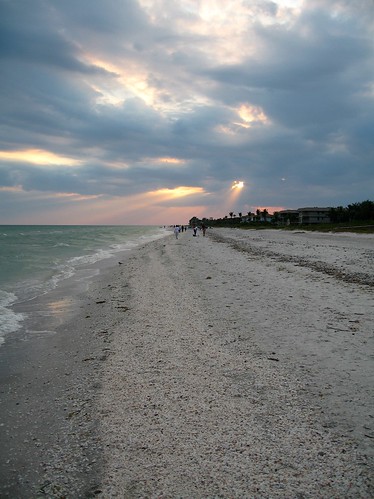
Beach

Not much bloggin
Week in NYC, home for a couple days, then off to Sanibel, mostly business
Did buckle down for some beach walks, 2 miles minimum, 6 max (handy mile markers on the beach)

Tried to do most early or late

Tuesday, November 06, 2007

On the lighter side

Should you really trust a Realtor?

Look Who Still Can't Sell His Home! (Hint, He's In The Industry) - Realty Check with Diana Olick - CNBC.com

Maybe not...

Dialog ... ?

Background
We had some high winds, power fluctuations
(Winds ... gusts to 50 MPH, standard November fare here ... see Edmund Fitzgerald)

Anyway, we had a service outage, basic cable worked, but no high end digital or internet

My message to Charter:

suggestion: establish a call to report outage number

This morning, my service went out about 7:30
By 8:30, after several reboots, I called your "help" line
Well, 10-15 min with your robot service, then at least 10 with your call center, we got a service call scheduled.

I was 99% certain that you had a system outage
Sure enough, around 3PM I checked again, and have service.

Now, if you had a line to call to report an outage, it would help both of us.

I'm no dummy, and your call center was not aware of the outage. I could have helped.

This is a question of customer satisfaction.
When I know that you have a problem, I don't like to waste time with robot voice or overseas call centers.

I would believe that it is much cheaper for Charter to receive reports of problems, than to send a truck on a wild goose chase.

Figure where it’s best to spend your corporate funds.
My time is worth money, you took at least ½ hour which I would bill at $100. What does a truck roll cost? What does a “call to report outage” number cost?

More importantly, what does a satisfied customer cost?

Sincerely
JTHoagland

Reply tonight from Charter
Does it look canned?
Note the sales pitch
Hey ... if I had the connection, why would I need the "self help"

Dear JT Hoagland,

Thank you so much for contacting Charter Communications, my name is Ronand. I understand that you are having issues with your service. I am sorry that you had to go through this inconvenience. I understand your frustration; rest assured I will do my best to address this concern. If you have additional questions, please let me know.

I would like to encourage you to please visit our website, www.charter.com for further information and assistance regarding any of your services. There are self-help options available for you there.

Great News! Charter telephone is now available in your area! You can save money with charter's 5-feature pack that gibes you the popular calling feature you want for one low price. Call our toll free number 1-800-545-0994 to learn more and sign up for Charter's Telephone Service!

Thank you for your e-mail submission to our website! Have a wonderful day!

Sincerely,

Ronand
Email Support Team
High Speed Internet Department
Charter Communications

Monday, November 05, 2007

Travel tips

Check this out, but also check the comments for follow up's
Found via Doc (Doc Searls Weblog : Same old blog, brand new place)

Travelhacker :

10 Useful Secrets the Major Airlines Don’t Want You to Know
Monday, October 22, 2007 at 2:25pm
byBy Laura Milligan

"Ironically, traveling by air is getting more and more inconvenient as overbooked flights, lost luggage, and pricey ticket sales become more common. Unfortunately, booking a flight is sometimes just plain necessary, a fact that airlines know all too well, allowing them to continue maximizing profits while we passengers often get stuck on the ground."

Sunday, November 04, 2007

Tick Tock

Daylight "Savings"

Seems we swapped 6AM to 7AM darkness for 7PM to 6PM darkness
Just a bit of a shift in behavior
Easier to get up early enough
Tend to fix dinner earlier ...

Not that the sun, moon and stars really care

Only our associates/friends/partners

Friday, October 26, 2007

Bent but not broken

Spotted in back corner of our property while doing a bit of "orienteering" with the Conservancy while wrapping up plans for our easement.

Wednesday, October 24, 2007

Journalist

Steve Forbes, on his mentor
James W. Michaels - Forbes.com

Only met Jim once.
Forbes Cruise
Out of Dover and Steve was on board to do the meet/greet

Jim singled me out for photo-op
Well, I was/still am a bit "shaggy" with longish hair and beard ... perfect offset for Steve

Jim had an eye for what worked
I had intended to us it for Christmas card with "thought bubble" of "don't run"
Steve was bright and engaging in person, too wooden on TV

Stick to print

God speed Jim

Monday, October 22, 2007

Photos for the day

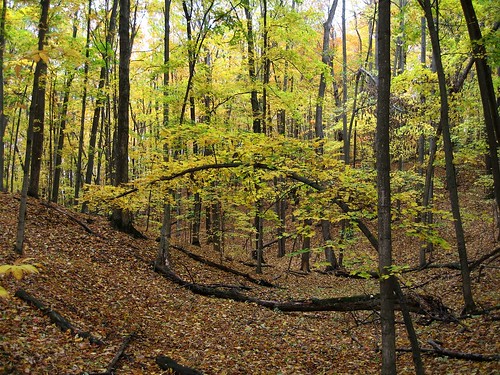
Went off to our woodlot this afternoon to cut some cordwood
Stopped to take this shot up one of our trails - these hardwoods haven't been cut.
Leads up to ouir "lookout


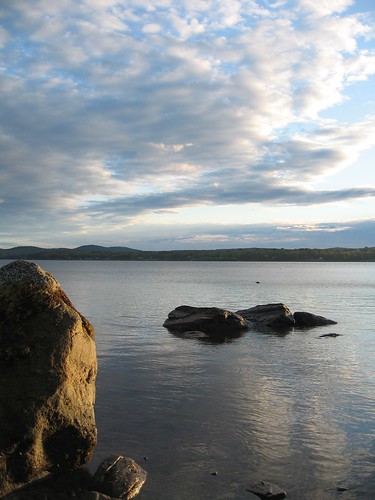
Then, while prepping dinner, decided I had to shoot the clouds over the lake.
The few ripples are from a mallard on our beach I spooked

Meltdown

Good overview of what led to the sub-prime/housing bubble and likely impacts:

CFA Institute Publications: CFA Magazine - 18(4):39 - Abstract

Sunday, October 21, 2007

Polar Point of View

With all the talk of Global Warming, potential opening of the Artic Ocean I got to thinking about Buckey Fuller's Dymaxion "AirOcean" Map

Dymaxion map - Wikipedia, the free encyclopedia:

"The Dymaxion map of the Earth is a projection of a global map onto the surface of a polyhedron, which can then be unfolded to a net in many different ways and flattened to form a two-dimensional map which retains most of the relative proportional integrity of the globe map. It was created by Buckminster Fuller, and patented by him in 1946, the patent application showing a projection onto a cuboctahedron. The 1954 version published by Fuller under the title The AirOcean World Map used a slightly modified but mostly regular icosahedron as the base for the projection, and this is the version most commonly referred to today. "

The map also makes evident the importance of the Artic Ocean and polar air routes
(and ICBM flight paths)


I have a similar map hanging over my desk

Friday, October 19, 2007

It was 20 years ago today

Same date on the calendar, Oct 19th, but different day of the week
20 years ago it was a Monday, aka "Black Monday" the day of the '87 Market Meltdown
I remember it well
I was not on the floor, nor even in New York
I was in little old Holt Michigan, but with cable TV, my old Mac and ... a VCR
Maybe the tape is too old now, but I watched it several times, about 6hours of the old FNN (Financial news Network, the precursor of CNBC).

So what happened?
Not well covered is the impact of Mr. David Ruder, Chairman of the SEC.
(note that he was only in office for a matter of months)

The markets were trending down, there were issues with valuation, an ongoing "spat" with Europe etc.
But there was a key element ... actions and words of the SEC Chair
A week or two earlier, to a group of bond managers/traders, either as a comment or response to a question, Mr. Ruter indicated that , in the case of market turmoil, the SEC would consider closing the exchanges.
This caused a sell off in the bond market

This was not widely covered in the press, but was know on the street.

What did it mean?
Analogy: You are waiting in line for a movie and the management announces that "in case of fire, we will lock the doors"
Huh?
Are you going to the movie or go have a beer?

Well on Monday, October 19, 1987, the markets were headed down, but was starting to recover.
Mr. Ruter was interviewed. He made a similar statement.
Word spread and any buyers said ... whoa ... I'm pulling my bid.
Market plunged
Then the market started to recover, and the quote was carried on another newswire
Once again ... bids were pulled
Buyers strike

Many other events were triggered
"program trading" triggered additional selling
Paper transaction couldn't keep pace, trades were reported 10-15-30 min late
Banks shut their lending windows to specialists, rumors spread
Panic

But the key element was the threat to close the markets - to lock the doors

And the rest is history
It was a good time to buy

Thursday, October 18, 2007

Interesting Meeting

Can't really say what core topic was... yet, but most interesting conversation.

Check David's site:
David T. Hanawalt: Architecture - Land Planning - Community Design - Site Plans

Sleeze... cont.

Looney Dunes: Sleeze: "Sleeze Digging into the practices of the country's largest mortgage generator."

Now the SEC is taking a look
Stock Sales by Chief of Lender Questioned - New York Times
"After starting a plan in October 2006, Mr. Mozilo twice raised the number of shares that could be sold: once in December 2006, when Countrywide stock was $40.50, and again in February, when it hit a high of $45.03. He has had gains of $132 million since starting the October 2006 plan and expects to sell his remaining shares by the end of the week, a move that will generate millions more."

Wednesday, October 17, 2007

Global Warming Delusions ?

Copyrighted material, but as it will eventually go into the "pay-per-view" archives, I'm preserving for posterity.

A most interesting read
Global
Warming Delusions


Global Warming Delusions
By DANIEL B. BOTKIN
October 17, 2007; Page A19

Global warming doesn't matter except to the extent that it will affect life -- ours and that of all living things on Earth. And contrary to the latest news, the evidence that global warming will have serious effects on life is thin. Most evidence suggests the contrary.
Kilimanjaro's shrinking ice cap is not directly related to global warming.

Case in point: This year's United Nations report on climate change and other documents say that 20%-30% of plant and animal species will be threatened with extinction in this century due to global warming -- a truly terrifying thought. Yet, during the past 2.5 million years, a period that scientists now know experienced climatic changes as rapid and as warm as modern climatological models suggest will happen to us, almost none of the millions of species on Earth went extinct. The exceptions were about 20 species of large mammals (the famous megafauna of the last ice age -- saber-tooth tigers, hairy mammoths and the like), which went extinct about 10,000 to 5,000 years ago at the end of the last ice age, and many dominant trees and shrubs of northwestern Europe. But elsewhere, including North America, few plant species went extinct, and few mammals.

We're also warned that tropical diseases are going to spread, and that we can expect malaria and encephalitis epidemics. But scientific papers by Prof. Sarah Randolph of Oxford University show that temperature changes do not correlate well with changes in the distribution or frequency of these diseases; warming has not broadened their distribution and is highly unlikely to do so in the future, global warming or not.

The key point here is that living things respond to many factors in addition to temperature and rainfall. In most cases, however, climate-modeling-based forecasts look primarily at temperature alone, or temperature and precipitation only. You might ask, "Isn't this enough to forecast changes in the distribution of species?" Ask a mockingbird. The New York Times recently published an answer to a query about why mockingbirds were becoming common in Manhattan. The expert answer was: food -- an exotic plant species that mockingbirds like to eat had spread to New York City. It was this, not temperature or rainfall, the expert said, that caused the change in mockingbird geography.

You might think I must be one of those know-nothing naysayers who believes global warming is a liberal plot. On the contrary, I am a biologist and ecologist who has worked on global warming, and been concerned about its effects, since 1968. I've developed the computer model of forest growth that has been used widely to forecast possible effects of global warming on life -- I've used the model for that purpose myself, and to forecast likely effects on specific endangered species.

I'm not a naysayer. I'm a scientist who believes in the scientific method and in what facts tell us. I have worked for 40 years to try to improve our environment and improve human life as well. I believe we can do this only from a basis in reality, and that is not what I see happening now. Instead, like fashions that took hold in the past and are eloquently analyzed in the classic 19th century book "Extraordinary Popular Delusions and the Madness of Crowds," the popular imagination today appears to have been captured by beliefs that have little scientific basis.

Some colleagues who share some of my doubts argue that the only way to get our society to change is to frighten people with the possibility of a catastrophe, and that therefore it is all right and even necessary for scientists to exaggerate. They tell me that my belief in open and honest assessment is naïve. "Wolves deceive their prey, don't they?" one said to me recently. Therefore, biologically, he said, we are justified in exaggerating to get society to change.

The climate modelers who developed the computer programs that are being used to forecast climate change used to readily admit that the models were crude and not very realistic, but were the best that could be done with available computers and programming methods. They said our options were to either believe those crude models or believe the opinions of experienced, data-focused scientists. Having done a great deal of computer modeling myself, I appreciated their acknowledgment of the limits of their methods. But I hear no such statements today. Oddly, the forecasts of computer models have become our new reality, while facts such as the few extinctions of the past 2.5 million years are pushed aside, as if they were not our reality.

A recent article in the well-respected journal American Scientist explained why the glacier on Mt. Kilimanjaro could not be melting from global warming. Simply from an intellectual point of view it was fascinating -- especially the author's Sherlock Holmes approach to figuring out what was causing the glacier to melt. That it couldn't be global warming directly (i.e., the result of air around the glacier warming) was made clear by the fact that the air temperature at the altitude of the glacier is below freezing. This means that only direct radiant heat from sunlight could be warming and melting the glacier. The author also studied the shape of the glacier and deduced that its melting pattern was consistent with radiant heat but not air temperature. Although acknowledged by many scientists, the paper is scorned by the true believers in global warming.

We are told that the melting of the arctic ice will be a disaster. But during the famous medieval warming period -- A.D. 750 to 1230 or so -- the Vikings found the warmer northern climate to their advantage. Emmanuel Le Roy Ladurie addressed this in his book "Times of Feast, Times of Famine: A History of Climate Since the Year 1000," perhaps the greatest book about climate change before the onset of modern concerns with global warming. He wrote that Erik the Red "took advantage of a sea relatively free of ice to sail due west from Iceland to reach Greenland. . . . Two and a half centuries later, at the height of the climatic and demographic fortunes of the northern settlers, a bishopric of Greenland was founded at Gardar in 1126."

Ladurie pointed out that "it is reasonable to think of the Vikings as unconsciously taking advantage of this [referring to the warming of the Middle Ages] to colonize the most northern and inclement of their conquests, Iceland and Greenland." Good thing that Erik the Red didn't have Al Gore or his climatologists as his advisers.

Should we therefore dismiss global warming? Of course not. But we should make a realistic assessment, as rationally as possible, about its cultural, economic and environmental effects. As Erik the Red might have told you, not everything due to a climatic warming is bad, nor is everything that is bad due to a climatic warming.

We should approach the problem the way we decide whether to buy insurance and take precautions against other catastrophes -- wildfires, hurricanes, earthquakes. And as I have written elsewhere, many of the actions we would take to reduce greenhouse-gas production and mitigate global-warming effects are beneficial anyway, most particularly a movement away from fossil fuels to alternative solar and wind energy.

My concern is that we may be moving away from an irrational lack of concern about climate change to an equally irrational panic about it.

Many of my colleagues ask, "What's the problem? Hasn't it been a good thing to raise public concern?" The problem is that in this panic we are going to spend our money unwisely, we will take actions that are counterproductive, and we will fail to do many of those things that will benefit the environment and ourselves.

For example, right now the clearest threat to many species is habitat destruction. Take the orangutans, for instance, one of those charismatic species that people are often fascinated by and concerned about. They are endangered because of deforestation. In our fear of global warming, it would be sad if we fail to find funds to purchase those forests before they are destroyed, and thus let this species go extinct.

At the heart of the matter is how much faith we decide to put in science -- even how much faith scientists put in science. Our times have benefited from clear-thinking, science-based rationality. I hope this prevails as we try to deal with our changing climate.

Mr. Botkin, president of the Center for the Study of the Environment and professor emeritus in the Department of Ecology, Evolution, and Marine Biology at the University of California, Santa Barbara, is the author of "Discordant Harmonies: A New Ecology for the Twenty-First Century" (Replica Books, 2001).

Sunday, October 14, 2007

Morning light

One of the reasons we love it here...


Just before 8AM
Fog on the lake, wispy clouds above

Saturday, October 13, 2007

Security issues

Jeff Jonas: Six Ticks till Midnight: One Plausible Journey from Here to a Total Surveillance Society:
All tracking all the time...

Panopticon ?

And Google-plex

Techdirt: Denied Entrance Into The US Thanks To A Google Search Of Your Permanent Record:
"For a long time, people have talked about how Google has effectively created the infamous "permanent record" teachers always warned us about in school. And, now, it appears that it's not just being used for background checks on dates and job reference checks, but for official government purposes as well. Joe McEnaney writes in to alert us to a story of a Canadian man who was denied entrance to the US after border guards did a Google search on his name and discovered a peer-reviewed academic paper he'd written years earlier that mentioned his own LSD use over 30 years ago. Setting aside any thoughts one way or the other on whether or not that should be a criteria for entering the US, just think of what this means for teens today who are discussing their lives very publicly on sites like MySpace. We've already wondered what will happen once the MySpace generation runs for office, but right now they might just want to be careful leaving and entering the country."

which may have led to Cory's piece:

From The Magazine : Radar Online : Cory Doctorow imagines a world in which Google is evil: "Scroogled Google controls your e-mail, your videos, your calendar, your searches… What if it controlled your life? By Cory Doctorow "

which led to WSJournal piece

Cory Doctorow’s craphound.com >>Scroogled in the Wall Street Journal

"There are lots of ways in which Google knowing more about you makes Google better for you. But without much regard to what’s happening in the world around us, in an era in which the national security apparatus has turned into a kind of lumbering, savage, giant toddler, it behooves us to not leave things within arm’s reach that it might stick in its mouth. And that includes things like my search history. And I’d prefer that Google not be storing a lot of that stuff, especially today, especially after Patriot [Act] and so on. They’re inviting abuse, I think, by doing that. The steps you don’t save can’t be subpoenaed. And by saving them, Google is inviting a subpoena."

and there was this ...

Cory:
"I had a really interesting meeting a couple of years ago with some of the [chief information officers] of Danish ministries. We sat down to talk about data interoperability and document retention. Document retention's a really thorny one, because hard drives are cheap, and governments don't really understand why they shouldn't just save everything. Who knows when it will be useful? I started to talk to them about this, and a gentleman put his hand up and said you know, you may need to talk to people in other countries about this, but you don't need to talk to the Danes about this.

Because after the Nazis occupied Copenhagen, they went down to the police station and got from the files all the addresses of the people they wanted to round up and stick in boxcars, and they took them away. We don't retain anything here. As soon as we're done with it, we throw it away because we understand that you can't always predict how information will be used, and the only way to ensure it's not misused is to get rid of it when you're done with it."


Just be careful what you wish for

Good PR, maybe less good science

Gore and U.N. Panel Win Peace Prize - New York Times:

"He turned that slide show into ''An Inconvenient Truth.''

The film won praise but also generated controversy. On Wednesday, a British judge ruled in a lawsuit that it was OK to show the movie to students in school. High Court Judge Michael Burton said it was ''substantially founded upon scientific research and fact'' but presented in a ''context of alarmism and exaggeration.'' He said teachers must be given a written document explaining that.

More than 20 top climate scientists told The Associated Press last year that the film was generally accurate in its presentation of the science, although some were bothered by what they thought were a couple of exaggerations. "

From International Herald Tribune:

"Kalee Kreider, a spokeswoman for the former U.S. vice president, said the judge's decision backed key elements of the documentary.

"The ruling upheld fundamental pieces of the film and the scientific consensus that global warming is real and caused by human activities," she told The Associated Press. "Of the thousands of facts in the film, the judge only took issue with just a handful. And of that handful, we have the studies to back those pieces up."

Burton outlined nine problems — including Gore's claim that sea level rises of 23 feet (7 meters) might occur in the immediate future — something the judge characterized as "distinctly alarmist."

He also cited claims that Hurricane Katrina, the evaporation of most of Lake Chad and the melting of the snow on Mount Kilimanjaro were all caused by global warming. Burton said there was insufficient evidence to back those claims."


Note esp. that the sea level rise is not a fact, but a prediction and among the most graphic conclusions of the film, therefore not trivial.

And I question the position that all warming is anthropomorphic, I believe that the consensus is that human activity has contributed to warming, not that it is the sole cause.

More here:
Too-Convenient Truths in An Inconvenient Truth, Part One on Wired Science: "Too-Convenient Truths in An Inconvenient Truth"

Friday, October 12, 2007

But so did Yasser Arafat

U.S. Home - WSJ.com:
"Al Gore and the U.N.'s Intergovernmental Panel on Climate Change win the 2007 Nobel Peace Prize. 5:23 a.m."

Saturday, October 06, 2007

Religon in the Oval Office

Just how bad can this get?
What are the risks of an evangelical president?

Journals: 1952-2000 - Arthur M. Schlesinger Jr. - Reviewed by Maureen Dowd - Books - Review - New York Times: "...Schlesinger says he “could not bring myself to vote for a man who believes that Adam and Eve once existed and that Eve was literally made out of Adam’s rib ... and believes he has seen flying saucers.”

Schlesinger considers Reagan nutty and passes on an anecdote told to him by Jim McCartney of Knight-Ridder, who sat next to the president at the ’87 Gridiron dinner. Reagan told McCartney that Chernobyl had been predicted in “the eighth chapter of Revelations with the account of the opening of the seventh seal ... a great star falling from heaven causing men to die from the bitter waters. The star, Reagan said, was called Wedgewood, and the Ukrainian word for Wedgewood is Chernobyl. McCartney looked up the passage on his return and discovered that the star was called Wormwood.”"

Oh yeah, the first paragraph referred to ... Jimmy Carter.

Wednesday, October 03, 2007

Evil does exist

Watching
THE WAR | PBS
Coverage of the Holocaust
Very graphic proof that there have been evil people

Maybe Ahmadinejad should watch?

Tuesday, October 02, 2007

Remember Maine

Talk about sea change (prior post)
They have tides in Maine, I mean TIDES
About 10-12 ft while we were there
This is near low tide
Titled "Lobster traps" as there are a few buoy's out past the rocks.


May add more later here: Maine - a photoset on Flickr

Did not get nearly as many good shots as I'd hoped to, just matter of timing

Sunday, September 30, 2007

Sooner rather than later

While I've been sure it would happen, this is sooner than I thought.
I was guessing a couple years out ...

Bottom line - no interest in Ethanol, at least from corn.

Ethanol’s Boom Stalling as Glut Depresses Price - New York Times:

"“The end of the ethanol boom is possibly in sight and may already be here,” said Neil E. Harl, an economics professor emeritus at Iowa State University who lectures on ethanol and is a consultant for producers. “This is a dangerous time for people who are making investments.”

While generous government support is expected to keep the output of ethanol fuel growing, the poorly planned overexpansion of the industry raises questions about its ability to fulfill the hopes of President Bush and other policy makers to serve as a serious antidote to the nation’s heavy reliance on foreign oil."

Wednesday, September 26, 2007

Sea Change?

Besides likely closer identity of interest between management and the union's (assuming a portion of the VEBA is funded with GM stock).

Will the UAW have some ammunition to use in approaching workers for Japanese ( and other ) plants here in the states?
"We can offer you health coverage, what do you get from your employer?"

This might get interesting.
(some of this from conversation with friend at GM)

G.M. Workers Return After Deal Reached With Union - New York Times:

"G.M.’s key demand was the VEBA, which would include the union’s participation. G.M. would be the first among the Detroit companies to take full responsibility for coverage for active and retired workers and their families. G.M. estimates that liability at $55 billion.

Similar trusts could soon follow at the Ford Motor Company and Chrysler.

The automakers have pushed hard for the union to agree to form such trusts, maintaining that their so-called legacy costs hinder their ability to compete with Japanese auto companies, whose costs are lower.

All told, the three companies have health care liabilities totaling nearly $100 billion."

Google-plex

Scroogled in the Wall Street Journal - Boing Boing:

"The Wall Street Journal just published a short interview with me about my story Scroogled, which appears in Radar this month. It's a commissioned piece where the brief was, 'Write a story about the day Google turned evil,' and it's the first Creative Commons-licensed story to appear in Radar Magazine."

On Google and Government

"There are lots of ways in which Google knowing more about you makes Google better for you. But without much regard to what's happening in the world around us, in an era in which the national security apparatus has turned into a kind of lumbering, savage, giant toddler, it behooves us to not leave things within arm's reach that it might stick in its mouth. And that includes things like my search history."

Source here: A New Short Story Imagines Google as a Bad Big Brother - WSJ.com

Tuesday, September 25, 2007

Silence fiction

Looking for wordplay

Maybe something like "I don't mean to tell you what to do but..."

Ah Michigan

First we have State Government"
"Published September 22, 2007
[ From Lansing State Journal ]

Capitol veterans decry state budget impasse

Ex-lawmakers, pundits find faults with leadership
Kathleen Gray
and Chris Christoff


Veterans of Lansing's political wars said Friday that the state House and Senate and Gov. Jennifer Granholm all need to take a cue from past leaders as diverse as former Govs. William Milliken, John Engler and James Blanchard when they return late Sunday afternoon to try again to roll the big rock of a tax increase up a steep hill.

Drop the finger-pointing. Stop holding news conferences. It's time to do what you were elected to do - make decisions.

That was the assessment Friday - after the state House's failure again Thursday night and Friday morning to reach a deal to solve the state's budget crisis - from longtime observers of the Lansing political scene."

Then we have GM and the UAW
cue up Jethro Tull ..."Living in the Past"

How long can the strike last?:

"The strike many believed never would happen shut down General Motors Corp. plants nationwide Monday, casting uncertainty on whether the U.S. auto industry can get the kind of revolutionary changes it says it needs to compete.

An end to the first nationwide UAW strike in 31 years will depend on resolving the key union issues of wages and benefits, job security and investment in U.S. facilities and vehicles, UAW President Ron Gettelfinger indicated at a news conference Monday. He repeatedly said that the strike was not related to talks over a landmark retiree health care trust on which the two parties are believed to have agreed to a general framework."

Monday, September 24, 2007

Arrrgh

So
Working on travel reservations

All went well with Northwest
I know ... NorthWorst, but we get miles (pennies a mile) and it does cover most of our area

So here's the next step
Made my car reservation (National Emerald Club) for Fla business trip
Then, just to make sure, checked for this Wed. rental
Missing ...

Call to National
Note... NOTE : possible source of issues : Enterprise bought National earlier this year.
Finally found my reservations, both this week and Nov.
Neither was on my "Emerald Club", now they are.

Ah well, staff were polite and, once we started to track things down, efficient.
Odd thing was that I'd gone to the regular rental site, with Firefox, it recognized me, etc.
But the reservations weren't being recorded

Bonus - got my discounts (G)

Now to go print my confirms

Validation

Just a couple of days after, finally, signing up for FaceBook, Stevie B. decides MuSoft is interested
Talk about timing ...

Microsoft Is in Talks To Buy Facebook Stake - WSJ.com: September 24, 2007 3:07 p.m. SAN FRANCISCO --
"Microsoft Corp. is in talks with Facebook Inc. about making an investment in the social-networking startup that could value Facebook at $10 billion or more, according to people familiar with the matter. The talks set up another likely face-off between tech titans: Google Inc. has also expressed strong interest in a possible Facebook investment, said people familiar with the matter."

Procrastination

For the time-challanged

"Tomorrow is the busiest day of the week"

Sunday, September 23, 2007

One Web Day or Every Web Day

Doc's comments
Thanking our own heaven on OneWebDay | Linux Journal

Interesting:
"* I got ahead of myself here. Being somewhat calendar-blind (much as some people are color-blind), I actually woke up today thinking it was the 22nd, and that I'd better get my OneWebDay piece finished fast. I just noticed, at the point when 90 people have already read this piece, that, um, it's the 18th. Duh."

Well, we went out Friday night 21st, then stayed at the Cabin - note, no net connection's

I did go online later in the day to check news headlines (did GM/UAW make progress?)
But it was Saturday, clear skies, mild breezes.
Went to our woodlot to cut some trees (standing dead stuff).

In the evening I did get back online, to make travel reservations, and from a piece in Businessweek (Social Networks), comments by Doc on same as well as Paul Boutin :.

Decided to fiddle with Facebook
As one who often as not works solo, I'm not sure of it's value to me...

So what?

Basically, not sure that I buy into "one day" celebration of most anything.
I choose to "celebrate" every day.

The "web" is part of much of what I do on a near daily basis, from access to news, to sharing information with family,friends and business associates. It allows me to "work" from a bit of paradise, on a lake, surrounded by a National Park, yet be orders of magnitude more productive.

Rather than be "calendar blind" as Doc says, I tend to be "time/date aware"
Rather than celebrate "One Day", I prefer to celebrate "Every Day" and view the web as a tool and part of my everyday routine.
I don't "celebrate" the electricity that lights our night, provides information and entertainment.

Farewell Bip

Had the pleasure of seeing a performance a couple of decades ago...

Marcel Marceau, Acclaimed Mime, Is Dead at 84 - New York Times: "PARIS (Reuters) - Marcel Marceau, the world's best-known mime artist who for decades moved audiences across the globe without uttering a single word, has died aged 84."

Friday, September 21, 2007

Whoo-who

big brag:
got a small piece of IntroNetworks

Used their product for a couple of years at PCForum, liked it, responded when they were raising some early round funding.

Now being mentioned with the "big boys" ...

BizWeek Oct 1 :
The Water Cooler Is Now On The Web

" Corporations are being nudged along by employees, and not just the digital-savvy Generation Y that's now entering the workforce. More 30-plus employees are signing up with Facebook to trade daily updates with colleagues and friends. They're also building lists of contacts from among the 13 million professionals on LinkedIn. At Ernst & Young alone, 11,000 workers now have Facebook accounts.

That translates into a juicy new sales opportunity for tech companies that sell networking products. Everyone from IBM (IBM )toMicrosoft (MSFT ) and on down to startups like intro Net-works, Awareness Inc., and Jive Software, are offering applications and services."

Green-speak

Transcript excerpts from CNBC "Greenspan: Power. Money & the American Dream"
Martin Mayer (link to Amazon for his book "The Fed":

My own transcription from DVR of the show:
"I use to go and watch him testify before the House and Senate Banking Committees, which are not among the intellectual leadership groups of the United States, and about half of these guys would ask really dumb questions, I thought what could he do?
But he would convert the question into something to which you could give an intelligent answer which backed the positions that he’d taken, at the Fed itself."


Congress lacks IQ?
They play to the camera?
I'm shocked, simply shocked...

Mayer's comments were followed by this exchange:

Maria:

"I remember watching some of the hearings, and you testifying and one of the congressmen would say “look I don’t understand what you’re talking about.”
I remember one where you rolled your eyes and thought, yeah I know you don’t understand what I’m talking about. Should people have been more studied about these issues, should they have known, and do you think some of these guys were attacking you because they really didn’t understand the issues?"


Greenspan:

"No, you gotta remember that, in large part, ah, for a lot of the Congressmen and Senators, you’re a prop.
Because the cameras that matter are not the National cameras, but the home town cameras, and so that what you get is a… shots of their asking the question, very few shots of the answer."


Therefore we have "Green-speak" aka nonsense
From the CNBC website:

"MARIA BARTIROMO: 
All of these important economic events you are overseeing the most important institution, and leading things. And then not only are you dealing with these crises, but then you've got to convey what's going on to people. That means Congress, the president, the media, the public. So what? You come up with Green speak.

ALAN GREENSPAN:
Otherwise known as known as Fed speak.

MARIA BARTIROMO:
What is it?

ALAN GREENSPAN:

"It's a-- a language of purposeful obfuscation to avoid certain questions coming up, which you know you can't answer, and saying-- "I will not answer or basically no comment is, in fact, an answer." So, you end up with when, say, a Congressman asks you a question, and don't wanna say, "No comment," or "I won't answer," or something like that. So, I proceed with four or five sentences which get increasingly obscure. The Congressman thinks I answered the question and goes onto the next one."

Thursday, September 20, 2007

Doc on Beantown

Bit from Doc on SiValley, then some comments on Boston

Doc Searls Weblog : Where vs. Why
Make sure to check the comments

Nikki & Rob, looks like you scored two home runs!

Wednesday, September 19, 2007

Tom Barnett on "Growth"

Tom delves into the idea of more states.
Not sure I buy his ideas, but glad Esquire looks to have "opened up"
Next - dig through Tom's prior pieces

Nos. 5 Through 9: The Next Five States - Esquire:
"In the lives of men and nations, either you are growing or you're dying. In our time, the Soviet Union imploded, China is adding back lost colonies, and Europe is now the European Union. So why did the United States stop growing? And what will our next five states be?"

Tuesday, September 18, 2007

NYTimes "get's it"

Quick post
Doc Searls has been preaching this for quite some time - open the archives and you win.

Post this in the "win - win" column, publisher and reader both win.

A Letter to Readers About TimesSelect - New York Times: "Since we launched TimesSelect in 2005, the online landscape has altered significantly. Readers increasingly find news through search, as well as through social networks, blogs and other online sources. In light of this shift, we believe offering unfettered access to New York Times reporting and analysis best serves the interest of our readers, our brand and the long-term vitality of our journalism. We encourage everyone to read our news and opinion – as well as share it, link to it and comment on it."

Monday, September 17, 2007

Can't possibley be true ...

or can it?

Defense Tech: The Sunday Paper (Repackaged Edition) - Updated

Bush as other than a bumbling idiot?

""The President was very intelligent, razor sharp, warm, focused, emotional (especially about his dad), and genuine," Blackfive wrote. "Even more so than this cynical Chicago Boy expected. I was overwhelmed by the sincerity -- it wasn't staged."

Bill Ardolino, who participated from Baghdad, wrote on indcjournal.com that he asked Bush about progress in Anbar province and Fallujah and that Bush's answer "honestly surprised me in its length, level of detail and grasp of events on the ground."


Remember, this is the same guy who beat the Democrats twice...(with help from Karl Rove)

Sunday, September 16, 2007

Bits on Banking & Finance

Click headers for full story

Structure on the credit freezeup:

The banking system | Down the drain | Economist.com: "“NOT only is there no God,” said Woody Allen, “but try getting a plumber on weekends.” That just about sums up the problems of today's financial markets. The plumbing is badly blocked, and nobody seems able to fix it, not even the central banks, the market's immortals.

The problem is the apparent reluctance of banks to lend to each other, particularly over three months. That problem arises, in part, from uncertainty about who will pay the bill for America's subprime-mortgage collapse. But it also results from the need for banks to protect their own balance-sheets in the face of some unexpected claims on their capital."

On the next round of International Standards for Bank Regulation(s):

Bank regulation | Uphill work | Economist.com:

"Market turmoil raises concerns about the Basel 2 banking accord SISYPHUS was lucky. He could have wound up on the Basel committee. Since 1999 the committee has been sweating over the Basel 2 accord, a regulatory framework that guides how much capital banks should set aside to cover the level of risk they face. An end is finally in sight. A few European Union banks have already adopted the new rules; others will follow next year. A select number of American banks will implement Basel 2 in 2009. But this summer's credit crunch has put the incoming framework under scrutiny before it has even had a chance to prove itself. “This is the first stressed situation in a long time and it's directly pertinent to many of the changes being brought in by Basel 2,” says Vishal Vedi, a partner at Deloitte, an accounting firm."

And on the problems with the current structure of Credit Ratings:

Buttonwood | Credit and blame | Economist.com:

"The rating agencies operate on shaky foundations AS OSCAR WILDE might have said, it is the unspeakable in pursuit of the unrateable. America's Congress is holding hearings on the subprime-mortgage shambles and the losses that have resulted. The firms that must be feeling most nervous about the outcome are Standard & Poor's (S&P), Moody's and Fitch.

Those rating agencies have earned huge sums in the past ten years offering opinions on the creditworthiness of an alphabet soup of mortgage-related securities created by over-eager banks. As the market blossomed, so did the agencies' profits. Moody's net income rose from $289m in 2002 to $754m last year. But did the fat fees lead to a drop in standards?"

Perceptions

Classic Cover
I'm perfectly comfortable living up here in "flyover" country

Note that all the borders/and boundries are square or grid-like


Saul Steinberg
"View of the World from 9th Avenue,"

source of poster

NYC is fine, for a few days as a dose

Saturday, September 15, 2007

For Ian...

Marc Andreessen

Link to Marc Andreessen's blog

blog.pmarca.com: Quote of the week: Michael Cembalest of JP Morgan

" Advice to portfolio managers around the globe: please stop referring to "7-standard deviation events" when describing performance.

Whether it's the decline in home prices in real terms, a sudden widening of credit spreads, the impact of too much leverage on previously uncorrelated hedge fund strategies, a sudden shift in liquidity, a selloff in riskier emerging market stocks and bonds despite no change in fundamentals, unexpected outflows from fund investors, problems with credit derivatives or declines in bank credit lines, this has all happened before.

The smartest managers had prepared for volatility.

The good ones will learn from what's happened and make adjustments.

Those that spend too much time explaining why it wasn't likely in the first place fall into the bottom category."

Even more Hybrid Bashing

I've posted a number of times on my doubts about hybrids

Feels like good company to keep:

VentureBeat : Vinod Khosla: Hybrid-electric cars won’t make a difference:

"Vinod Khosla, a well-known venture capitalist and one of the most prolific investors in green technologies, has declared personal war on oil and coal.

He also thinks the environment can be helped by stressing efficiency and finding breakthroughs in new materials.

But hybrid electric cars won’t succeed, he said in an interview. You have to pay $5,000 more on a Prius in order to save half a ton of carbon a year, which is more than most consumers will go for, he explained. Buying hybrids “is mostly about personal guilt trips.” It’s like wealthy investors giving money to “art museums instead of to starving people” in Africa, he said."

I have no doubt that hybrids will continue to roll out, they have Prius PR factor, and maybe diesel hybrids will be an answer, but there are still many "issues"

Note that Vin has his own agenda ... he's been making some huge bets on solar, ethanol and bio-fuels.

One of Bush's Failures

Marc Andreessen, of Mosaic and Netscape, lately OpsWare, posted excerpt from Greenspan's new book (from wsj.com)

Greenspan had his share of flaws, but this is perceptive:

"In a withering critique of his fellow Republicans, former Federal Reserve Chairman Alan Greenspan says in his memoir that the party to which he has belonged all his life deserved to lose power last year for forsaking its small-government principles."

They spent like politicians ...

More from Marc here:
blog.pmarca.com: You learn something new every day:

"You learn something new every day"

Or maybe you don't.
Have Republicans learned how to be as thrifty as Democrats?

More from Greenspan here:
Fed’s Ex-Chief Attacks Bush on Fiscal Role - New York Times

Also, Greenspan on various presidents:
"From serving under so many presidents, Mr. Greenspan concludes that there's something abnormal about anyone willing to do what it takes to get the job. Mr. Ford, he writes, "was as close to normal as you get in a president, but he was never elected." The Watergate tapes, he says, show Richard Nixon as "an extremely smart man who is sadly paranoid, misanthropic and cynical." He recalls telling someone who had accused Nixon of anti-Semitism that he "wasn't exclusively anti-Semitic. He was anti-Semitic, anti-Italian, anti-Greek, anti-Slovak. I don't know anybody he was pro."

Ronald Reagan's ability to instantly tap one-liners and anecdotes in support of a particular policy represented an "odd form of intelligence." He describes Bill Clinton as "a fellow information hound" with "a consistent, disciplined focus on long-term economic growth" whose relationship with Monica Lewinsky "made me feel disappointed and sad.""

Friday, September 14, 2007

Go Green

Leader or Editorial on Nukes
Links to articles embedded in it.

Energy | Nuclear power's new age | Economist.com:

"Energy Nuclear power's new age Sep 6th 2007 From The Economist print edition A nuclear revival is welcome so long as the industry does not repeat its old mistakes"

Calling John Stewart

More reason to trust network TV.
About as good as tabloid trash ...

The Informed Reader - WSJ.com : Series of High-Profile Interviews Unmasked as Frauds:

"A former ABC News analyst appeared to have scored an unusually remarkable string of on-the-record interviews with such prominent individuals as Nancy Pelosi, Alan Greenspan, Michael Bloomberg, Bill Gates and Kofi Annan. But it turns out the achievement was apocryphal — the interviews were fabrications, ABCNews.com reports."

Thursday, September 13, 2007

Model Shift

Doc has used the model of architecture and buildings to present a paradigm of software, esp Linux.

I recall this from conversations some years ago
I propose a different model - wheels, hot rodding, cars and motorcycles.

Inspiration here:

On valuing freedom more than cushy jail cells | Linux Journal

Wheels vs. Bricks
Motors vs. Mortar

Doc

Thinking on your piece on V-Dubs

This image or paradigm works better in my mind you’re your one of buildings/architecture … software as tools, vehicles that carry us and our goals/purposes rather than structures that “house” our activities.

Where it’s what we do, vs. where we sleep…

The side commentary is that I too, was involved with V-Dubs
From working on friends ‘dubs ( have you ever seen a connecting rod bent down and around at 90 degrees from intended posture? Ah … DUCTILE Iron!) to my own VDub Combi.

Combi tales :
1: little air cooled plant was in rear, driver, passengers in front, we duct taped visqueen behind the front bench seat. Still had frost on windows.
2: no power, learned how to (seriously) draft trucks … 3-4 ft off rear bumper worked
3) finally plugged in nice Corvair 6 – and solved the problems!
4) cool thing was 4 bolts (to tranny) and a few cables, gas line was the engine swap.
5) related on engine swaps… some folks were smart enough to maintain “spare” for quick swaps. I think we could do one in about 30 min (likely an hour, maybe more if a few beers) with floor jack and hand tools
6) handling- Dubs had swing-axle rear ends – not good, bad “tuck in” if you pushed them very much. This was same as the problem with the early Corvairs – same rear suspension. By the time Ralf Nadar (Nadir?) testified before congress, the rear suspension had been updated to full independent layout, but it was too late.


Of course, I got more extreme, on to a ’68 Firebird, and became a “street racer” ( lots of tales, including run-in with University Poly-Sci department when I wanted to develop survey data on street racers … I was “golden boy” asked to teach when still undergrad … we didn’t see eye to eye )

Got to point of doing motor mods on weekends, from cams, to heads (my own porting and polishing) to full motor swaps (from 350 Cube to 400 Cube, chassi mod’s… final version was quick and fast. Quarter mile was mere low 13’s but that was going through traps in 3rd … high end was 150+ … Therefore was learning aerodynamics and all about “spoilers”, developed my own tweaks.

Then … Insurance intervened
Next was Toyota, which got it’s own hop-ups, from fiberglass bodyparts to wide wheels/tires

Fun, but I was still learning …

Soon after, discovered motorcycles
At first (because, at the time I was living in an old farmhouse …side story about building darkroom, drywalled it myself, driving nails (no screws then) into 100 yr old oak beams!)

Dirt bikes teach you a lot about control
Then learned about street bikes (quasi racers, sometimes know as café racers) learning about cambering machines vs. skid (the late Mark Donahue on “friction circle” … key idea).
Most American “performance” vehicles (cars) rely on “slip angle” the skid of the tire, motorcycles, on the other hand, lean or camber through turns (to go really fast, you spin up the rear, and slide it, but not for the street)

Many many many miles on “scooters” … from local rides with buddies to cross country tours, both solo and with bride to be.

Many many impressions of why scooters beat cars for touring, from smelling manure, to being acutely aware of the weather – raingear when the lighting is flying… parking and huddling up under overpasses when really severe stuff is shaking the truck trailer with a load of steel!

Also developed skills, some engineering, some management, to run a race team (invaluable stuff: do just enough to win, but don’t to much more than enough to win… learned some of this from Porsche), to politics (much politics in racing…)

Did it-we won National Championship
Endurance racing no less, races from 3hrs up to 24hrs.
When you run long, “Systems” become important, how to make things readily “fix-able”

OK, to apply these ideas to software … and open systems

1) work on tools, not structures, things to do or tools to use, not be housed

2) deliver what works, not what “could be best” (racing lessons)

Having watched where the shift has been to more electron based than “whole atom” based – ie: we started playing with software ….

The Revolution for me was you could screw up, and “nothing bad happened” ( as might in the full atomic world )
Granted, sometimes, not fully tested/vetted systems have been used and there have been “results”, but nothing catastrophic.

Work mostly for myself, not large systems.
I first learned a bit back in high school, doing Fortran for some University Professor’s, some Time-share (TymShare?) but not much else until … Apple

Started with early Apple II, learned enough basic to do what I wanted – some graphics I use to do by hand (data representation), then … VisiCalc
Been spreadsheeting ever since.

Digital photography, blogging etc. is secondary.
Nice, but more hobby, communications etc.

Note, I haven't bought a new motorcycle since about 1985! and haven't really worked on any since some time late 80's early 90's

Wednesday, September 12, 2007

Favorite time of year

Still warm (well, Fall fell a bit early this year, it's been a bit cool)
Tourists and many seasonal folks have left, traffic is way down, lake much quieter.


Clouds seem to be lower.
Sunsets better.
I was a few min late on this one tonight.

Tuesday, September 11, 2007

Perceptions

Bjorn Lomborg on priorities, on doing what's best vs what's most "photogenic. What's hard vs what's easy (point fingers and call out the "bad guys")

‘Feel Good’ vs. ‘Do Good’ on Climate - New York Times:

"The lesson from our expedition is not that global warming is a trivial problem. Although Dr. Lomborg believes its dangers have been hyped, he agrees that global warming is real and will do more harm than good. He advocates a carbon tax and a treaty forcing nations to budget hefty increases for research into low-carbon energy technologies.

But the best strategy, he says, is to make the rest of the world as rich as New York, so that people elsewhere can afford to do things like shore up their coastlines and buy air conditioners. He calls Kyoto-style treaties to cut greenhouse-gas emissions a mistake because they cost too much and do too little too late. Even if the United States were to join in the Kyoto treaty, he notes, the cuts in emissions would merely postpone the projected rise in sea level by four years: from 2100 to 2104. "

Sunday, September 09, 2007

Who killed the Electric Car?

Maybe it WAS the customer?

On the 50th anniversary of the Ford Edsel, TIME and Dan Neil, Pulitzer Prize-winning automotive critic and syndicated columnist for the Los Angeles Times, look at the greatest lemons of the automotive industry:

1997 GM EV1 - The 50 Worst Cars of All Time - TIME:

"The early car's lead-acid bats, and even the later nickel-metal hydride batteries, couldn't supply the range or durability required by the mass market. The car itself was a tiny, super-light two-seater, not exactly what American consumers were looking for. ... GM, the company that had done more to advance EV technology than any other, became the company that 'killed the electric car.'"

Saturday, September 08, 2007

Power outage your Prius

Yet more hybrid hype
Read whole thing
Power to the People: Run Your House on a Prius - New York Times
Then throw in safety aspect
Rewire your main box, with throw out, or flip out switch to remove your house from the grid.
We have this, along with 3.6KV Honda generator
Key : you have to isolate yourself from the grid when you power up. Otherwise you can send nasty (fatal?) shock to line workers, transformers that step down power for your home,step up power when it backflows.

Not good

Tuesday, September 04, 2007

Geotagging Pics

Geotagging links photos to locales - New York Times:

"Today, people can retrieve digital photos based on the time they were taken. A nascent technology called geotagging, though, enables people to organize photos by where they were taken, not just when."

Not into the fancy GPS camera idea, but did discover lower level tool with Flickr

Played with it over weekend tagging some of my shots (some are approximate locations)
Flickr: Explore your geotagged photos on a Map

If I get "inspired" I'll try more as the days grow short-er.

Clinton's Carl Rove?

Of note, trying what looks like new tool at NYTimes, a permalink.
Differs from the nyt-bloglink tool before, creates new pop-up with link and some text

Questions for Mark Penn
The Adviser
Interview by DEBORAH SOLOMON
Published: September 2, 2007
"The political strategist and pollster to the Clinton campaign talks about his relationship with Hillary, what makes a microtrend and his Diet Coke habit."

Monday, September 03, 2007

Sunday, September 02, 2007

Axis of Evil ... update?

One down, two to go?
If true, will the Administration get any credit?

U.S. Home - WSJ.com:

"The U.S. Said North Korea has agreed to declare and disable all its nuclear programs by the end of the year."

Friday, August 31, 2007

Head's keep rollin

WSJ.com:

"MCGRAW-HILL replaced S&P's president amid mounting criticism of the company's financial-information unit for its role in the subprime-mortgage crisis. Kathleen Corbet will be succeeded by Deven Sharma."

Wednesday, August 29, 2007

But But But ....

We're not Vegans, not even Vegetarians, but we do try to be modest in our animal protein intake.

But SUV's are such an easy target compared to steaks and burgers, or oil companies vs farmers.

Trying to Connect the Dinner Plate to Climate Change - NY Times:

"Ever since “An Inconvenient Truth,” Al Gore has been the darling of environmentalists, but that movie hardly endeared him to the animal rights folks. According to them, the most inconvenient truth of all is that raising animals for meat contributes more to global warming than all the sport utility vehicles combined."

Matt Ball, executive director of Vegan Outreach:

“Al Gore calls global warming an existential risk to humanity, yet it hasn’t prompted him to change his diet or even mention vegetarianism,” he complained. “And I guess the environmentalists recognize that it’s a lot easier to ask people to put in a fluorescent light bulb than to learn to cook with tofu.”

Tuesday, August 28, 2007

Milestone

With some haze, the hills get some definition
Our hill is in the middle, the second back


Hey
Checking the logs, this is the 1,000th posting

What does it mean - just another number ...

Probably means that there are about 100 worthwhile posts

Not exactly my cup of tea

It's fine to set goals, work towards them, but lists?

Note that I keep lists of short term "things to do"

Ten Things to Do Before This Article Is Finished - NY Times:

"Once the province of bird-watchers, mountain climbers and sufferers of obsessive-compulsive disorder, the life list has become widely popular with the harried masses, equal parts motivational self-help and escapist fantasy."